Chinese Exclusion, Nativism, and Immigration Law
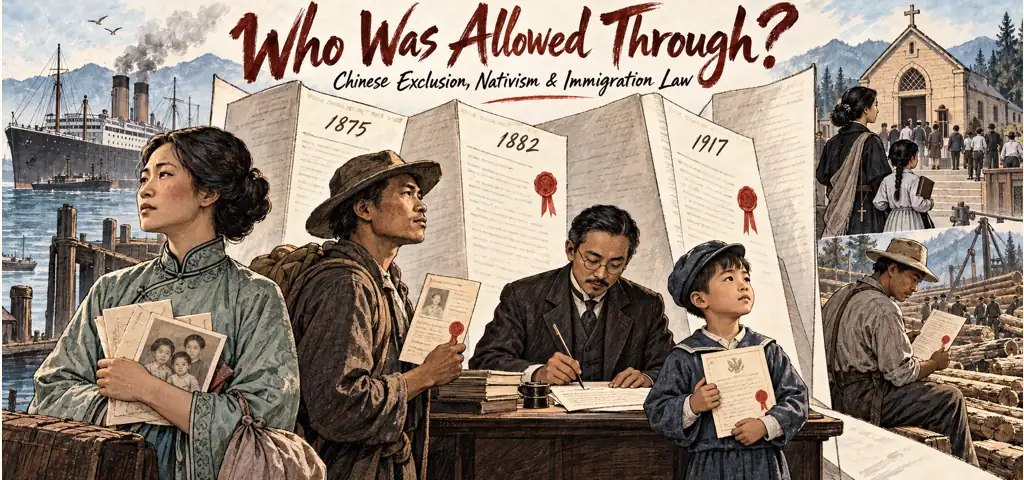
Chapter 4 of the CLEP History of the United States II study guide on Effortless Math covers Chinese Exclusion, Nativism, and Immigration Law: the key terms, the core ideas, and worked examples showing how this topic is tested on the exam.
CLEP History of the United States II, Chapter 4
Nativism turns difference into political danger
Nativism favors the interests of established residents over immigrants and often defines newcomers as racially, religiously, or politically unfit. In the late nineteenth century it appeared through mob violence, employment discrimination, secret orders, school laws, administrative interrogation, and federal exclusion. Targets differed by region: Chinese laborers on the Pacific coast, Catholics in many northern cities, and southern and eastern Europeans among professional restrictionists. Economic competition mattered, but claims about race, religion, citizenship, gender, and national loyalty gave exclusion its political force. Distinguish a general category barred for conduct from a law directed at a nationality.
The Page Act creates a gendered gate
The Page Act of 1875 specifically regulated subjects from China, Japan, and other Asian countries. It barred coerced contract labor and people convicted of nonpolitical felonies while targeting women believed to be entering for prostitution. U.S. Consular questioning in Hong Kong treated Chinese women as presumptively suspect and rejected many applicants seeking ordinary family migration. Women's migration fell sharply, leaving Chinese American communities disproportionately male. Statutory limits on Asian migration and administrators' gender stereotypes reinforced each other. Because the law came seven years before Chinese labor exclusion, the 1882 act was not the first federal restriction to damage Chinese family formation.
Chinese exclusion makes nationality the rule
The Chinese Exclusion Act of 1882 suspended Chinese labor immigration and confirmed that Chinese immigrants remained ineligible for naturalization under racial rules. Merchants, diplomats, students, and some travelers received exceptions, but laborers were the central target. Earlier laws barred categories such as convicts or suspected prostitution; the 1882 act imposed the first broad federal bar aimed at a nationality. The Scott Act of 1888 blocked the return of many Chinese laborers who had left, while the Geary Act of 1892 required resident laborers to carry certificates or face deportation. Exclusion lasted until 1943. Literacy tests and national-origins quotas came later and should not be projected backward.
Family life bears the cumulative effect
The Page Act sharply restricted Chinese women's entry, and exclusion then barred most laborers from bringing a normal stream of spouses and relatives. Merchants could use exemptions more readily than laborers. Communities became overwhelmingly male and aged, while families maintained ties across the Pacific and used citizenship claims, court petitions, and paper identities to reunite. The 1898 Wong Kim Ark decision protected birthright citizenship for U.S.-born children of Chinese immigrants, but citizenship of the American-born did not erase restrictions on immigrant parents. Exclusion was demographic policy as well as labor policy.
Rock Springs turns labor resentment into massacre
Union Pacific coal managers had used Chinese miners as a lower-paid workforce and brought them in during an 1875 labor dispute. On September 2, 1885, white miners in Rock Springs, Wyoming Territory, attacked Chinese residents, killing at least twenty-eight, wounding others, burning homes, and driving survivors away. Federal troops escorted survivors back and remained to protect them; no attacker was convicted. The grievance combined wage competition, strikebreaking, and racial exclusion. The 1882 law had halted many new laborers but did not remove Chinese workers already in the country, so nativist violence persisted after restriction.
The Foran Act targets a practice
The Alien Contract Labor Law of 1885, known as the Foran Act, prohibited employers from prepaying passage for foreign workers bound by labor contracts signed before departure. Unions argued that contract recruitment imported strikebreakers at fixed low wages. The measure targeted a labor arrangement rather than a nationality. Chinese exclusion, by contrast, barred Chinese laborers because of national identity. This comparison is central: restriction could classify by conduct or employment relation, health or dependency, political belief, race, or national origin, and those legal designs had different human effects.
Federal law adds barred classes
The general Immigration Act of 1882 imposed a head tax and excluded people likely to become a public charge. The 1885 law added contract-labor controls. The 1891 act centralized federal inspection and expanded medical and other exclusions. After President McKinley's assassination, Congress excluded anarchists in 1903. Adult illiteracy was not a federal ground until Congress enacted a reading test over President Wilson's veto in 1917. This order defeats a frequent distractor: the literacy test did not govern the peak Ellis Island years around 1900.
The APA makes Catholicism its target
Henry Bowers founded the American Protective Association in Iowa in 1887. Members pledged not to hire or vote for Roman Catholics and circulated stories of papal plots against republican government. Irish and German Catholic families and officeholders were central targets. The APA grew in midwestern cities and faded rapidly after 1896 as tariff and currency issues displaced it. It was not the principal organization behind Chinese exclusion. Nativist movements could share a language of threatened Americanism while selecting very different enemies.
Language laws enter the schoolroom
In 1889, Wisconsin and Illinois enacted laws that subjected private and parish schools to English-language instruction requirements. German Catholic and Lutheran families saw the measures as attacks on parental authority, religious schooling, and their use of German. They mobilized politically, defeated supportive legislators in 1890, and secured repeal. Irish Catholic conflict with public-school Protestant Bible reading had an older history, but German-language parish schools were especially central to these laws. The episode shows that Americanization disputes concerned institutions and family power, border admission.
Professional restrictionists seek a literacy test
Boston-area academics and professionals founded the Immigration Restriction League in 1894. The organization argued that newer southern and eastern European migrants threatened American institutions and promoted a literacy test, expecting it to exclude poorer and less-schooled arrivals selectively. Congress passed versions repeatedly; Presidents Cleveland, Taft, and Wilson vetoed them before Congress overrode Wilson in 1917. The Dillingham Commission later supplied expert-looking support for restriction, but it was a federal commission rather than the private League.
The Gentlemen's Agreement uses diplomacy
After San Francisco ordered Japanese pupils into a segregated school, President Theodore Roosevelt sought a settlement that avoided a humiliating exclusion statute against a rising power. In the 1907-1908 Gentlemen's Agreement, Japan stopped issuing passports to laborers bound for the continental United States, while San Francisco ended the segregation order. Japan continued passports for wives and children, enabling picture-bride migration and family growth. The agreement was executive diplomacy, not a congressional nationality ban identical to Chinese exclusion.
classify the restriction
Suppose one law bars Chinese laborers, another bars workers arriving under prepaid contracts, and a third requires adult entrants to read a short passage.
Chronology and a scope boundary
Remember the sequence: Page Act in 1875, Chinese Exclusion in 1882, Foran and Rock Springs in 1885, APA in 1887, English-school conflicts in 1889, the Restriction League in 1894, anarchist exclusion in 1903, Gentlemen's Agreement in 1907-1908, and literacy test in 1917. This lesson focuses on exclusion and nativism. Public anger over immigrant packinghouse conditions in 1906 chiefly strengthened consumer-protection laws. It did not create a new immigration restriction, so keep that episode with Roosevelt-era food and drug regulation.
Watch the history in motion
This short lesson adds voices, images, and chronology to the ideas you just studied.
Video: The dark history of the Chinese Exclusion Act – Robert Chang, TED-Ed.
Try four CLEP-style questions
- The Geary Act required Chinese residents to carry certificates and strengthened the threat of deportation. How did this extend the 1882 exclusion system?
- It imposed documentation and deportation burdens on Chinese residents.
- It reopened labor immigration but barred merchants and students.
- It transferred enforcement from federal officers to labor unions.
- It substituted a European literacy test for nationality-based enforcement.
- It granted naturalization to residents who obtained certificates.
- Members of a city association pledge not to hire or vote for Catholics but seek no new federal entry statute. What does the evidence show about nativism?
- It becomes nativism only when Congress changes admission law.
- It loses political force when organized around religion rather than nationality.
- It concerns economic competition only when the targeted group is already resident.
- It is institutionally identical to a federal immigration commission.
- It can operate through domestic employment and electoral exclusion.
- Which pairing accurately distinguishes two restriction organizations?
- The APA used professional research to promote literacy testing, while the Restriction League pledged members against Catholic candidates.
- The APA mobilized against Catholic influence, while the Immigration Restriction League promoted literacy testing against newer immigrants.
- The Restriction League focused on Catholic schools, while the APA sought national-origin quotas.
- The APA chiefly opposed contract recruitment, while the League negotiated Japanese passports.
- Both were federal commissions, but only the APA collected immigration statistics.
- In 1903 Congress added anarchists to the barred classes. How did that rule differ in design from the Chinese labor exclusion law?
- It regulated prepaid employment contracts regardless of belief.
- It applied a literacy standard rather than a political category.
- It classified an asserted political belief rather than selecting laborers by national origin.
- It relied on a diplomatic passport agreement rather than federal statute.
- It governed eligibility for naturalization but did not affect entry.
Check your answers and reasoning
Independent preparation. CLEP is a registered trademark of the College Board, which does not endorse this lesson.

Related to This Article
More math articles
- The Wonderful World of the Triangle Inequality Theorem
- How to Solve Systems of Equations: 4 Methods That Always Work
- Louisiana LEAP Algebra 1 Free Worksheets: Free Algebra 1 PDF Worksheets with Clear Answer Keys
- How to Graph Linear Inequalities? (+FREE Worksheet!)
- 5 Best Smartphones for Math Teachers
- Algebra Puzzle – Critical Thinking 12
- Function Values of Special Angles
- GED vs. HiSET vs. TASC: Which Test Should You Take?
- Press freedom
- Merit system





















What people say about "Chinese Exclusion, Nativism, Immigration Law"?
No one replied yet.