New Immigration, Ellis Island, and Angel Island
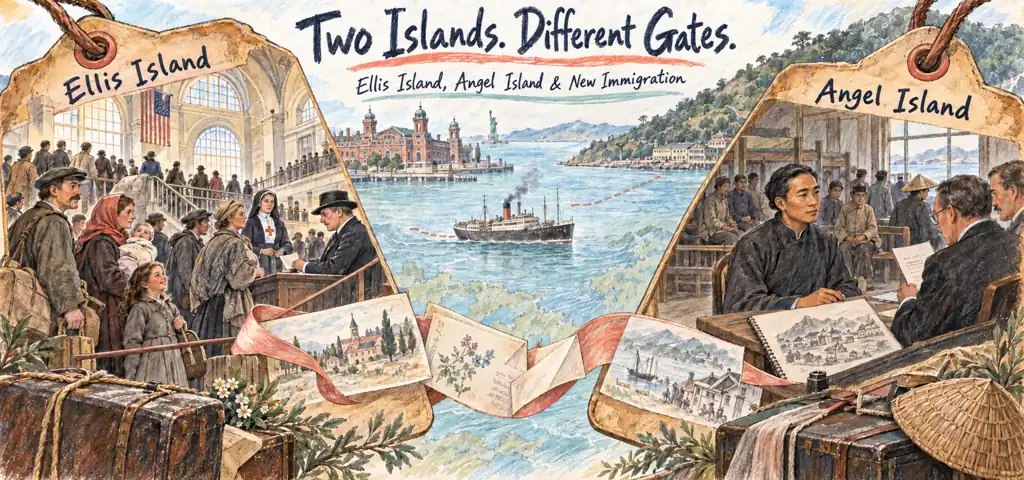
Chapter 4 of the CLEP History of the United States II study guide on Effortless Math covers New Immigration, Ellis Island, and Angel Island: the key terms, the core ideas, and worked examples showing how this topic is tested on the exam.
CLEP History of the United States II, Chapter 4
A migration changes its principal origins
Before the 1880s, most European immigrants to the United States came from Ireland, Britain, German-speaking lands, and Scandinavia. From the 1880s to 1914, growing shares came from southern and eastern Europe: Italy, Greece, Poland, Russia, and lands within the Austro-Hungarian and Ottoman empires. Contemporaries called this the "new immigration". Many newcomers were Catholic, Jewish, or Orthodox and entered industrial, construction, garment, mining, and service work in cities. The label describes a change in origin and destination, not a biological difference or a complete end to northern and western European migration.
Push and pull worked through networks
Poverty, land scarcity, military service, political repression, and religious persecution pushed migrants, while industrial wages and transport links pulled. Chain migration lowered risk: a relative or village contact supplied an address, job lead, loan, and familiar language. Steamship travel became faster and cheaper, and agents advertised passage. Migrants were not simply uprooted peasants severed from home. Letters and remittances moved back across the Atlantic, families made staged journeys, and some workers crossed repeatedly. The decision to migrate responded to both long-term conditions and short-term labor demand.
Italians and Jews reveal different migration strategies
Many southern Italian migrants were young men who came as temporary laborers, sent earnings home, and intended to return. Contemporaries called them birds of passage; a large share ultimately did go back. Jewish migrants leaving the Russian Empire often fled pogroms and legal disabilities, traveled in family groups, and had a far lower return rate. They concentrated in garment trades and urban neighborhoods where religious and mutual-aid institutions could be rebuilt. Ellis Island processed both groups, so the station does not explain their difference. Motive, family composition, occupation, and possibility of safe return do.
Arrivals followed the business cycle
Annual immigration did not rise in one smooth line. Arrivals fell sharply after the Panic of 1893, recovered as jobs returned, peaked in 1907, and dropped after the financial panic that year. This pattern supports a labor-demand explanation: potential migrants and shipping networks responded to news of employment and wages. Restriction statutes cannot explain every fluctuation, and national-origins quotas did not begin until the 1920s. Cheap passage helps explain the scale of migration; the business cycle helps explain short-term rises and falls. A table of arrivals must therefore be read against economic chronology.
Inspection becomes a federal responsibility
Before 1891, state authorities inspected arrivals under federal arrangements, most famously at Castle Garden in New York. The Immigration Act of 1891 placed inspection under a federal superintendent of immigration, added or clarified medical grounds for exclusion, and authorized deportation for unlawful entry. Ellis Island opened as a federal station in January 1892. This sequence matters: the federal government had regulated categories since 1882, but 1891 centralized administration. Literacy testing came only in 1917 and numerical quotas later, so neither should appear in an accurate description of Ellis Island's opening.
What happened at Ellis Island
Most European cabin passengers were inspected aboard ship, while steerage passengers went through Ellis Island. Doctors observed arrivals climbing stairs, marked suspected medical problems for closer examination, and legal inspectors asked about money, destination, criminal record, work contracts, and likelihood of becoming a public charge. Roughly 98 percent were admitted, many within hours; there was no compulsory three-week quarantine for everyone. Those detained could appear before a Board of Special Inquiry. Ellis Island combined screening with mass admission, a reality different from both the myth of an open door and the myth that most arrivals were imprisoned.
Gender shaped the public-charge decision
Immigration rules formally applied to men and women, but inspectors often treated a woman traveling alone as especially likely to become a public charge even when she possessed money. Matrons supervised detention rooms while officials telegraphed male relatives or intended husbands. Clergy sometimes performed marriages at the station so a woman could be released, and ethnic aid societies sent representatives to vouch for travelers. This practice reveals administrative discretion: a gendered assumption about dependency shaped how a formally general legal standard operated.
Angel Island enforced exclusion
Angel Island immigration station in San Francisco operated from 1910 to 1940. Whereas Ellis Island admitted most European arrivals quickly, Angel Island served an exclusion regime directed especially against Chinese migration. Chinese applicants whose status was challenged could face boards that asked detailed questions about villages, houses, relatives, and family events and compared their testimony with witnesses. Discrepancies could mean deportation, and these contested cases could produce detention lasting weeks, months, or sometimes longer; poems carved into barracks walls record frustration and resistance. Not every person processed at Angel Island experienced the same long confinement, so the precise comparison concerns Chinese exclusion cases rather than all Asian or Pacific arrivals.
The fire creates "paper sons"
The 1906 San Francisco earthquake and fire destroyed municipal birth records. Some Chinese residents could claim U.S. birth without surviving local documents and then report sons born in China. Because citizenship could descend through eligible parents and U.S.-born Chinese citizenship had been affirmed in United States v. Wong Kim Ark (1898), these claimed family positions created entry opportunities. Some identities were sold to migrants known as paper sons, who memorized coaching books before interrogation. This response was an adaptation to exclusion, not evidence that Angel Island welcomed Chinese laborers.
Brokers and mutual-aid institutions
A padrone could recruit newly arrived Italian or Greek laborers into gangs, connect them with railroad or construction employers, advance fares, arrange lodging, run a commissary, send remittances, and take a cut or markup. The broker supplied access while creating dependency. Immigrant mutual-benefit societies used members' dues to pay sickness and burial benefits and maintained a familiar language and social space. Americanization programs, especially around World War I, worked in the opposite cultural direction by teaching English, civics, and prescribed household norms and sometimes treating old-country practices with suspicion.
Immigration and urban growth
Immigrants and U.S.-born rural migrants supplied labor and population to rapidly growing cities. Northern industrial centers such as Chicago, Cleveland, and Milwaukee grew several times over and contained large foreign-born shares, while southern cities such as Nashville could grow mainly through internal migration. Streetcars expanded the built-up area, and steel framing and safe elevators allowed downtowns to rise. Federal mortgage insurance did not cause nineteenth-century city growth; the Federal Housing Administration was created in 1934 and later supported suburban home finance. This chronology trap separates the industrial city from the mid-twentieth-century suburb.
The Statue gains an immigrant meaning
The Statue of Liberty was conceived as Liberty Enlightening the World, honoring republican government and Franco-American friendship. Emma Lazarus wrote "The New Colossus" in 1883 while aiding Jewish refugees, imagining a mother of exiles welcoming the poor. The poem was not central to the statue's 1886 dedication. A plaque placed inside the pedestal in 1903 gradually recast the monument as a symbol of immigrant welcome. Historical symbols can acquire meanings after construction; the chronology of poem, dedication, and plaque supplies the evidence.
Expert study can carry political assumptions
Congress created the Dillingham Commission in 1907, and its staff produced an enormous multivolume immigration study in 1911. The commission collected valuable evidence but interpreted newer migrants as less assimilable and supported restriction. Progressive faith in expertise did not make the findings value-free. Its public authority strengthened the restriction campaign. The private Immigration Restriction League was a different organization; it lobbied for a literacy test. Distinguishing federal commission from advocacy group clarifies how research, administrative power, and political goals could reinforce one another.
compare two stations
A source describes short medical and legal inspection with same-day release; another describes questions about the number of windows in a father's village house and months of detention.
Chronology as a defense against distractors
Place the major markers: federal categories began expanding in 1882; inspection became exclusively federal in 1891; Ellis Island opened in 1892; Wong Kim Ark affirmed birthright citizenship in 1898; Lazarus's plaque appeared in 1903; San Francisco records burned in 1906; Congress created Dillingham in 1907; Angel Island opened in 1910; and the report appeared in 1911. Literacy testing followed in 1917 and quotas in the 1920s. A common error projects quotas backward onto Ellis Island's busiest years. The system was selective and discriminatory before quotas, but it used different rules.
Watch the history in motion
This short lesson adds voices, images, and chronology to the ideas you just studied.
Video: Immigration & Migration in the Gilded Age [APUSH Review], Heimler's History.
Try four CLEP-style questions
- Letters, remittances, loans, and job leads move repeatedly between a U.S. city and one European village. Which effect of chain migration does this evidence best illustrate?
- Cheaper steamship fares, rather than social contacts, account for the named destination.
- A labor broker's control of jobs made family information less important.
- It lowered the cost and uncertainty of later migration through a transatlantic social network.
- Continued remittances show that migrants planned permanent return at the same rate.
- Industrial demand explains the network's timing but not its concentration in one village.
- An Ellis Island inspector marks an arrival for further review, and the traveler then appears before a Board of Special Inquiry with a witness from an aid society. What does the sequence show?
- An initial concern could lead to a hearing informed by additional testimony.
- An inspector's medical notation resolved admissibility unless the traveler appealed in federal court.
- Aid-society witnesses could authorize admission when inspectors lacked family records.
- The Board conducted the initial screening and returned routine cases to line inspectors.
- Special Inquiry hearings chiefly applied national-origins quotas during Ellis Island's first decade.
- A padrone advances a worker's fare and controls access to a job and lodging; a mutual-benefit society pays sickness aid from members' pooled dues. What is the clearest distinction?
- The broker supplies access through a hierarchical dependency, while the society pools risk through reciprocal membership.
- The society depends on a broker's private markup, while the padrone distributes member insurance.
- Both reduce risk by conditioning benefits on party loyalty.
- The padrone is collectively governed, while the society concentrates authority in one recruiter.
- Both institutions create the same contractual debt to an employer.
- The Dillingham Commission assembled extensive data but interpreted newer European immigrants as less assimilable and recommended restriction. What broader lesson does this example support?
- The volume of evidence determines whether policy conclusions are free of assumptions.
- Recommendation of restriction makes the commission's collected data unusable for historical study.
- A federal commission and a private lobbying league exercise the same authority.
- Expert investigation can expand knowledge while still carrying political and cultural assumptions.
- Progressive expertise divided cleanly between neutral research and political advocacy.
Check your answers and reasoning
Independent preparation. CLEP is a registered trademark of the College Board, which does not endorse this lesson.

Related to This Article
More math articles
- Math for Nurses: Dosage, Conversions, and IV Calculations for 2026
- 6th Grade PEAKS Math Worksheets: FREE & Printable
- The Best Grade 6 ELA Practice Tests for Maine Students
- Vector-Valued Functions: Fundamentals and Applications
- Iron triangles and issue networks
- Comparative Advantage, Specialization, and Trade
- How to Use Algebra Tiles to Identify Equivalent Expressions?
- Black Codes and the Civil Rights Act of 1866
- Merton’s Strain Theory and Adaptations
- Case File: How to Solve Multi-step Problems Involving Percent






















What people say about "New Immigration, Ellis Island, Angel Island"?
No one replied yet.