The Great Strikes from 1877 through Pullman
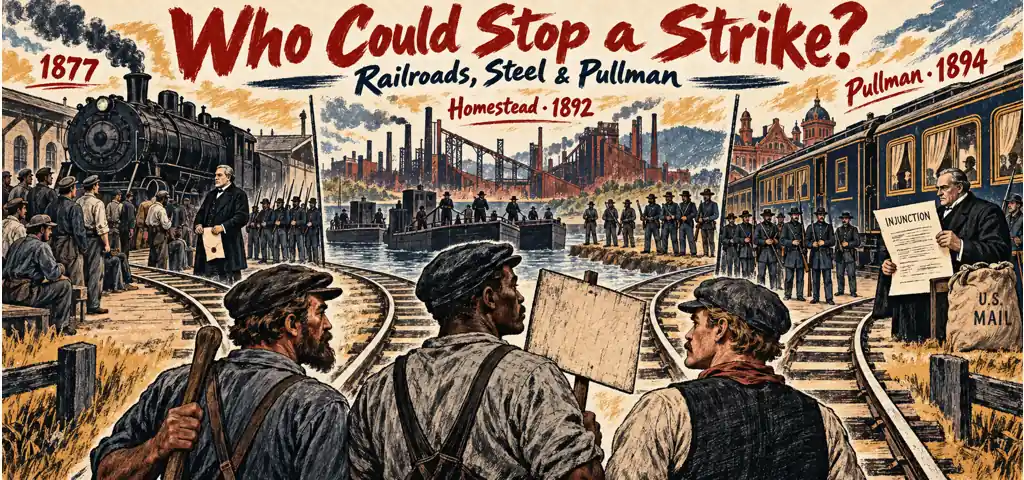
Chapter 4 of the CLEP History of the United States II study guide on Effortless Math covers The Great Strikes from 1877 through Pullman: the key terms, the core ideas, and worked examples showing how this topic is tested on the exam.
CLEP History of the United States II, Chapter 4
The Great Railroad Strike becomes national
In July 1877, the Baltimore and Ohio Railroad announced another wage reduction amid the long depression that followed the Panic of 1873. Railroad workers at Martinsburg, West Virginia, stopped trains, and the action spread along trunk lines to Baltimore, Pittsburgh, Chicago, St. Louis, and other cities. Crowds included workers from outside the railroads, turning a wage dispute into a broader social uprising. State militias sometimes refused orders or could not control violence. In Pittsburgh, clashes and fires destroyed railroad property and killed participants. The strike lacked one national command, which shows both spontaneous solidarity and the difficulty of negotiating a coordinated settlement.
Why Hayes sent federal troops
President Rutherford B. Hayes did not deploy troops simply because rail executives requested them. Governors in West Virginia, Maryland, Pennsylvania, and Illinois asked for federal assistance after reporting that state forces could not restore order. The constitutional route was protection against domestic violence upon state request. Soldiers reopened lines, and the strike collapsed without a national union or agreement. This reasoning differs from Pullman in 1894, when Illinois governor John Peter Altgeld opposed federal intervention and the Cleveland administration invoked interstate commerce and the mails. Comparing the legal justifications prevents two episodes of federal force from blending together.
Haymarket reshapes the eight-hour struggle
On May 1, 1886, workers across the country struck for eight hours without reduced pay. At Chicago's McCormick works on May 3, police fired into a confrontation and killed workers. A protest meeting at Haymarket Square the next evening was nearly over when police advanced and someone threw a bomb. Gunfire killed officers and civilians. Eight anarchists were convicted largely for their ideas and associations rather than proof that they threw the bomb; four were executed, and Governor Altgeld later pardoned the survivors. Haymarket weakened the Knights and made employers and much of the press equate militant labor with disorder.
Homestead: private force followed by state militia
At Carnegie Steel's Homestead plant in 1892, manager Henry Clay Frick locked out the Amalgamated Association after demanding wage and union concessions. Hundreds of Pinkerton agents arrived by barge, and armed workers defeated them in a deadly confrontation on July 6. Pennsylvania governor Robert Pattison then sent thousands of state militia, enabling the plant to reopen with replacement workers. The union lost. Homestead did not involve federal troops. Its sequence-company lockout, private armed agents, state militia-distinguishes it from Pullman's federal injunction and soldiers.
Pullman: injunction and federal force
Pullman workers struck in 1894 after wage cuts without matching rent reductions. The American Railway Union boycotted trains carrying Pullman cars. Attorney General Richard Olney obtained a federal injunction arguing that the boycott obstructed interstate commerce and delivery of the U.S. mails. President Grover Cleveland sent federal troops to Chicago over Governor Altgeld's protest. Defiance of the injunction exposed leaders to contempt proceedings without a jury. The Supreme Court upheld broad federal power in In re Debs (1895). The strike failed, Debs was jailed, and the episode demonstrated how courts could turn a labor dispute into a question of national commerce and sovereign authority.
Danbury put members' property behind a boycott
The United Hatters tried to unionize D. E. Loewe's Connecticut factory and organized a national boycott of its hats. In Loewe v. Lawlor and the later damages decision, the Supreme Court treated that interstate boycott as a combination covered by the Sherman Antitrust Act. Members who knowingly continued to authorize the campaign could be jointly liable for damages, so a national union tactic threatened individual homes and savings as well as the organization's treasury. The cases did not make every strike an antitrust offense. Their danger lay in applying treble-damage exposure to a boycott that reached interstate customers.
Comparing the instruments of strikebreaking
Federal troops in 1877, Pinkertons and Pennsylvania militia at Homestead, and a federal injunction plus troops at Pullman were not one interchangeable response. Each reveals a different state-business relationship. A governor's request triggered federal assistance in 1877. Carnegie's company hired private guards, then state militia secured the mill in 1892. In 1894, the national executive acted over a governor's objection using commerce and mail claims. Employers won each major confrontation, but the institutional pathway changed. Courts and injunctions became especially important because they could command conduct before a full criminal trial.
A later sequence shows conflict continuing
Four events anchor the extension into the Progressive Era. The Uprising of the Twenty Thousand began in New York's shirtwaist trade in November 1909. The Triangle Shirtwaist factory fire killed 146 workers on March 25, 1911. Lawrence textile workers struck in January 1912 after an hours reduction brought a pay cut. At Ludlow, Colorado, National Guardsmen and mine guards attacked a miners' tent colony on April 20, 1914. The correct sequence is Uprising, Triangle, Lawrence, Ludlow. It shows that publicity and reform grew while violent industrial conflict persisted.
Ludlow exposes company-town power
United Mine Workers members struck the Rockefeller-controlled Colorado Fuel and Iron Company in 1913. Greek, Italian, Mexican, Slavic, and other miners sought union recognition, honest weighing of coal, an end to company scrip and guards, and enforcement of existing safety laws. Evicted from company houses, families lived in a tent colony. On April 20, 1914, Guardsmen and company-aligned forces attacked; the camp burned, and about twenty people died. Eleven children and two women suffocated in a cellar pit. The union lost recognition, but national outrage brought investigation, federal troops, and later a Rockefeller company-union plan.
match force to episode
Suppose three notes say: "governors request help", "Pinkertons arrive by barge", and "mail obstruction supports an injunction".
Why the great strikes usually failed
Employers controlled capital, facilities, and replacement hiring; rail and manufacturing firms coordinated across regions; courts issued injunctions; police, militia, federal troops, and private guards protected property and transport; and unions had limited treasuries and divided memberships. Public sympathy could shift after violence, regardless of who initiated it. Yet defeat was not the same as no consequence. Strikes created union experience, exposed company-town grievances, produced investigations, encouraged mediation and safety laws, and turned labor relations into a public question. The correct causal judgment holds immediate defeat beside longer institutional change.
Watch the history in motion
This short lesson adds voices, images, and chronology to the ideas you just studied.
Video: the great railroad strike of 1877, JK47.
Try four CLEP-style questions
- Federal soldiers entered two railroad conflicts. In 1877 governors requested aid; in 1894 Illinois's governor objected. What is the most important inference from that contrast?
- The legal and political route to federal force changed even when employers benefited in both cases.
- Both deployments relied on state requests, but the governors described disorder differently.
- The commerce-and-mails rationale governed 1877, while domestic-violence requests governed 1894.
- Federal authority was constant; only command of state militia changed.
- A governor's position affected political legitimacy but could not distinguish the claimed legal bases.
- Haymarket defendants were convicted largely from political writings and associations rather than proof that they had thrown the bomb. Which criticism follows most directly?
- Conspiracy evidence established an agreement to bomb the meeting even without identifying the thrower.
- Political advocacy was treated as sufficient evidence of responsibility for another person's violent act.
- The prosecution separated each defendant's conduct from his associations before seeking conviction.
- The case concerned only whether police had authority to disperse the rally.
- The verdict applied ordinary accomplice rules after proof that each defendant supplied the bomb.
- The 1877 railroad walkout spread rapidly across trunk lines but had no national command. How did that organizational fact shape the outcome?
- It gave one bargaining committee authority to settle for every railroad.
- It prevented solidarity from spreading beyond railroad employees.
- It allowed governors to negotiate a uniform national wage agreement.
- It converted the stoppage into an industrial union campaign led by the ARU.
- Workers spread disruption but lacked national bargaining coordination.
- Ludlow miners demanded honest coal weighing, enforcement of safety laws, and an end to company guards and scrip. What common problem linked those demands?
- Union recognition alone would settle the dispute without changing company-town institutions.
- The weighing dispute concerned wages, while guards and scrip lay outside employer power.
- The demands sought craft autonomy rather than limits on community-wide corporate authority.
- State safety enforcement was effective, but miners objected to its cost.
- Company control reached beyond wages into measurement, law enforcement, housing, and community life.
Check your answers and reasoning
Independent preparation. CLEP is a registered trademark of the College Board, which does not endorse this lesson.

Related to This Article
More math articles
- 7th Grade North Carolina End-of-Grade Math Worksheets: FREE & Printable
- The Best Grade 7 Math Book for Arizona Students
- 4th Grade KAP Math Worksheets: FREE & Printable
- How to Find Inverse of a Function? (+FREE Worksheet!)
- How to Master the Squeeze Theorem for Calculating Limits
- Georgia Georgia Milestones Algebra 1 Free Worksheets: Free Printable Algebra 1 PDFs Covering Every Skill
- 6th Grade PEAKS Math Worksheets: FREE & Printable
- Assimilation, Carlisle, and the Dawes Severalty Act
- Incorporating Technology in Math Education: Tools and Techniques for Modern Teachers
- The Best Grade 7 Math Book for Maine Students














What people say about "The Great Strikes from 1877 to Pullman"?
No one replied yet.