The AFL, Craft Unionism, Debs, and Industrial Unionism
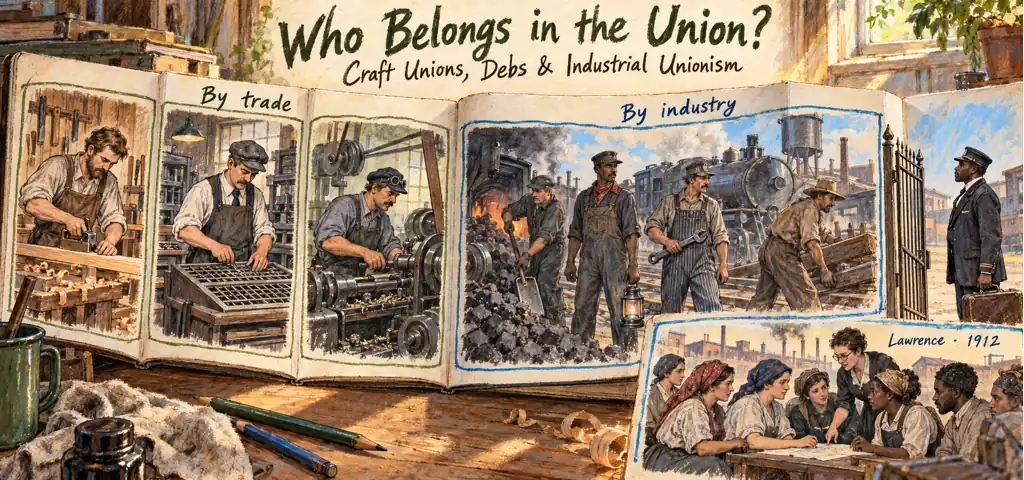
Chapter 4 of the CLEP History of the United States II study guide on Effortless Math covers The AFL, Craft Unionism, Debs, and Industrial Unionism: the key terms, the core ideas, and worked examples showing how this topic is tested on the exam.
CLEP History of the United States II, Chapter 4
A federation built around the craft
Delegates created the American Federation of Labor in 1886, with cigar maker Samuel Gompers as its enduring leader. The AFL was a federation of largely autonomous craft unions: carpenters, printers, machinists, and other skilled workers organized by trade. Gompers's "pure and simple unionism" concentrated on wages, hours, safety, union recognition, and enforceable contracts rather than replacing capitalism with cooperatives. The federation used dues, strikes, boycotts, and political pressure while leaving bargaining authority with affiliates. This focused program often produced durable organizations, but it reached only a fraction of an industrial labor force filled with unskilled and semi-skilled workers.
Craft strength creates an industrial weakness
A skilled craft worker could control scarce knowledge, maintain apprenticeship standards, and threaten an employer with a difficult-to-fill vacancy. Craft organization built bargaining power from that position. A mass-production firm, however, employed many occupations whose disputes could be defeated one department at a time. Industrial unionism proposed one organization for all employees in an industry, regardless of particular craft. Its power came from shutting down the entire integrated process. The contrast is organizational, not a claim that every craft worker was conservative or every industrial union revolutionary.
Knights and AFL: program and constituency
The Knights welcomed many unskilled workers, women, and Black workers and spoke of a cooperative producer future; the AFL concentrated more narrowly on skilled craft bargaining. Many AFL affiliates wrote racial exclusions into constitutions or enforced color bars through hiring halls and apprenticeship. Tens of thousands of Black workers had belonged to the Knights, sometimes in segregated assemblies, but Black carpenters, molders, and machinists often found AFL craft doors closed and formed independent unions. European immigrants could enter many affiliates, while the federation supported immigration restriction. Organizational security for a skilled membership came at the cost of a divided working class.
Debs moves from brotherhood to industrial union
Eugene V. Debs began in the Brotherhood of Locomotive Firemen, a rail craft association. Experience convinced him that separate brotherhoods could not match railroad systems spanning crafts and regions. In 1893 he helped form the American Railway Union across most railroad jobs but not across race. Its constitution excluded Black workers, and the 1894 convention kept that barrier despite Debs's plea for inclusion. The ARU won an early strike against the Great Northern and then entered the Pullman conflict. Debs's path shows both industrial unionism's strength and its limit: the ARU united many jobs inside one system while abandoning workers whom racial exclusion left available as strikebreakers.
Pullman's grievance becomes an industry boycott
During the depression beginning in 1893, the Pullman Palace Car Company cut wages by roughly one quarter but did not reduce rents in its company-owned town south of Chicago. Residents already lacked normal control over municipal life and resented paying the employer with reduced pay. Pullman workers struck in 1894 and appealed to the ARU. Delegates voted to boycott trains carrying Pullman cars, transforming a local company-town dispute into a national rail stoppage. The episode belongs here because Debs's industrial strategy made that expansion possible; the injunction and federal military response belong to the next lesson's analysis of state power.
The IWW extends the industrial principle
In 1905, radicals and industrial unionists founded the Industrial Workers of the World, or IWW, advocating "one big union" across skill, ethnicity, and often race and gender. The IWW rejected exclusive craft boundaries and organized mobile and poorly paid workers whom the AFL often ignored. Its revolutionary language and free-speech fights drew severe repression. The WFM supplied important founders and experience. Industrial unionism therefore covered a spectrum: Debs's ARU organized one transportation system, the WFM organized mining, and the IWW imagined one organization for the working class as a whole.
Lawrence tests inclusive strike organization
In January 1912, a Massachusetts law reduced the workweek for women and minors, and Lawrence textile companies reduced weekly pay accordingly. Workers, many of them women and teenagers from numerous immigrant communities, walked out. IWW organizers helped create a strike committee with representation and interpreters for different nationalities. Families sent children to supporters in other cities, drawing publicity when police tried to stop them. After ten weeks, mills granted raises. Unlike typical AFL actions, Lawrence organized unskilled workers across many nationalities within one industry; the AFL's textile affiliate had not built such a base.
identify the union design
A source says a union admits engineers, porters, shop laborers, and switchmen employed by the same rail system.
A record of gains and exclusions
The AFL survived because affiliates built treasuries, apprenticeship systems, and bargaining routines around achievable workplace demands. Its membership grew during periods of skilled-labor strength and fell in depressions and employer offensives. Industrial unions could mobilize a wider workforce but faced language barriers, strikebreaking, injunctions, troops, and unstable employment. A common misconception treats craft and industrial unionism as political ideologies by themselves. Either form could support reform, socialism, or pragmatic bargaining. The decisive difference is whom the organization unites. By 1914, neither approach had secured the majority of U.S. workers, but each supplied a model later labor movements would reuse.
Watch the history in motion
This short lesson adds voices, images, and chronology to the ideas you just studied.
Video: LABOR in the Gilded Age [APUSH Review Unit 6 Topic 7] Period 6: 1865-1898, Heimler's History.
Try four CLEP-style questions
- A printers' union controls apprenticeship, preserves scarce technical knowledge, and can make a vacancy difficult to fill. Which feature supplies its strongest bargaining power?
- Coordination with unskilled workers throughout one industrial chain
- Affiliate autonomy within a federation regardless of labor supply
- Control over craft entry and qualified labor supply
- A boycott aimed chiefly at consumers rather than the employer
- A producer-reform program extending across unrelated occupations
- Pullman employees stopped work over wages and rents; the ARU then refused to handle trains carrying Pullman cars. What changed when the union adopted the boycott?
- A network dispute narrowed into bargaining by one railroad craft.
- A local company-town dispute became a conflict across an integrated national rail network.
- The workers exchanged a wage grievance for a campaign about craft apprenticeship.
- The ARU returned authority over the dispute to separate brotherhoods.
- Industrial coordination reduced the conflict to municipal ownership of Pullman.
- The ARU organized many railroad occupations but excluded Black workers. Which consequence most directly exposed the strategic cost of that boundary?
- It left excluded workers outside the union's solidarity and available to employers during conflict.
- It narrowed racial exclusion to management while preserving worker unity.
- It made the ARU's industrial boundary broader than the IWW's later model.
- It gave Black railroad workers equal voice through separate ARU districts.
- It turned each rail occupation back into an autonomous craft brotherhood.
- Carpenters, printers, and machinists each keep their own treasury, officers, jurisdiction, and contract authority while joining one national federation. Which structure does the arrangement most closely describe?
- A Knights assembly organized around community membership rather than trade
- The AFL model of autonomous craft affiliates joined for common support
- One industrial union with authority over every occupation in a factory
- The IWW's one-big-union model for the working class as a whole
- A company union whose bargaining authority comes from management
Check your answers and reasoning
Independent preparation. CLEP is a registered trademark of the College Board, which does not endorse this lesson.

Related to This Article
More math articles
- What Are the Applications of the Law of Sines?
- Question Types and the Test Interface
- What a Theory Does
- Squeeze, Speed, Mini: The Math Differences Across Baccarat Variants
- Divide and Conquer: How to Tackle Word Problems with Division Facts up to Twelve
- The Best Grade 5 Math Book for Indiana Students
- Grade 3 Math: Multiplication and Division Relationship
- Federal budget and appropriations process
- Policy instruments differ in information and flexibility
- 3D Shapes for 5th Grade: Faces, Edges, and Vertices












What people say about "The AFL, Craft Unionism, and Debs"?
No one replied yet.