The National Labor Union and the Knights of Labor
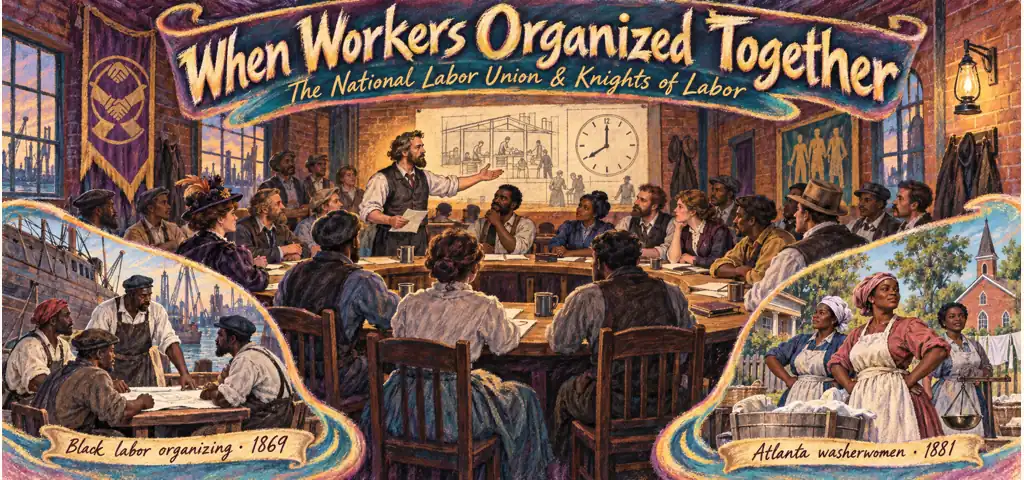
Chapter 4 of the CLEP History of the United States II study guide on Effortless Math covers The National Labor Union and the Knights of Labor: the key terms, the core ideas, and worked examples showing how this topic is tested on the exam.
CLEP History of the United States II, Chapter 4
A national movement begins across trades
In August 1866, delegates from local unions, city trade assemblies, and eight-hour leagues met in Baltimore to form the National Labor Union. Rather than represent one craft, the NLU attempted to gather workers from many trades behind shared political and economic demands. Iron molder William H. Sylvis became its leading president in 1868. The organization pressed most visibly for the eight-hour day, monetary and labor reforms, and worker cooperation. Congress granted an eight-hour day to federal employees in 1868. The NLU's achievement was organizational imagination: it treated labor as a national constituency even though its federation remained fragile and short-lived.
Race reveals the limits of early solidarity
Many white unions excluded Black workers. The NLU admitted Black delegates in 1869 but did not overcome segregated local practice. Black labor leaders including ship caulker Isaac Myers organized the Colored National Labor Union that year to pursue equal access to trades, education, land, and political rights. Sylvis died in 1869, and the NLU weakened as leaders turned toward third-party politics; its last convention came in 1873. The separate national body was both an act of Black institution building and evidence that general declarations of worker unity did not guarantee equal membership or hiring.
The Knights imagine a cooperative order
The Noble and Holy Order of the Knights of Labor began in 1869 under Uriah Stephens and initially operated in secrecy. Under Terence V. Powderly, it became public and expanded dramatically in the 1880s. The Knights organized local and district assemblies rather than only individual crafts. They welcomed skilled and unskilled workers, women, and many Black workers, while excluding bankers, lawyers, professional gamblers, liquor dealers, and Chinese workers. They advocated the eight-hour day, cooperatives, equal pay for equal work, limits on child labor, and an eventual end to the wage system. This broad producer vision distinguished them from a narrow bargaining organization.
Inclusion was real but incomplete
At their 1886 peak, the Knights counted hundreds of thousands of members, including perhaps seventy-five thousand Black workers. Black assemblies organized dockworkers, farm laborers, and artisans; women formed assemblies and sometimes led strikes. Southern assemblies could remain segregated, and the national order's opposition to Chinese immigration exposed a racial boundary in its universal language. Powderly preferred education, arbitration, and cooperation to strikes, yet local Knights often walked out despite him. The organization should therefore be understood through tension: unusually inclusive for its era, but neither free of discrimination nor fully controlled by national leaders.
The eight-hour movement and Haymarket
The Federation of Organized Trades and Labor Unions declared that eight hours would become the legal workday on May 1, 1886. Roughly 350,000 workers joined strikes and demonstrations. Powderly urged Knights to stay back, but some local assemblies participated. In Chicago on May 4, a rally at Haymarket Square protested police violence at the McCormick works. Someone threw a bomb as police advanced; shooting followed, killing police and civilians. Authorities convicted anarchists in a deeply prejudiced trial. Public opinion linked labor radicalism with violence, damaging the Knights even though the order had not planned the bombing.
Organizing beyond the factory
Black washerwomen in Atlanta demonstrated how collective power could arise outside a formal national union. In 1881, about twenty women formed a washing society and demanded a uniform rate of one dollar for every twelve pounds of laundry. Using churches and neighborhood networks, the strike grew to roughly three thousand participants. Police arrested and fined women, and the city threatened a twenty-five-dollar annual license. The strikers answered that they would pay and set their own prices. Because washing could be done in their own yards, these workers had more control than live-in domestics and could coordinate a citywide service households could not easily forgo.
The "servant problem" was a labor-choice problem
Domestic service remained the largest paid occupation for American women in 1900, especially for Black and immigrant women. Live-in cooks and maids could be summoned from before breakfast through the evening and slept in employers' houses with little private time. As factories, offices, stores, and day-work arrangements widened alternatives, many women refused live-in service. Middle-class employers called the result a "servant problem", but the phrase concealed workers' preference for jobs they could leave each evening. The comparison with Atlanta's washerwomen shows why control over one's residence and hours could matter as much as the nominal occupation.
A bridge toward industrial unionism
The Western Federation of Miners, created in 1893 after violent conflicts in western mines, organized everyone working in and around mines rather than separating skilled miners from surface laborers and helpers. That industrial principle differed from the craft structure the American Federation of Labor was consolidating. It also echoed the Knights' broad membership without reproducing the Knights' cooperative program. Labor history is not a simple succession in which one organization disappears and another starts. Strategies overlap: national federation, community assemblies, craft bargaining, industrial inclusion, political reform, and direct action competed throughout the period.
compare constituency and goal
Suppose a chart lists the NLU, Knights, and Western Federation of Miners.
Chronology and organizational consequence
The NLU formed in 1866 and faded after 1872; the Knights began in 1869, expanded after the railroad upheavals of the late 1870s, peaked in 1886, and declined after Haymarket and unsuccessful strikes; the WFM formed in 1893. The Knights also suffered from rapid growth, loose local control, employer resistance, and competition from the AFL. Haymarket alone did not cause collapse. A strong causal account combines damaged public legitimacy with organizational weakness and lost workplace battles. Across the sequence, workers repeatedly rebuilt organizations when a prior structure failed to translate broad solidarity into durable bargaining power.
Watch the history in motion
This short lesson adds voices, images, and chronology to the ideas you just studied.
Video: LABOR in the Gilded Age [APUSH Review Unit 6 Topic 7] Period 6: 1865-1898, Heimler's History.
Try four CLEP-style questions
- After William Sylvis died, NLU leaders devoted increasing attention to third-party politics while the federation's trade-union ties weakened. Which conclusion best fits that evidence?
- Leadership loss mattered, but the federation's workplace base remained fully cohesive.
- Post-1873 unemployment alone explains a strategic shift already underway.
- Political strategy could weaken a reform coalition's fragile union base.
- The separate Colored NLU ended every possibility of common economic demands.
- The federal eight-hour victory made further labor organization unnecessary.
- Why could Atlanta washerwomen coordinate a citywide strike more readily than many women employed as live-in domestic servants?
- Households' need for laundry mattered, but workers' neighborhood ties did not.
- A uniform piece rate gave washerwomen more bargaining power than control of their worksite did.
- The threatened city license converted washing into a protected skilled trade.
- Washerwomen controlled their work setting and could organize through neighborhood and church networks.
- Living in an employer's home gave servants comparable freedom to organize after work.
- Powderly discouraged many strikes, yet local Knights repeatedly joined walkouts. What does this pattern reveal about the order?
- The national office treated every local wage dispute as a cooperative experiment.
- Secrecy gave national officers tighter operational control after the order became public.
- Local assemblies followed AFL craft jurisdictions rather than Knights rules.
- Powderly's preference for arbitration was identical to a ban on local economic action.
- Rapid growth and decentralized assemblies limited national leaders' control over local action.
- Which explanation best accounts for the Knights of Labor's decline after 1886?
- Haymarket stigma was decisive because the order had no prior organizational strain or strike losses.
- Damaged public legitimacy interacted with loose organization, employer resistance, failed strikes, and AFL competition.
- AFL competition alone explains the decline despite the Knights' different membership and program.
- The cooperative program remained popular, but exclusion from electoral politics ended the order.
- A fall in membership preceded Haymarket and made the bombing irrelevant to public opinion.
Check your answers and reasoning
Independent preparation. CLEP is a registered trademark of the College Board, which does not endorse this lesson.

Related to This Article
More math articles
- Permutations & Combinations Practice (Free)
- How Is the PERT Test Scored?
- How Mathematical Thinking Transforms Your View of Life
- Microorganisms and Disease
- Finding Derivatives Made Easy! Product Rule of Differentiation
- Paroli (Reverse Martingale): The Math of Riding Streaks
- Algebra 1 Topics: Everything You’ll Learn This Year
- How AI Writing Tools Help Students Explain Math Solutions More Clearly
- Top 10 Tips to Create a CBEST Math Study Plan
- Number Properties Puzzle – Challenge 14


















What people say about "The National Labor Union and Knights of Labor"?
No one replied yet.