The ICC, the Sherman Act, and the Limits of Early Regulation
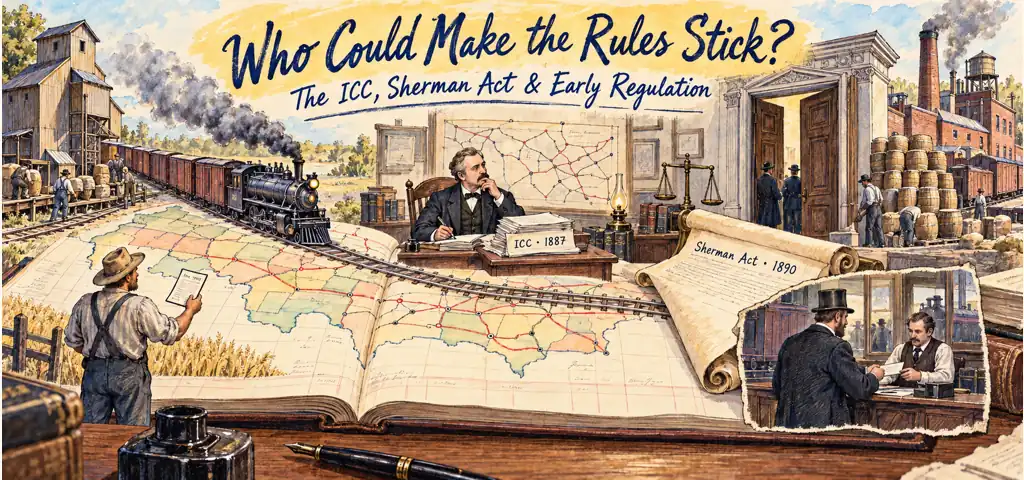
Chapter 3 of the CLEP History of the United States II study guide on Effortless Math covers The ICC, the Sherman Act, and the Limits of Early Regulation: the key terms, the core ideas, and worked examples showing how this topic is tested on the exam.
CLEP History of the United States II, Chapter 3
A national economy outruns local rules
Farmers and merchants could depend on a railroad whose tracks crossed several states, while the legal power regulating it remained divided. Complaints centered on rebates for large shippers, secret discrimination, pooling, and the long-haul/short-haul problem. States enacted Granger laws, but a state could not easily govern an interstate network. Large corporate combinations created a similar mismatch: states issued charters, yet trusts moved ownership and commerce across borders. Early federal regulation emerged because national markets exposed the limits of state-by-state control. The central question was no longer whether government influenced business, but which level and branch could do so effectively.
Munn permits regulation in the public interest
In Munn v. Illinois (1877), the Supreme Court upheld Illinois regulation of grain-elevator and warehouse rates. Chief Justice Morrison Waite reasoned that private property used in a business affected with a public interest could be subject to public regulation. The decision supported state police power in an economy where grain storage facilities held strategic control over market access. The ruling did not give states unlimited authority over all interstate corporations. It showed that constitutional property rights did not automatically invalidate every rate rule, establishing an important opening for regulation.
Wabash exposes the interstate gap
In the Wabash decision of 1886, the Court invalidated an Illinois rule as applied to interstate shipments. Regulation of interstate commerce belonged to Congress under the Commerce Clause. The case did not declare all railroad regulation unconstitutional; it identified the constitutional level that had to act when commerce crossed state lines. The practical result was pressure for national legislation. This case sequence is a useful reasoning tool: Munn sustained state control of a locally situated public-interest business, while Wabash restricted state reach into interstate rates.
The Interstate Commerce Act creates an agency
Congress enacted the Interstate Commerce Act in 1887. It required interstate railroad rates to be reasonable and just, prohibited certain discrimination and rebates, restricted charging more for a shorter than a longer haul under similar conditions, banned pooling, and required public rate schedules. The law created the Interstate Commerce Commission, the first permanent federal regulatory commission. This was an institutional innovation: Congress set rules while an expert body gathered information, heard complaints, and pursued enforcement. The act acknowledged that episodic lawsuits alone could not supervise a technically complex industry.
Railroad economics encouraged unstable rate cutting
A railroad required immense fixed investment in track, bridges, terminals, and rolling stock, but the added cost of carrying one more ton in a train with spare capacity could be comparatively low. Once several lines reached the same market, each had an incentive to discount rates to fill cars and collect some contribution toward its fixed costs. The result could be destructive rate cutting, secret rebates to large shippers, and discrimination against places or customers with fewer alternatives. Pools attempted to divide traffic and stabilize revenue, but members could gain by cheating. The mechanism helps explain why competition alone did not reliably produce transparent or equal rates.
Why the early ICC was weak
The commission initially lacked clear power to set rates prospectively, depended on federal courts to enforce orders, and faced railroads with extensive legal and financial resources. Courts often interpreted its authority narrowly, and proving unreasonable discrimination was difficult. Companies could alter rate practices faster than proceedings concluded. These limits do not make the act meaningless. Public reporting, national jurisdiction, and a permanent administrative body established precedents later Congresses strengthened. Early regulation is best understood as institution building under contested constitutional rules, not as a single law instantly disciplining the railroad industry.
The Sherman Act states a broad principle
The Sherman Antitrust Act of 1890 declared illegal every contract, combination, or conspiracy in restraint of interstate or foreign trade and made monopolization or attempts to monopolize a federal offense. Its sweeping language did not define every important term. Courts had to decide which restraints counted, what monopoly conduct required, and how commerce differed from manufacturing. The Justice Department also needed investigators, lawyers, evidence, and political support. Congress had announced that private combination could threaten public liberty, but a statute's practical force depended on interpretation and enforcement capacity.
E. C. Knight narrows the commerce connection
In United States v. E. C. Knight Co. (1895), the Supreme Court allowed the American Sugar Refining Company to retain acquisitions giving it control of roughly 98 percent of U.S. Sugar refining. The majority distinguished manufacturing, treated as local, from interstate commerce; the effect on later trade was considered indirect. The decision did not erase the Sherman Act or legalize every monopoly. It narrowed one route for applying the act to manufacturing combinations and revealed how formal legal categories could limit national power in an integrated economy. Later cases would expand antitrust reach under different facts.
Trademarks exposed another constitutional boundary
In the Trade-Mark Cases (1879), the Court struck down the 1870 federal trademark statute. Trademarks identify the commercial source of goods; they are not the "writings and discoveries" of authors and inventors covered by the Constitution's Copyright and Patent Clause. Congress also had not confined the law to interstate or foreign commerce, so that statute could not rest on the Commerce Clause as written. The decision did not make federal trademark protection impossible. Later legislation tied protection to commerce, illustrating how Congress could repair a constitutional footing by matching the statute to an enumerated power.
match case to institutional result
Suppose an item gives three holdings: a state may regulate local grain-elevator rates; a state may not set an interstate railroad rate; and federal power does not reach a manufacturing acquisition whose effect on commerce is deemed indirect.
Regulation could be redirected against labor
Courts and officials used antitrust language and federal injunctions against unions when strikes or boycotts obstructed interstate commerce. In In re Debs (1895), the Supreme Court upheld intervention against the Pullman boycott because the national government could clear interstate commerce and the mails. Prosecutors did not need a general federal police power or proof that Debs personally damaged railroad property. National power, the case showed, did not necessarily favor workers or small producers. Keep the sequence clear: Munn in 1877, the Trade-Mark Cases in 1879, Wabash in 1886, the Interstate Commerce Act in 1887, Sherman in 1890, and E. C. Knight and Debs in 1895.
Watch the history in motion
This short lesson adds voices, images, and chronology to the ideas you just studied.
Video: ICC, The Sherman Anti-Trust Act, and Expanding Definitions of "Commerce", American History.
Try four CLEP-style questions
- Several railroads agree to divide traffic at fixed rates, but one line secretly discounts shipments to win additional business. What does the episode best explain?
- Why secret rebates increased the revenue of every member equally
- Why common ownership made rate agreements legally self-enforcing
- Why the ICC required every railroad to join a national pool
- Why profitable cheating made pool agreements unstable
- Why a pool eliminated competition without changing carrier behavior
- An ICC order finds a rate unreasonable, but the railroad delays compliance while the commission asks a federal court to enforce the order. What weakness does the episode reveal?
- Congress had placed all interstate rates under state courts.
- The early ICC relied on courts and lacked direct rate-setting power.
- The Sherman Act prohibited administrative fact-finding.
- The ICC could regulate manufacturing but not transportation.
- Railroad pools possessed constitutional immunity from national law.
- Federal officials obtain an injunction to clear trains carrying interstate freight and mail during a strike. What broader conclusion is best supported by the Debs precedent?
- Federal authority over commerce could be used only to protect unions from employers.
- Commerce and mail powers supported intervention against labor obstruction.
- A federal injunction required prior conviction under state criminal law.
- Interstate commerce became immune from all labor protest after 1895.
- The mail power transferred railroad ownership to the national government.
- Congress declares combinations in restraint of trade unlawful but leaves key terms undefined and provides a small enforcement staff. Which factor will most directly determine the statute's early practical reach?
- Whether every corporation voluntarily dissolves after enactment
- How quickly railroads convert pools into public ownership
- Whether states surrender their power to issue corporate charters
- Whether the ICC sets prices for all manufacturing industries
- Prosecutorial choices and judicial interpretations of broad language
Check your answers and reasoning
Independent preparation. CLEP is a registered trademark of the College Board, which does not endorse this lesson.

Related to This Article
More math articles
- What to Consider When Retaking the ACT or SAT
- Estimating Sums and Differences for 4th Grade
- Media as a Social Institution
- First Amendment Freedom of Religion
- Full-Length TABE 11 & 12 Math Practice Test-Answers and Explanations
- CLEP U.S. History I 015: Quaker Pennsylvania and Negotiated Diversity
- The Best Grade 5 ELA Practice Tests for Florida Students
- 3rd Grade MEAP Math Worksheets: FREE & Printable
- How to Solve Perfect Square Trinomial?
- Propaganda, Wartime Civil Liberties, and Schenck


















What people say about "The ICC, the Sherman Act, and Early Regulation"?
No one replied yet.