Deskilling, Taylorism, Child Labor, and Women’s Wage Work
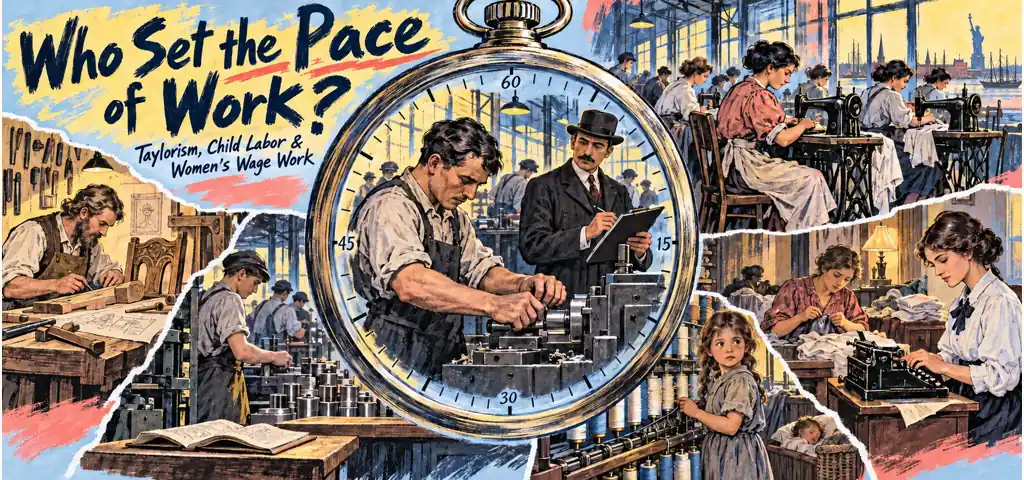
Chapter 3 of the CLEP History of the United States II study guide on Effortless Math covers Deskilling, Taylorism, Child Labor, and Women’s Wage Work: the key terms, the core ideas, and worked examples showing how this topic is tested on the exam.
CLEP History of the United States II, Chapter 3
A machine changes who controls knowledge
A skilled craft worker might once have planned an entire product, selected tools, set the pace, and trained an apprentice. In a large factory, managers could divide the process into narrow repeated tasks performed with specialized machines. This deskilling transferred some knowledge from workers to machinery and supervisors, allowing firms to substitute labor more readily. It could increase output and reduce training time, but it also narrowed autonomy and bargaining power. Industrialization did not deskill every occupation: engineers, machinists, electricians, accountants, and managers developed new expertise. The larger change was a reorganization of skill, authority, and the boundary between planning and execution.
Scientific management measures the task
Frederick Winslow Taylor developed scientific management through experiments in industrial work and summarized it in The Principles of Scientific Management (1911). Managers observed tasks, selected tools and motions, established a prescribed "one best way", and used standards or differential piece rates to encourage output. Taylor argued that systematic study could supersede rule-of-thumb methods and benefit both employer and worker through higher productivity and pay. Critics replied that workers became objects of measurement, lost control over pace, and faced standards set without their knowledge. Taylorism concerns managerial analysis and control; it is not identical to the moving assembly line, though the two could reinforce each other.
The assembly line intensifies flow
Henry Ford's moving assembly line for automobiles, introduced in 1913, arranged tasks so the product came to workers in a timed sequence. Interchangeable parts, conveyor movement, and extreme specialization reduced production time and price. Ford's well-publicized five-dollar day in 1914 helped reduce turnover but came with eligibility rules and intrusive supervision. The chronology matters because factory division of labor preceded Ford, Taylor's methods did not require a moving line, and Fordism combined production technique with mass consumption and labor management. Productivity gains could support higher wages while also making work repetitive and closely paced.
Why children worked
Children worked in agriculture, mines, canneries, street trades, and textile mills because family incomes were low and employers valued small, inexpensive, compliant workers. The 1900 census counted roughly 1.75 million wage-earning children ages ten through fifteen, though definitions and unrecorded work complicate the figure. Work could teach skills or contribute to family survival, but long hours, dangerous machinery, dust, and missed schooling imposed severe costs. Reform photography and investigations later publicized these conditions. Early state laws varied and were often weakly enforced; national restrictions faced constitutional challenges in the next era.
Women’s work was broad and segmented
Women worked for pay as domestic servants, garment and textile workers, laundresses, food processors, teachers, salesclerks, and factory operatives. Domestic and personal service remained women's largest paid field in 1900. Some servants preferred day work to living under an employer's roof, prompting middle-class complaints about a "servant problem." Typewriters and expanding offices created clerical jobs when record keeping outgrew the supply of male clerks. Employers hired educated women at lower pay while men kept many supervisory posts. Race and immigration shaped opportunity: Black women remained concentrated in domestic and farm labor, immigrant women filled factories and garment shops, and native-born white women had greater access to teaching and clerical work.
Households combined several kinds of labor
Immigrant households often combined several kinds of work. An unmarried daughter might leave for a garment shop, textile mill, store, or office, while a married woman took boarders, laundry, or piecework at home. Young women living away from relatives shared rooms or used supervised residences run by the YWCA and similar groups. Garment manufacturers cut cloth and sent sewing to contractors, who set piece rates in crowded shops and tenements. In anthracite towns, a miner might be paid by the ton, hire his own helper, and send sons to pick slate. Factory, subcontracted, and household labor overlapped; "home" and "work" were not cleanly separate.
Industrial schedules and hazards were not abstract
Pittsburgh Survey investigators found that many steelworkers labored twelve-hour shifts, seven days a week, sometimes enduring a twenty-four-hour turn when crews changed shifts. Freight brakemen in the 1880s coupled cars by hand and set brakes from car roofs; deaths and injuries far exceeded most trades, while common-law defenses made compensation difficult. Reform did not come automatically from productivity. Hazards created pressure for factory codes, automatic railroad safety devices, investigation, and collective action, but enforcement and employer resistance determined whether a rule changed daily work.
Education, law, and institutions widened women's options
Women's colleges opened in the Northeast, while state and land-grant universities admitted women across much of the Midwest and West. Around 1900, girls outnumbered boys in public high schools. Boys more often left for paid work, while diplomas opened teaching and office jobs to girls. Married women's property and earnings laws weakened coverture by letting wives hold property or wages in their own names. Divorce still required state-court proof of fault, but filings grew faster than population after 1870 and wives filed most petitions. Catholic sisters built parish schools, hospitals, and orphanages for immigrant cities. These openings widened options without ending wage inequality or occupational segregation.
Professional nursing creates an occupation
Civil War experience and Florence Nightingale's model encouraged hospital-based nurse training. The New England Hospital for Women and Children opened a program in 1872. Bellevue in New York, the Connecticut Training School, and Boston's Massachusetts General program followed in 1873. Student nurses staffed wards for long hours without wages; graduates often earned money through private-duty work in patients' homes. White institutions excluded many Black women, so Black hospitals and schools created other routes. Chicago's Provident Hospital founded a training school in 1891. About 1,500 women then served as Army contract nurses in 1898, helping prompt creation of a permanent Army Nurse Corps in 1901.
Women carried labor questions into civic reform
Young Jewish and Italian immigrant women led the 1909 Uprising of the Twenty Thousand for shorter hours and better pay. The 1911 Triangle fire then exposed lethal needle-trade conditions. Florence Kelley's National Consumers' League used a White Label to mark goods from factories meeting its labor standards. The General Federation of Women's Clubs promoted libraries, pure food, clean milk, playgrounds, sanitation, conservation, and child-labor limits. Maternalist reformers also secured a federal Children's Bureau in 1912 under Julia Lathrop. It investigated infant mortality, children's conditions, and birth registration but could not prosecute employers or administer state pensions. Reformers turned household and consumer concerns into demands for public investigation and law.
read a productivity record
Imagine a factory record showing output per worker rising after management divides one task into six timed motions, while injury complaints and turnover also rise.
Agency within constraint
Workers did not simply receive industrial discipline. They changed jobs, slowed output, protected craft knowledge, organized unions, struck, used family networks, and demanded legislation. Women workers joined labor actions and reform campaigns; working children and parents made choices within household necessity. Yet individual resistance could not by itself remove unsafe machinery, discrimination, or an employer's power to set terms. Chronologically, hospital training schools expanded from the 1870s, offices and mass factories grew in the 1880s and 1890s, Taylor published his synthesis in 1911, and Ford's line followed in 1913. Occupational change produced both new careers and new systems of control.
Watch the history in motion
This short lesson adds voices, images, and chronology to the ideas you just studied.
Video: LABOR in the Gilded Age [APUSH Review Unit 6 Topic 7] Period 6: 1865-1898, Heimler's History.
Try four CLEP-style questions
- A factory replaces all-around craft production with separate machine-tending jobs, but it also hires a smaller group of highly trained tool designers. Which conclusion best fits the evidence?
- Mechanization raised every worker's autonomy by the same amount.
- The factory eliminated the distinction between planning and execution.
- The change proves that industrialization reduced total technical knowledge.
- Craft unions necessarily gained control of hiring after the reorganization.
- Industrialization narrowed some jobs while creating specialized ones.
- A manager studies several crews, specifies a sequence of motions, and sets a differential piece rate, while products remain at fixed workstations. The evidence most directly indicates
- collective bargaining over a uniform hourly wage
- a continuously moving assembly line without managerial measurement or task analysis
- a craft apprenticeship controlled by workers
- horizontal integration among competing plants
- scientific management without proof of a moving assembly line
- Which piece of evidence most directly explains why industrial child labor persisted around 1900 despite its dangers?
- Federal inspectors uniformly enforced a national minimum working age.
- Low adult earnings made children's wages essential to many families.
- Factory machines required years of adult craft training to operate.
- Compulsory high school attendance covered every child through age eighteen.
- Employers paid children more because their small size increased bargaining power.
- An immigrant household's payroll record lists a daughter's factory wages and a mother's income from boarders and garment finishing. Which interpretation is best supported?
- Women combined wage work with income-producing household labor.
- Home production disappeared when factory employment expanded.
- Only unmarried women contributed cash to working-class households.
- Married women usually held the best-paid corporate clerical positions.
- Boarding and piecework were unpaid forms of household consumption.
Check your answers and reasoning
Independent preparation. CLEP is a registered trademark of the College Board, which does not endorse this lesson.

Related to This Article
More math articles
- Population Pyramids, Cohorts, and Dependency Ratios
- Indiana ILEARN Grade 6 Math Free Worksheets: Free Skill-Targeted Worksheets with Answer Keys
- The Ultimate 6th Grade SBAC Math Course (+FREE Worksheets)
- Full-Length 8th Grade SBAC Math Practice Test
- Free Grade 4 English Worksheets for Iowa Students
- Earth Systems and Internal Layers
- Free Grade 7 English Worksheets for Michigan Students
- The Best Grade 5 Math Book for New Jersey Students
- How to Handle Your Math Assignments?
- Top 5 Free Websites for TExES Mathematics Preparation



















What people say about "Deskilling, Taylorism, and Child Labor"?
No one replied yet.