Economic cost includes implicit opportunity cost
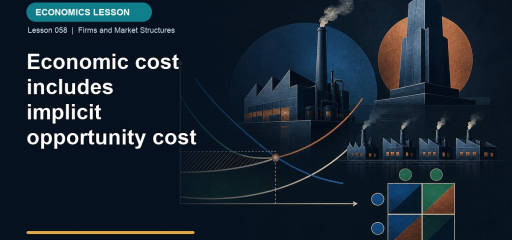
Economic cost includes implicit opportunity cost: this Effortless Math guide explains the topic in plain language, shows how it works through solved examples, and gives you free practice to try immediately, so the idea sticks instead of staying abstract.
Accounting records do not capture every forgone alternative.
Accounting profit subtracts explicit monetary costs from revenue. Economic profit also subtracts implicit costs, including the owner’s forgone salary, forgone return on invested funds, and normal return to entrepreneurship. Therefore accounting profit is normally at least as large as economic profit.
Explicit costs require direct payments: wages, rent, materials, utilities, and interest paid to lenders. Implicit costs arise when the firm uses resources the owner already possesses. An owner who works without a salary gives up earnings elsewhere. Using an owner-financed building gives up rent that another tenant might have paid. These forgone alternatives are real economic costs even when no check is written.
The relationship is accounting profit=TR-explicit cost, economic profit=TR-explicit cost-implicit cost. If revenue is $300,000, explicit cost is $220,000, and the owner’s forgone salary and investment return total $50,000, accounting profit is $80,000 while economic profit is $30,000.
Zero economic profit does not mean the owner receives nothing. It means revenue covers explicit costs plus all implicit opportunity costs, including normal profit. The owner is doing as well as in the next-best alternative.
Normal profit is the minimum return needed to keep entrepreneurial resources in the business. It is included in economic cost. At zero economic profit, the owner can still receive a salary-equivalent return and a normal return on capital. There is no excess return to attract entry, but the business is not operating for free.
A positive accounting profit and zero economic profit
A consultant earns $140,000 in revenue and pays $40,000 in explicit business expenses. Accounting profit is $100,000. The consultant could earn a $92,000 salary elsewhere and could earn $8,000 annually on funds tied up in the firm. Economic profit is 140,000-40,000-92,000-8,000=0. The business covers all opportunity costs.
Economic loss does not automatically require immediate shutdown. It signals that revenue is below total economic cost. In the short run, fixed costs may be unavoidable and operation can still reduce loss if price covers average variable cost. In the long run, persistent negative economic profit induces exit when resources can move to better uses.
| Result | What revenue covers | Long-run signal |
|---|---|---|
| Positive economic profit | Explicit, implicit, and an excess return | Entry if barriers are low |
| Zero economic profit | Explicit and all implicit cost, including normal profit | No entry or exit incentive |
| Negative economic profit | Less than total opportunity cost | Exit if persistent and avoidable |
Do not add an opportunity cost twice if it is already included as an explicit payment. Classify each resource once. The stem’s wording determines whether a cost appears in accounting records or remains implicit.
Owner-supplied financial capital is a commonly missed implicit cost. If $100,000 invested in the business could earn 6 percent elsewhere, the annual opportunity cost is $6,000 even when the firm pays no interest. Owner labor and an owner-occupied building are treated the same way: value the best forgone alternative.
Economic profit is forward-looking for resource allocation. A positive number says the current use beats the next-best use. A negative number says resources could earn more elsewhere. It does not automatically describe cash flow, taxable income, or the owner’s bank balance. Keep the opportunity-cost purpose visible.
A business reports accounting profit of $90,000. The owner’s forgone salary and return on invested funds total $35,000. Economic profit is
- $125,000
- $90,000
- $55,000
- $35,000
- $0
$55,000 Economic profit subtracts implicit opportunity costs from accounting profit: $90,000 – $35,000 = $55,000.
Which cost is implicit for a restaurant owned and managed by one person?
- Payments made to food suppliers
- Hourly wages paid to restaurant servers
- Monthly charges for electricity and water
- The owner’s forgone management salary
- Interest paid on a business bank loan
The owner’s forgone management salary The forgone management income is an opportunity cost that does not require a cash payment. The other choices are explicit costs.
In long-run equilibrium, zero economic profit means that firms
- receive no revenue above variable cost
- cannot pay owners any return
- earn zero accounting profit
- cover all explicit and implicit opportunity costs
- produce where price is below ATC
cover all explicit and implicit opportunity costs Zero economic profit includes a normal return to owners and payment of every explicit and implicit cost.
Watch the idea in action
A focused video lesson from Khan Academy.

Reza is an experienced Math instructor and a test-prep expert who has been tutoring students since 2008. He has helped many students raise their standardized test scores--and attend the colleges of their dreams. He works with students individually and in group settings, he tutors both live and online Math courses and the Math portion of standardized tests. He provides an individualized custom learning plan and the personalized attention that makes a difference in how students view math.
Related to This Article
More math articles
- MTEL Elementary Mathematics (68) Worksheets: FREE & Printable
- Top 10 SSAT Middle Level Prep Books (Our 2023 Favorite Picks)
- 6th Grade WY-TOPP Math Worksheets: FREE & Printable
- Device Parts, Materials, Joints, and Lumens
- Build a Word, Then Check It Against the Whole Word
- Algebra Puzzle – Challenge 39
- Grade 3 Math: Comparing Fractions
- Crash Cash-Out Targets: 1.5x vs 2x vs 5x Compared
- Federalist No. 78 and the judiciary
- How to Show the Relation in the Coordinate Plane





















What people say about "Economic Cost Includes Implicit Costs"?
No one replied yet.