NREMT EMT Exam Changes: Check Your Level Before Choosing a Course (2027 Prep)
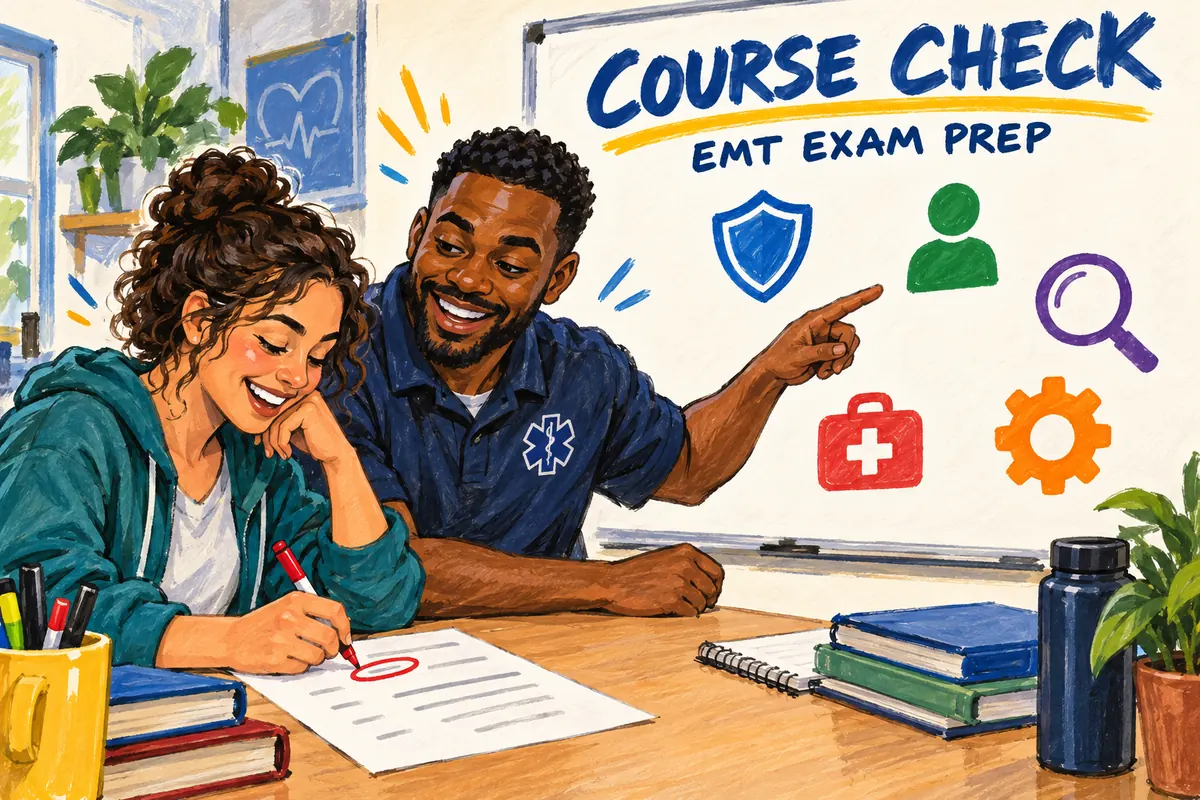
An EMT book can be a few years old and still explain airway care well. Before you replace it, open the exam blueprint. The date printed on the cover tells only part of the story about whether the course still tracks the exam. Match the lessons and practice feedback to the current EMT tasks.
The exams changed on April 7, 2025. Five task-based domains organize the EMT cognitive exam and describe the questions candidates encounter. Those labels describe what the exam tests. They describe exam tasks rather than a required order for assessment and care on a real call. Start with NREMT’s exam update page for version details.
Check the level on the label
A course catalog may group EMR, EMT, AEMT, and Paramedic under one NREMT heading. The exams have different plans. Read the blueprint and answer explanations before you judge the product title. The EMT cognitive exam is the focus here.
Old chapters can still teach
Older EMT books often sort lessons under Airway, Respirations, and Ventilation, or Cardiology and Resuscitation. Other chapters cover Trauma, Medical, Obstetrics, and Gynecology, plus Operations. The current plan organizes the exam around tasks. A breathing lesson, for instance, can help with Primary Assessment and with treatment decisions, depending on the question.
Start with one old heading. The map below shows possible current domains for that topic. It is a study aid, not an official NREMT crosswalk, and a topic can support several domains.
| Older EMT study heading | Where to check it in the current EMT plan |
|---|---|
| Airway, Respirations, and Ventilation | In the current EMT plan, airway threats may call for work under Primary Assessment as well as treatment decisions. Patient Treatment and Transport covers those airway-related care decisions. |
| Cardiology and Resuscitation | Primary Assessment can cover immediate threats. Patient Treatment and Transport also covers intervention choices and decisions about moving the patient to an appropriate setting. |
| Trauma | Scene Size-Up and Safety can cover scene hazards. Assessment or Patient Treatment and Transport may fit the task described. |
| Medical, Obstetrics, and Gynecology | Use Assessment or Patient Treatment and Transport, then check which task the item asks you to perform. Questions about special populations can appear in several parts of the current plan. |
| EMS Operations | Operations remains a domain. Scene risks and resource decisions also connect to Scene Size-Up and Safety. |
Five checks for a course or practice test
- Read the level. The course, blueprint, and explanations should name EMT. A package built for EMR or an advanced certification answers a different exam plan.
- Compare the domain names. NREMT’s current EMT specifications use five task-based labels. If a course reports only the retired subject headings, ask how its lessons map to today’s tasks.
- Look at study emphasis. Primary Assessment carries 39–43% of the exam. Scene Size-Up and Safety is 15–19%, Secondary Assessment is 5–9%, Patient Treatment and Transport is 20–24%, and Operations is 10–14%. The ranges allow variation across attempts. Find the full domain breakdown in NREMT’s official EMT specifications.
- Try every response format. The plan includes multiple choice, multiple response, options table, build list, and drag-and-drop items. Use NREMT’s sample packet and navigation tutorial. Read the instruction on each item before you answer.
- Before you choose a course, look closely at what its feedback tells you after a missed question. Can you name the EMT task behind the question and choose a focused review? A percentage alone leaves that work to you. Fixed-length practice forms help you study, while the live exam adapts to your performance.
Keep the book, update your notes, or choose another course
An older book can stay in your rotation when its EMT facts hold up and its lessons help you make current assessment and treatment decisions. Its chapter labels can still work as an index.
If the teaching works but the progress report uses retired labels, write the five current domains and their ranges beside your missed-question log. Use those labels as you review.
Choose a course that names EMT and teaches the task-based plan when your current resource uses a different certification level or leaves you guessing after a wrong answer. Check the current official EMT plan before you spend money on a replacement course.
Then try a short mixed set. Tag each missed question with the task it tested. If the rationale does not make that task clear, read it once more before adding questions. The EMT and NREMT practice hub offers fixed-form practice. A fixed practice set helps you learn item formats, while CAT adjusts question difficulty as you answer.
This page offers independent exam-preparation material for EMT candidates. NREMT administers the official cognitive exam. Check NREMT and your state EMS office for current certification and skills requirements.

Related to This Article
More math articles
- Why Learning Styles are a Myth?
- How long Is the SHSAT Test?
- Live Dealer Baccarat and the Math That Doesn’t Move
- Firms connect production, cost, and revenue
- Alabama ACAP Grade 8 Math Free Worksheets: 72 Printable PDFs with Step-by-Step Answer Keys
- Majority-minority districts
- TASC Math Formulas
- Mini Baccarat Is Faster — Which Quietly Costs You More
- 6th Grade STAAR Math Practice Test Questions
- 4th Grade MCAS Math Practice Test Questions
















What people say about "NREMT EMT Exam Changes: Check Your Level Before Choosing a Course (2027 Prep) - Effortless Math"?
No one replied yet.