Praxis 8003 Fraction Division: Read the Model, Then Choose the Operation (2027 Prep)
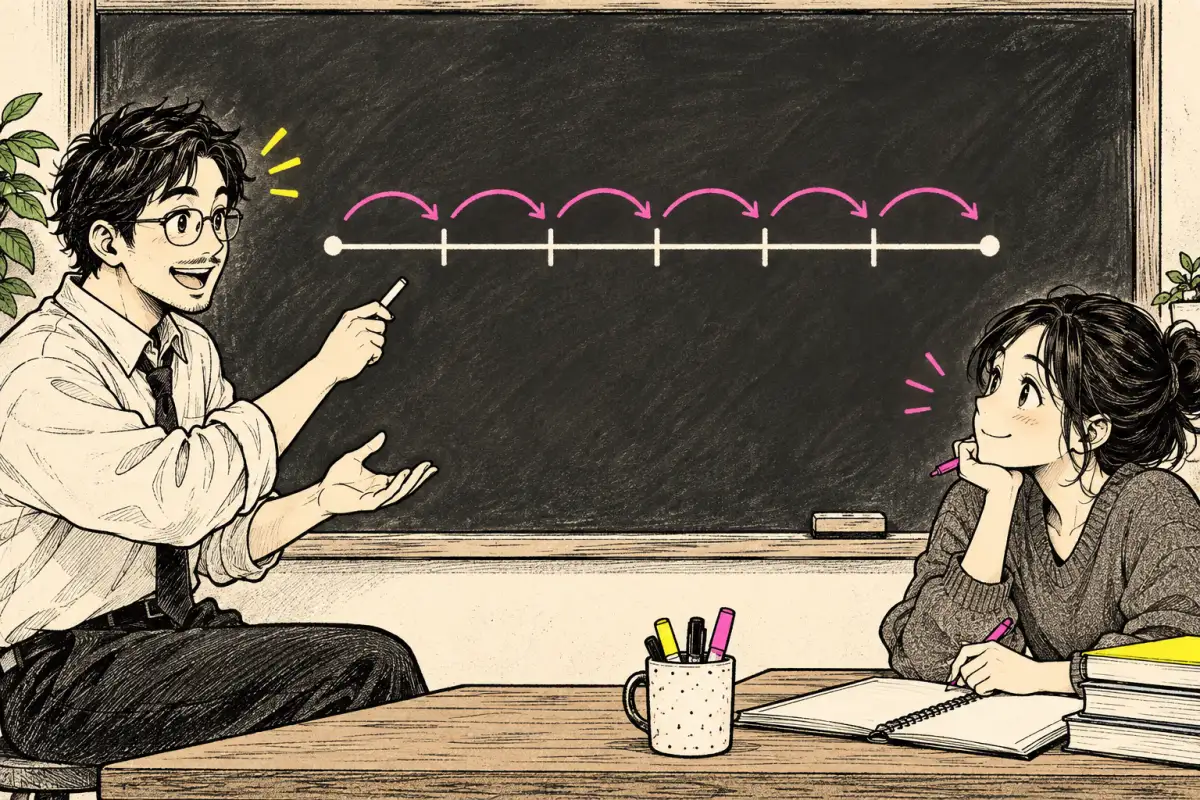
When a fraction-division answer looks surprisingly large, check the unit before changing the calculation. In 3/4 ÷ 1/8, the answer is 6 because the question asks how many eighth-size pieces fit along a length of three-fourths. The quotient counts pieces. It does not measure a new length.
That small distinction helps with both the arithmetic and the teaching-style questions in Praxis 8003 preparation. A number line makes the “how many fit?” meaning visible. A sharing problem needs a different reading of division, so let’s separate the two.
Start with the question the division is asking
Division can describe two useful situations. In a measurement question, you know the total and the size of each group, then count how many groups fit. In a sharing question, you know the total and number of groups, then find the amount in each group.
Compare these:
- How many eighths are in three-fourths? Write 3/4 ÷ 1/8. The unknown is a count of one-eighth lengths.
- Share three-fourths equally between two people. Write 3/4 ÷ 2. The unknown is each share, so the answer is 3/8.
The symbol ÷ appears in both. The story tells you what the answer should measure. Say the unit out loud before you calculate: “eighth-size pieces” in the first problem, “fraction of the whole per person” in the second.
Use a number line for “how many groups fit?”
For 3/4 ÷ 1/8, mark zero and three-fourths on a number line. Split each whole into eighths. The endpoint 3/4 is the same point as 6/8, so count the one-eighth jumps from zero: six. Therefore, 3/4 ÷ 1/8 = 6.
The quotient is larger than 3/4, and that is sensible. Three-fourths is a length. Six is a count of eighth-length units. Those numbers describe different kinds of quantity. If a learner says “six is too big,” ask, “Six what?” That question often reveals the missing unit.
The same model explains a division where the quotient is less than one. For 1/2 ÷ 2/3, ask what fraction of a two-thirds length is one-half. On a line, mark zero, two-thirds, and one-half. Since 1/2 is three-quarters of 2/3, the quotient is 3/4. Check it by multiplication: 3/4 × 2/3 = 1/2.
Where an area model helps, and where it gets awkward
An area model works well when the task is about equal parts of one whole, equivalent fractions, or the overlap in a multiplication problem. It can also show sharing. Divide a 3/4-length bar into two equal parts, and each part measures 3/8.
For “how many groups of 1/8 fit in 3/4?” a row of eight equal boxes can show that six boxes make three-fourths of the whole. That is useful. But once you are counting repeated eighth-lengths along an amount, a number line puts the distance and the count in the same view. It tends to keep the question’s unit in focus.
A study with 123 fifth- and sixth-grade students compared number lines, circular area models, rectangular area models, and no visual model for fraction-division problems. In that study, children using number lines were more accurate and produced stronger conceptual models across most of the problems than children in the area-model or no-model groups. The study supports trying a number line for fraction division, but it did not report a separate result for measurement-division tasks. This article applies that evidence to a “how many groups fit?” example because equal intervals make the counted unit visible. That model choice follows the structure of the problem. Area models remain useful for equal shares and part-whole questions.
Why “keep, change, flip” needs one more sentence
The shortcut gives the right computation: 3/4 ÷ 1/8 = 3/4 × 8/1 = 24/4 = 6. The reciprocal of 1/8 is 8, and multiplying by 8 counts how many eighths make each whole before taking three-fourths of that count.
Here is the unit reasoning. One whole contains eight pieces of size 1/8. Three-fourths of that whole contains three-fourths of eight such pieces: (3/4) × 8 = 6 pieces. The number line gives those six pieces a location and equal spacing. The reciprocal rule is a compact calculation of the same count.
If the denominator switch feels like a magic trick, pause at the phrase “how many groups of this size fit?” Write the division statement from the story first. Then use the shortcut and check that the answer’s unit makes sense.
A quick model-selection check for a teaching question
| What the problem asks | A useful first model | What to watch |
|---|---|---|
| How many groups of a known fraction fit? | Number line with equal jumps the size of the divisor | Count jumps, then name the counted unit |
| How much goes in each of a known number of equal groups? | Bar or area strip partitioned into that many equal shares | Keep the original whole the same size |
| What fraction of one amount is another amount? | Number line or aligned length bars | Compare both lengths from the same zero point |
| What part of a whole is shaded? | Area model with equal partitions | Check that each part has the same area |
Try this original practice scenario. A student writes 3/4 ÷ 1/8 = 6, then says, “I flipped the second fraction because that is the rule.” The answer is right, but the explanation does not show what six counts. Ask the student to place 3/4 on a line divided into eighths and label each jump. If the student marks six jumps, the model connects the procedure to the situation. If the student draws three-fourths of one bar and shades one-eighth of that same bar, ask what is being compared. That picture may show a part of a part instead of counting how many eighths fit in three-fourths.
This is a study prompt written for this article, not an ETS question. ETS describes 8003 as a mathematics assessment that includes selected-response and numeric-entry questions, and says about 10 to 15 percent of its questions ask candidates to apply mathematics content and processes in a teaching scenario or instructional task. The official description does not promise that any particular fraction model will appear. Use this exercise to practice explaining mathematics, not to predict a test item.
Build a five-minute fraction-model routine
- Underline what is unknown: a count, a share, or a comparison.
- Write the unit for each number. Keep “whole,” “one-eighth piece,” and “number of pieces” distinct.
- Choose a line for repeated lengths, or a partitioned bar for equal shares of a whole.
- Estimate the answer before using the reciprocal rule. Ask whether its size and unit are plausible.
- After calculating, explain one sentence that links the model to the operation.
For more Praxis Elementary Mathematics practice and topic review, use the Praxis Elementary Mathematics study hub. Confirm current test and licensing requirements through ETS and your state or preparation program.
Sources and scope
- ETS, Elementary Education Fundamentals: Mathematics (8003), for current test description and teaching-scenario estimate.
- Sidney, Thompson, and Rivera, “Number lines, but not area models, support children’s accuracy and conceptual models of fraction division,” Contemporary Educational Psychology 58 (2019), 288–298, for a bounded comparison of visual models.
Scope note: This article teaches a fraction-reasoning strategy relevant to elementary mathematics preparation. It does not claim that ETS will use a specific fraction-division item or model.

Related to This Article
More math articles
- CLEP U.S. History I 019: The First Great Awakening
- Earmarks
- Market factor demand adds firms’ input demands
- Chemical Reactions and Conservation of Mass
- CLEP U.S. History I 070: Abolitionists and Antislavery Politics
- Consultants and polling
- Understanding Decimals for 5th Grade: Place Value and Meaning
- 7th Grade Georgia Milestones Assessment System Math Worksheets: FREE & Printable
- Interpreting Text and Visuals Together
- How to Determine Limits Using Algebraic Manipulation?






















What people say about "Praxis 8003 Fraction Division: Read the Model, Then Choose the Operation (2027 Prep) - Effortless Math"?
No one replied yet.