ParaPathways 5758 Reading: Main Idea vs Supporting Details (2027 Prep)
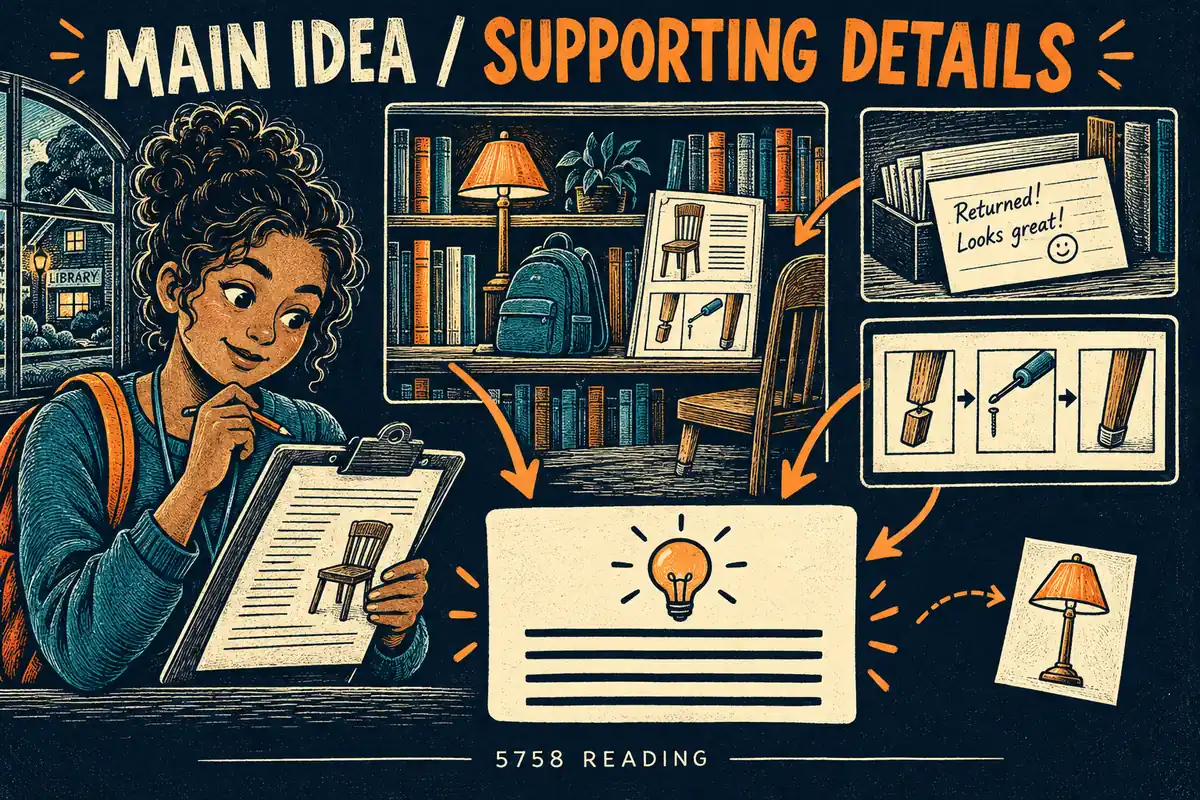
A patient, worked method for finding what a passage says as a whole, checking which details support it, and avoiding tempting answers that are true but too narrow.
Find the passage’s claim first, then test each detail against it.
The main idea tells what the passage says about its topic. Supporting details explain, show, or qualify that point. A detail can be accurate and still be the wrong answer to a main-idea question, so read for the relationship between the sentences instead of the one you remember best.
The official ParaPathways 5758 Reading and Writing Study Companion names this skill plainly: identify a main idea, summarize a text’s purpose, find key supporting details, and judge whether evidence supports a claim. ParaPathways is designed for people preparing to become, or currently serving as, paraeducators who support classroom teachers. ETS delivers it on computer. The example below is original practice written for this guide. It is not an ETS question.
Where this skill fits on ParaPathways 5758
| Test fact | Current published description |
|---|---|
| Assessment | ParaPathways 5757 includes separately timed Reading and Writing (5758) and Mathematics (5759) subtests. |
| Delivery | Computer-delivered. |
| 5758 time | 85 minutes. |
| Questions | About 51 selected-response questions in 5758. A question may require one or more choices. |
| Content split | About 30 Reading questions (60%) and 21 Writing questions (40%). These are estimates, not a promise about an individual form. |
| Scoring caution | ETS says some questions may not count toward the score. |
Those figures come from the current ParaPathways Study Companion, an ETS document posted by the Rhode Island Department of Education. ETS’s 5758 product page still shows a different three-subject, 90-question, 150-minute summary. For the subtest breakdown in this guide, use the detailed Companion and check your registration materials before test day.
Reading is broader than passage summaries. The companion also lists vocabulary in context, fluency, inferences, tone and word choice, text structure, author perspective and purpose, data displays, relevant textual evidence, phonemic awareness, phonics and text-based discussion. The examples here focus on one small skill within that wider 5758 outline.
A four-question check for the main idea
Name the topic first, then ask what the writer says about it. Your sentence should fit the whole passage, and the passage should support every part of it. That second check matters.
- Topic: What is the passage about?
- Main idea: What point does the writer make about that topic?
- Supporting detail: Which fact, example, reason or explanation develops the point?
- Relevant evidence: How does that detail help support a stated claim?
Write your summary as a full sentence. “The library” names the topic. A memorable number may be one detail. Find the statement that joins the passage’s parts.
Try an original 5758-style example
Passage: A neighborhood library added a repair shelf with short guides for fixing lamps, torn backpacks and loose chair legs. Visitors could borrow a small tool kit with each guide. During the first month, 18 of the 24 borrowers returned a card describing what they tried. Several cards mentioned that the drawings helped them follow steps in order, so librarians are adding more diagrams to the next set of guides.
Question 1: Which choice best states the main idea?
- The library’s repair shelf offers short guides about lamps, backpacks and chairs.
- The library paired repair guides with borrowable tools and is using reader feedback to improve them.
- Eighteen borrowers returned a card during the first month.
- Diagrams are the only way to teach someone to repair an object.
Answer: B. The library made its guides practical with tool kits, then used reader comments to improve the next set. A lists examples, and C gives a count. Those facts are true but too narrow. D adds a claim the writer never makes.
Question 2: Which TWO details support the claim that the library used reader feedback to revise its guides?
- The guides covered lamps, backpacks and chair legs.
- Visitors could borrow a small tool kit with a guide.
- Eighteen of 24 borrowers returned a card describing what they tried.
- Several cards said the drawings helped readers follow the steps.
- The library is located in a neighborhood.
Answers: C and D. C shows how many borrowers gave feedback, and D tells what some of them said. B explains how the service worked, but it does not report what the library learned. A and E add setting details without answering the question.
A supporting detail can also be evidence, but only when it bears on the claim in the question. C and D show that readers responded and explain what several readers said, which supports the librarians’ decision to revise the guides. The object list is true, yet it says nothing about that decision. Keep the question in view.
Main idea and primary purpose answer different questions
The main idea answers, “What point does the passage make?” The primary purpose answers, “Why did the writer create this text?” Those answers can differ. Read this short example: A school’s reading-conference program helped more students finish books they chose, and teachers said the meetings helped them spot confusion sooner. The writer urges the district to fund the program in every school next year.
Main idea: the conference program appears to help students keep reading and helps teachers notice misunderstandings early. Primary purpose: persuade the district to expand and fund the program. The first answer summarizes the passage’s point; the second names the writer’s goal. If you choose “explain how conferences work,” you have added a purpose the passage does not serve. The ETS 5758 outline includes both question types, so check the stem before choosing.
| If the question asks… | Your task | Check before answering |
|---|---|---|
| What is the main idea? | State the writer’s point about the topic. | Does the answer cover the full passage? |
| What is the primary purpose? | Name the writer’s reason for presenting the text. | Is the writer explaining, persuading, describing or telling a story? |
| Which detail supports the claim? | Find a fact or example tied to that exact claim. | Can you explain the connection in your own words? |
When the question asks how to help a reader
The 5758 Reading outline also includes supporting text-based discussion, including prompts that help students cite evidence. A classroom question may ask how you would guide a learner who has read a paragraph but cannot summarize its point. You are choosing a prompt that helps the learner do the thinking. Use the teacher’s direction and let the student find the answer.
Classroom example: Read the paragraph the student has just seen: The school added covered bike racks near the gym, the library, and the south entrance. In a spring survey, 42 students said they would bike to school more often if their bikes were protected from rain. The principal proposed the racks as one way to make cycling a more practical trip to school.
The student can name each rack location but cannot explain why the school added them. Which response best helps the student connect the details?
- “The school wanted more students to ride bikes. Copy that sentence into your notes.”
- “What reason does the paragraph give for adding the racks? Which sentence helped you decide?”
- “Read the paragraph again as quickly as you can.”
- “Choose the location you remember best and use it as your summary.”
Answer: B. The prompt asks the student to connect details and point to evidence. A gives away the conclusion, C changes the task to speed, and D turns one example into the whole point. In a classroom item, the helpful move is to guide the student’s reasoning, not to supply a polished answer.
Why the wrong choices can feel convincing
Test writers can use a true statement as a distractor. The problem is its job in the passage.
- One example for the whole message: A sentence names the books, people or objects discussed. That may identify the topic without stating the author’s point.
- A number that grabs your eye: A statistic can support the main idea, but a statistic alone rarely captures the full point.
- A claim with extra certainty: Watch words such as “all,” “only,” “always” and “proves.” The author may have made a narrower claim.
- A personal recommendation: An answer can sound sensible while adding advice that the passage never gives.
- A detail that supports a different claim: It may be relevant to the passage overall and irrelevant to the specific question.
When two choices seem plausible, test each one against every sentence. Does it cover the whole passage? Is each part supported? Does it answer the exact stem? This catches choices that are true but too small or too broad.
How to practice without memorizing one trick
Take a short informational passage from a reputable source. After reading it, cover the text and write one sentence that starts, “The author explains that…” Reopen the passage and underline the sentence that best supports your summary, then name the link: reason, example, comparison, result or qualification. That label forces you to explain how the evidence works.
Compare your sentence with the choices. Label the tempting wrong answer too broad, too narrow, unsupported, or aimed at another part of the passage. Save that label and the sentence that fooled you in an error log. A few sets can reveal a habit. Maybe the first statistic keeps pulling you in. Maybe you choose the subject instead of the writer’s point. Now you know where to slow down.
On a multi-select item, judge each option on its own. Follow the exact screen directions. The Study Companion says a 5758 question may require one or more choices.
Keep a sensible pace across both parts
The 85-minute clock covers Reading and Writing together. The companion estimates about 30 Reading and 21 Writing questions, which works out to an average near 100 seconds per question if time were split evenly. Treat that as arithmetic for planning, not an ETS pacing rule. A passage or multi-select item may take longer, while a direct grammar item may take less.
Use official ETS materials to practice the full subtest, including Writing. For a passage question, jot down the topic in a few words and finish this sentence: “The passage’s point is that ___.” Check the details before you answer. If two choices are eating your time, mark the item if your screen allows review and return later.
Your next study step
For your next passage, make three notes: the main idea, its strongest supporting detail, and why that detail fits. Add one true detail that answers a different question. Explaining that mismatch is useful practice.
Use our ParaPathways 5758 Reading and Writing study hub to choose your next topic and find the linked official materials. Before you register, confirm that your employer or state accepts ParaPathways and verify the current test code and qualifying score with the ETS state and district requirements list. The 2026–27 ETS bulletin lists 5758 Reading and Writing as an 85-minute subtest, separately timed from 5759 Mathematics; check your current appointment details before test day.
Official sources
- ParaPathways Study Companion, current copy hosted by the Rhode Island Department of Education
- ETS ParaPro Information Bulletin, 2026–27
- ETS ParaPathways assessment page
- ETS 5758 Reading and Writing information and prep products
- ETS interactive practice tests
- ETS state and district requirements
Prepared by Effortless Math as independent study support. ETS does not sponsor or endorse this article. Check official materials again before your appointment because assessment details and local requirements can change.

Related to This Article
More math articles
- Experiments
- The Best Algebra 1 Book for Idaho Students
- Policy formulation
- Kansas KAP Grade 6 Math Free Worksheets: 72 Free Printable Worksheets with Step-by-Step Keys
- The Best Tablets for Math Teachers
- Arizona AASA Grade 4 Math Free Worksheets: Printable Practice for Every Fourth-Grade Math Skill
- Degrees to Radians Converter (and Back)
- How to Use Area Models to Divide Three-digit Numbers By One-digit Numbers
- Equipment-Area Safety and Preparation
- Interpreting Text and Visuals Together








What people say about "ParaPathways 5758 Reading: Main Idea vs Supporting Details (2027 Prep) - Effortless Math"?
No one replied yet.