Free Energy and ATP Coupling: Worked Examples
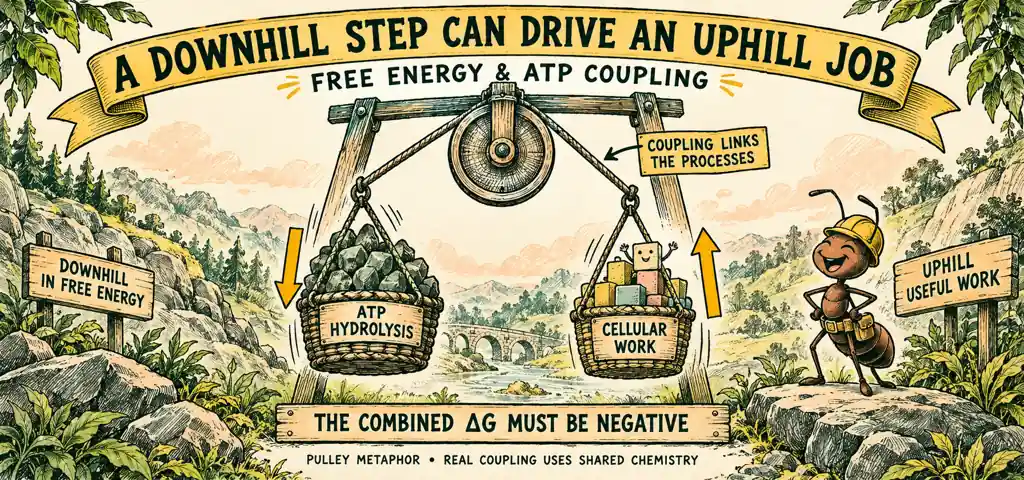
Free energy and ATP coupling explain whether cellular work is thermodynamically favorable. Add the free-energy changes of physically coupled steps under consistent conditions. A negative total favors the net process; it does not tell you how fast the process runs. Enzymes lower activation barriers without changing the free-energy difference under fixed conditions.
What the Sign of ΔG Tells You
| ΔG | Meaning | Rate? |
|---|---|---|
| Negative | Forward process favorable | Not determined by the sign |
| Positive | Forward process unfavorable on its own | Not determined by the sign |
| Zero | Equilibrium; no net reaction | Forward and reverse reactions can continue |
Sugar can remain unchanged in a dry dish while yeast rapidly metabolizes dissolved sugar. A favorable overall reaction can still be slow unless a suitable reaction pathway is available. Cells use enzymes to accelerate reactions and couple energy-releasing reactions to work.
Watch the process
Coupled Reactions
Two questions guide the energy accounting: is the reaction thermodynamically favorable under these conditions, and how fast can it proceed? Free-energy change answers the first. Activation energy and enzyme activity help answer the second.
Every process in a cell either releases usable energy or requires it. The quantity that sorts them is free energy, written \(G\), the portion of a system’s energy available to do work at constant temperature and pressure. What matters for biology is not \(G\) itself but the change across a reaction: \[\Delta G = G_{\text{products}}-G_{\text{reactants}} .\] Start by interpreting the sign. If \(\Delta G < 0\), the products hold less free energy than the reactants, the reaction releases usable energy, and it proceeds without an outside push. Such a reaction is exergonic, also called spontaneous. If \(\Delta G > 0\), the products hold more free energy than the reactants, the reaction cannot run on its own, and it is endergonic. If \(\Delta G = 0\) the system is at equilibrium and no net change occurs.
Read that word spontaneous carefully. It means thermodynamically favorable, not fast. Glucose burning in air is enormously exergonic, yet a bowl of sugar sits on the counter for years. Spontaneity gives the direction a reaction takes if it goes at all. Rate is a separate question governed by the activation barrier, temperature, and the available catalytic pathway.
College Preview
Optional enrichment: use the supplied enthalpy and entropy values to interpret the model. The core distinction is free-energy change versus activation energy. Two ingredients determine the sign. The relation \(\Delta G = \Delta H-T\Delta S\) says a reaction is favored when it releases heat (negative \(\Delta H\)) and when it increases disorder (positive \(\Delta S\)). Do not assign both signs from the word hydrolysis or synthesis alone. The net free-energy change depends on the particular reactants, products, and conditions. Cells commonly couple unfavorable biosynthetic steps to favorable reactions. A cell constantly builds ordered products, so it works against the drift toward disorder and must be paid for continuously. That is the ENE big idea: living systems require a continuous input of free energy to maintain organization, and they die when it stops.
Where the Sign Comes From: Enthalpy, Entropy, and Temperature
The following optional extension connects free energy with enthalpy and entropy. Use the supplied quantities and consistent units: \[\Delta G = \Delta H-T\Delta S .\]
Enthalpy, H, is a state function. At constant pressure, when pressure–volume work is the only work involved, the heat exchanged equals the enthalpy change. A negative ΔH contributes toward a negative ΔG.
Entropy, S, describes the number of microscopic arrangements consistent with the system’s state. A positive ΔS contributes a negative −TΔS term at positive temperature. Use kelvin for T and match the energy units in ΔH and TΔS.
Now read the equation as a competition between two terms rather than as a formula to plug into. Four combinations are possible, and working through them once is faster than memorizing them.
If \(\Delta H\) is negative and \(\Delta S\) is positive, both terms push the same way, \(\Delta G\) is negative at positive temperatures in this constant-parameter model. Apply this conclusion only over the range where the supplied signs and model assumptions remain valid.
If \(\Delta H\) is positive and \(\Delta S\) is negative, both terms push against the reaction, \(\Delta G\) is positive at positive temperatures in this constant-parameter model. Use the signs given for a particular reaction rather than assuming that every polymer-building reaction has this exact combination.
The two mixed cases are the interesting ones, because temperature decides them. If both \(\Delta H\) and \(\Delta S\) are positive, the reaction absorbs heat but increases disorder, so it becomes spontaneous only when \(T\) grows large enough for \(T\Delta S\) to outrun \(\Delta H\). If both are negative, the reaction releases heat but orders the system, so it is spontaneous only at low temperature. When an exam item tells you a process happens at one temperature and stops at another without any enzyme being mentioned, this is one possibility to test; temperature can also alter molecular structure, solubility, and reaction rates.
Working \(\Delta G = \Delta H-T\Delta S\) at Two Temperatures
A small enzyme unfolds from its folded, active shape to a loose random chain. In a simplified two-state model that treats enthalpy and entropy as constant over this range, measurements give \(\Delta H = +100\ \text{kcal/mol}\) and \(\Delta S = +0.30\ \text{kcal/(mol}\cdot\text{K)}\). Decide whether the protein unfolds spontaneously at body temperature, \(37^{\circ}\text{C}\), and at \(67^{\circ}\text{C}\), then find the temperature at which the two states are equally favored.
Step 1: read the supplied signs. This model supplies positive ΔH and ΔS for unfolding. The enthalpy is the net change for the protein and its interactions with the surrounding solvent, not simply a count of broken internal bonds. With both supplied values positive, the model predicts that increasing temperature can make unfolding more favorable. Do not assign those signs to every protein under every condition.
Step 2: convert to kelvin. The equation uses absolute temperature, so convert Celsius to kelvin before substituting. \[T_1 = 37 + 273 = 310\ \text{K}, \qquad T_2 = 67 + 273 = 340\ \text{K}.\]
Step 3: evaluate at \(310\) K. Compute the entropy term first, then subtract. \[T_1 \Delta S = 310 \times 0.30 = 93\ \text{kcal/mol},\] \[\Delta G = 100-93 = +7\ \text{kcal/mol}.\] Positive, so unfolding is not spontaneous at \(37^{\circ}\text{C}\). The folded state is favored in this model; measuring activity would still be needed to establish its rate.
Step 4: evaluate at \(340\) K. \[T_2 \Delta S = 340 \times 0.30 = 102\ \text{kcal/mol},\] \[\Delta G = 100-102 =-2\ \text{kcal/mol}.\] Negative, so at \(67^{\circ}\text{C}\) unfolding is spontaneous. The unfolded state is favored in this model. Whether the protein later refolds or aggregates requires additional evidence.
Step 5: find the crossover. The two states are equally favored where \(\Delta G = 0\), which means \(\Delta H = T\Delta S\). Solve for \(T\): \[T = \frac{\Delta H}{\Delta S} = \frac{100}{0.30} = 333\ \text{K} = 60^{\circ}\text{C}.\] The crossover illustrates why heating can favor unfolding. Actual activity curves depend on enzyme stability, exposure time, and reaction kinetics; they need not all have the same shape.
Answer
\(\Delta G = +7\ \text{kcal/mol}\) at \(37^{\circ}\text{C}\) (folded state favored) and \(-2\ \text{kcal/mol}\) at \(67^{\circ}\text{C}\) (unfolded state favored), with the crossover at about \(60^{\circ}\text{C}\). Convert to kelvin first, evaluate \(T\Delta S\), then subtract.
AP Core
Follow how an energetically favorable process can drive an unfavorable one.
ATP and the Logic of Coupling
ATP, adenosine triphosphate, is an adenine base, a ribose sugar, and a chain of three phosphate groups. Each phosphate is negative at cellular pH, so forcing three into a row creates electrostatic repulsion. Hydrolysis of the terminal phosphate relieves that repulsion, increases the number of particles, and lets water stabilize the products, so \[\text{ATP} + \text{H}_2\text{O} \longrightarrow \text{ADP} + \text{P}_i, \qquad \Delta G^{\circ\prime} \approx-7.3\ \text{kcal/mol}.\]
Notice what that sentence did not say. It did not say the bond stores energy and releases it when broken. Breaking any bond requires energy. The release comes from the whole accounting: the bonds formed in the products, plus the hydration of the products, plus the increase in entropy, more than pay for the bond broken. If you use the shorthand “high-energy phosphate bond,” explain that the overall hydrolysis reaction releases free energy; breaking a bond by itself requires energy.
Energy coupling lets a cell run endergonic reactions anyway. Couple an endergonic reaction to a more strongly exergonic one through a mechanism such as a shared chemical intermediate or a coupled conformational cycle, and the combined \(\Delta G\) is the sum of the two; a negative sum establishes thermodynamic favorability under those conditions, while the mechanism and kinetics determine the rate. Thermodynamics is not repealed. An unfavorable step was paid for out of a larger favorable one, and the net process remains thermodynamically favorable.
Adding Up a Coupled Reaction
Glutamate and ammonia combine to form glutamine. The reaction is endergonic, with \(\Delta G^{\circ\prime} = +3.4\ \text{kcal/mol}\). A cell nevertheless makes glutamine steadily. Show, with numbers, how coupling to ATP hydrolysis (\(\Delta G^{\circ\prime} =-7.3\ \text{kcal/mol}\)) permits this, and state what the combined sign establishes under the reference conditions.
Write the two reactions and add their free-energy changes, because free energy is a state function and sums across coupled steps. \[\Delta G^{\circ\prime}_{\text{total}} = (+3.4) + (-7.3) =-3.9\ \text{kcal/mol}.\] The sum is negative, so the net reaction is favorable under the stated reference conditions; that arithmetic alone does not establish its rate. The mechanism matters as much as the arithmetic. ATP does not hover nearby donating energy in the abstract. Glutamine synthetase first transfers the terminal phosphate of ATP onto glutamate, producing a phosphorylated intermediate that is less stable than glutamate itself. Ammonia then displaces the phosphate. The unfavorable step became favorable because the starting material was raised in free energy first.
The negative combined value establishes thermodynamic favorability under the stated reference conditions. Free-energy change is not identical to heat released, so this subtraction alone does not calculate heat production.
Answer
Coupling gives \(\Delta G^{\circ\prime}_{\text{total}} =-3.9\ \text{kcal/mol}\), so the pair is spontaneous; the negative sign establishes favorability, and the phosphorylated intermediate is what physically links the two reactions.
The same coupling principle applies to ATP-driven transport, molecular motors and biosynthesis. The mechanism must connect ATP turnover to the particular work. ATP is regenerated continually through pathways such as cellular respiration; the size of its pool and the rate of turnover vary with cell type and conditions.
ATP cycling links energy-releasing pathways to cellular work. Hydrolysis produces ADP and phosphate; energy from metabolism or light supports ATP regeneration. ATP is a rapidly recycled intermediate rather than the cell’s principal long-term energy store.
Distinguish standard-state values from values inside a cell. The value \(-7.3\ \text{kcal/mol}\) is the standard free-energy change, \(\Delta G^{\circ\prime}\), measured with standard-state solute activities and pH 7, with water treated as the solvent. A living cell keeps ATP far above its equilibrium level and ADP and phosphate far below theirs, and the ATP-to-products ratio can make hydrolysis more favorable than under the standard reference conditions. Textbook examples of cellular ATP hydrolysis are often more negative, roughly −11 to −13 kcal/mol, but the actual value depends on metabolite activities and cellular conditions; it is not a fixed number for all cells. You are not asked to calculate that. You are asked to know that \(\Delta G^{\circ\prime}\) is a reference condition and that the sign and size of the real \(\Delta G\) depend on how far the cell holds the reaction from equilibrium.
Distinctions to keep clear
An energy diagram separates the activation barrier from the free-energy difference between reactants and products. The activation energy is the height of the barrier a reaction must climb before it can run at all; keep that barrier separate from \(\Delta G\). \(\Delta G\) is the difference in level between the starting valley and the finishing valley. They answer different questions. The barrier answers “how fast,” while catalysts provide a pathway with a lower barrier and temperature changes the fraction of molecules able to cross it. The difference in levels answers “which way,” and its value depends on the reactants, products, concentrations, and conditions. Enzymes do not change that value under fixed conditions, but cells can alter concentrations or couple reactions.
Keep those quantities separate when interpreting a reaction. An enzyme cannot make an endergonic reaction spontaneous, because it works only on the barrier. And a strongly exergonic reaction can still sit untouched for years, because a large drop in free energy says nothing about the height of the wall in front of it.
Review: Free Energy, Coupling, and Why ATP Is the Cell’s Currency
The sign of \(\Delta G\) tells you whether a reaction can go, not whether it will go quickly.
Couple an endergonic reaction to a larger exergonic one and the summed \(\Delta G\) decides the fate of the pair.
Do not describe ATP as storing energy in its bonds or releasing energy by breaking them. Say that hydrolysis yields products of lower free energy.
Free energy and ATP coupling
Practice question 1
An uncoupled reaction has \(\Delta G = +5.1\ \text{kcal/mol}\) at the measured temperature and concentrations, yet it runs forward when incorporated into a coupled cellular pathway. The best explanation is that
-
an enzyme lowered the reaction’s \(\Delta G\) until it became negative
-
the reaction is coupled to a more strongly exergonic reaction, making the combined \(\Delta G\) negative
-
the cell raised the temperature enough to reverse the sign of \(\Delta G\)
-
the reaction proceeds because endergonic reactions release heat
Practice question 2
Which statement about ATP hydrolysis is consistent with how the AP course describes it?
-
Energy is stored inside the terminal phosphate bond and released when that bond is broken
-
ATP hydrolysis is endergonic and must be driven by a coupled reaction
-
The products ADP and inorganic phosphate have lower free energy than ATP, so the reaction is exergonic
-
ATP hydrolysis changes the equilibrium constant of the reaction it drives
Practice question 3
A reaction is described as spontaneous. This means that
-
it occurs rapidly
-
it requires no enzyme to occur at a useful rate
-
it releases free energy and can proceed without added energy
-
it increases the free energy of the system
Practice answer key
1. B; 2. C; 3. C.
Practice answer explanations
-
Free energy and ATP coupling, Question 1. Choice B is correct. For the stated positive free-energy change, the proposed pathway needs a physical coupling mechanism to a reaction whose exergonic \(\Delta G\) is larger in magnitude, so the summed \(\Delta G\) is negative. Choice A misstates catalysis, since an enzyme changes the rate and never the free-energy change. Choice C changes the stated conditions; the positive value already refers to the measured temperature and concentrations. Choice D reverses the definition, because endergonic reactions absorb rather than release free energy.
-
Free energy and ATP coupling, Question 2. Choice C is correct. Hydrolysis is exergonic because ADP and inorganic phosphate together hold less free energy than ATP and water, thanks to relieved charge repulsion, more particles, and better hydration of the products. Choice A wrongly attributes energy release to bond breaking alone; the net release comes from the full reaction accounting. Choice B reverses the sign of the reaction. Choice D confuses coupling with thermodynamics, because coupling does not change the equilibrium constant of the original uncoupled reaction at a fixed temperature; it creates a different net reaction.
-
Free energy and ATP coupling, Question 3. Choice C is correct. Spontaneous is a statement about direction and free energy, not about speed. Choice A is the classic confusion of thermodynamics with kinetics. Choice B is false, since many spontaneous reactions are far too slow without catalysis, which is why enzymes exist. Choice D describes an endergonic process instead.
Continue your review at the AP Biology study hub.
Connect Energy Accounting to Enzymes and Respiration
Review enzyme kinetics and the separate question of reaction rate, then follow ATP production through cellular respiration.
Sources for further study
OpenStax explains Gibbs free energy and temperature models. Molecular Biology of the Cell discusses catalysis and energy coupling and cellular ATP hydrolysis conditions.

Related to This Article
More math articles
- How to Develop Foundational Math Skills for Career Success
- How is the TABE Test Scored?
- 10 Tips for Advanced Studying Mathematics
- How to Identify Independent and Dependent Events?
- GED Calculator
- Triangles
- Praxis Core Math: Topics, Format, and Smart Study Tips
- Free Grade 6 English Worksheets for Utah Students
- TASC Math Formulas
- How to Simplify Polynomials? (+FREE Worksheet!)






What people say about "Free Energy and ATP Coupling: Worked Examples"?
No one replied yet.