NREMT Paramedic Exam Changes: What the 2024 Shift Means for 2027 Prep
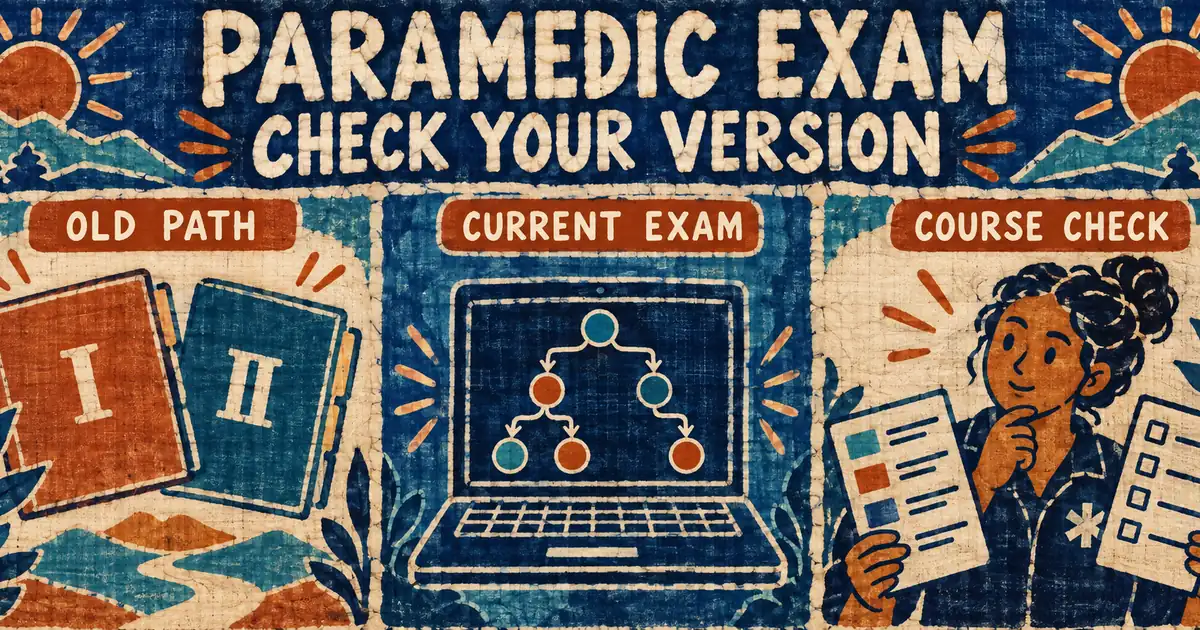
If you have heard that the NREMT Paramedic exam changed, check the date: the shift happened in 2024, and the Registry’s current candidate materials still point to that structure and plan. This guide explains what changed, what a current study resource should reflect, and which parts of paramedic preparation remain outside the national cognitive exam.
What changed on July 1, 2024?
Before the transition, ALS candidates completed a cognitive examination and a separate psychomotor examination for National Registry certification. The Registry ended that pathway on June 30, 2024. From July 1 onward, candidates seeking initial National Registry Paramedic certification use the updated Paramedic Certification Examination, a single computer-based exam that measures entry-level competency across six domains.
That is the key version check. An old course may teach useful cardiology, airway, trauma, medical, or operations content while giving out-of-date exam directions. If a resource says the current national Paramedic route requires you to book the retired ALS psychomotor exam, pause and check the source date.
The redesign added Clinical Judgment as a domain. It samples how a paramedic processes information as a call unfolds, along with communication and leadership. The computer exam uses written and technology-enhanced items to assess this domain. Your education program and state requirements still matter.
The current Paramedic exam at a glance
The current exam is delivered on a computer at an authorized Pearson testing center. It uses computerized adaptive testing, or CAT. The test can end after 110 to 150 questions once the system has enough evidence to make a pass-or-fail decision, or when the 3.5-hour limit is reached. Twenty questions are unscored pilot items. You cannot identify them, so answer every question as if it counts.
The exam uses multiple-choice, multiple-response, and technology-enhanced items. Some items sit inside a scenario. NREMT’s interactive sample items let you practise the response controls before test day. The test-center tutorial also explains how to answer each item type. Use the sample to learn the interface and item instructions, not to predict your questions or result.
CAT can make exam length vary. A short test does not prove a pass, and a longer test does not prove a fail. CAT ends when it has enough evidence against the same entry-level standard. Your job is to read each item carefully and choose the best answer supported by its facts.
Six content domains in the current test plan
| Domain | Published share |
|---|---|
| Airway, Respiration & Ventilation | 8%–12% |
| Cardiology & Resuscitation | 10%–14% |
| Trauma | 6%–10% |
| Medical/Obstetrics/Gynecology | 24%–28% |
| EMS Operations | 8%–12% |
| Clinical Judgment | 34%–38% |
These are ranges, not a promise about the exact number of questions in your individual CAT. Pediatric patient-care items are integrated across the content. The plan assigns 30% of Cardiology & Resuscitation to graphical ECG rhythm-strip items. That is 30% of the cardiology domain, not the full examination.
Clinical Judgment follows a six-step information-processing cycle: recognize cues, analyze cues, define a hypothesis, generate solutions, take action, and evaluate. A real scenario can send you through that cycle again as new details appear. You may need to decide what matters now, which information changes your working idea, and what action fits the facts and the paramedic role described.
The six domains are not sealed boxes. Clinical Judgment can draw on information from the other areas, so connect system knowledge with cue-reading practice. A respiratory scenario may call for knowledge of airway management and careful cue analysis. Keep learning the systems, then practise applying that knowledge across a changing case.
What did not change: education, competency, and state rules
The retired national psychomotor examination and your paramedic education are different things. The current National Registry pathway requires an eligible paramedic program, plus a Student Minimum Competency record that the program director verifies. A state may also have its own licensure steps. National Registry certification alone does not grant a legal right to practise in every state.
When a course page says “the skills exam is gone,” ask which requirement it means. The old national ALS psychomotor exam ended, while education programs still document competency and states set their own rules. Confirm your route with the program director and state EMS office.
The NREMT plan describes the national certification examination. It does not cover every course, state license, or agency credential.
A five-minute check before you choose a Paramedic course
Open the course outline, sample lesson, or practice-test description. Compare it with these official checkpoints.
- Level: Does the material say Paramedic or NRP? EMT and AEMT resources cover different certification levels. A page labeled “NREMT” may still be written for a different exam.
- Version: Does it identify the Paramedic plan in use since July 1, 2024, or link to the current NREMT Test Plan and handbook?
- Exam format: Does it describe CAT, a 110–150 item range, 20 unscored pilots, and a 3.5-hour limit? A claim of 150 scored questions needs a closer look.
- Clinical Judgment: Does it include the six-step cycle, communication, and leadership? Clinical Judgment makes up 34%–38% of the published plan.
- Item practice: Can you work through the official sample items and learn how multiple-response and technology-enhanced controls behave?
- Education and license: Does the provider separate the national exam from program competencies and state licensure?
Save the Paramedic course version-check checklist and try it on one resource. If a course covers all six domains but tells current candidates to schedule the discontinued national skills test, keep its subject lessons only if they fit your class, then replace its test-day directions with current NREMT guidance.
How to use the change in your study plan
Start with the current test plan, then mark the topics you can explain and apply. Give Clinical Judgment and Medical/OB-GYN regular attention because their published ranges are the largest. Keep all other domains in rotation. The smallest range is still tested.
After a practice scenario, record the cue you noticed, the one you missed, the domain knowledge involved, and the next reasoning step to practise. Keep these notes about exam learning. Field care follows your education, authorized scope, medical direction, and local protocols.
Use the NREMT interactive Paramedic sample items once before your final review week. Try them on a desktop or laptop, as the Registry recommends. Read the instructions before clicking. If an item asks for more than one response, check the wording and count. For a list or table response, practise the controls before exam day. Guessing how they work adds avoidable pressure.
The short version for 2027 candidates
For 2027 prep, the official material reviewed for this guide points to the Paramedic exam introduced July 1, 2024: one computer-based CAT, six content domains, Clinical Judgment, scenario-linked item types, and no separate ALS psychomotor exam in the national certification pathway. Before you test, check the NREMT handbook and live plan for any official update after this research date.
Use paramedic-specific material. Check the version date. Learn the item controls from the Registry’s sample. Keep program competency records and state licensure separate from the national exam plan. That simple source check can save you from studying through an outdated set of test-day directions.
Before choosing a resource, start at the NREMT Paramedic Study Center for the Paramedic-specific format overview and study links, then verify exam requirements against the official NREMT materials below.
Official sources and next steps
- NREMT Paramedic Candidate Handbook: About the Examination
- National Registry Paramedic Examination Specifications
- NREMT AEMT and Paramedic examination information and interactive sample items
- NREMT Paramedic education pathway
- NREMT certification and licensure overview
This article covers National Registry exam preparation. It does not replace official NREMT requirements, program instructions, state EMS rules, or medical direction. Effortless Math is an independent publisher and is not affiliated with or endorsed by NREMT.

Related to This Article
More math articles
- Long-Run Growth, Productivity, and Living Standards
- The Ultimate ISEE Upper Level Math Formula Cheat Sheet
- 6th Grade WVGSA Math Worksheets: FREE & Printable
- Chapter 31: General Elections
- FREE 7th Grade ACT Aspire Math Practice Test
- Majority opinions
- Power, Authority, Pluralism, and Elites
- What Kind of Math Is on the ATI TEAS 7 Test?
- The Best Grade 6 ELA Practice Tests for Arizona Students
- How the RLA Test Works
















What people say about "NREMT Paramedic Exam Changes: What the 2024 Shift Means for 2027 Prep - Effortless Math"?
No one replied yet.