Praxis 8005 Scientific Investigation Questions: Variables and Evidence (2027 Prep)
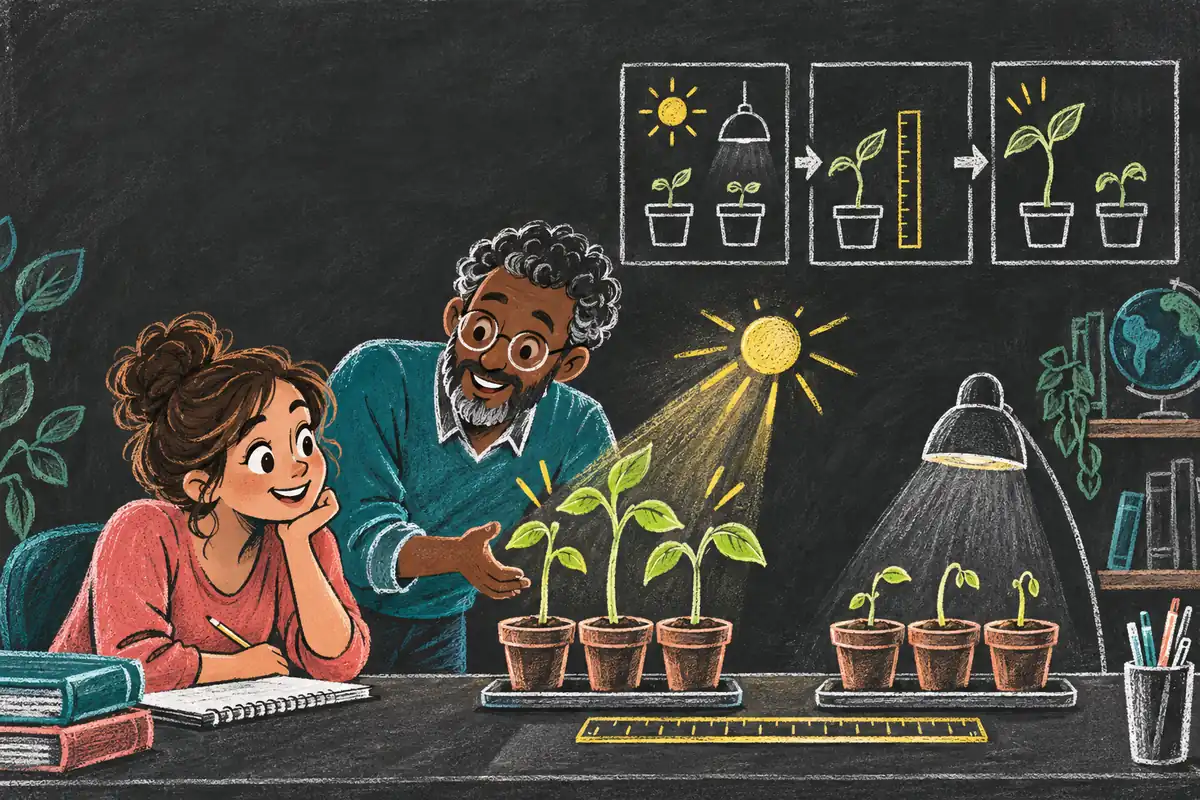
When a question shows a classroom experiment, pause before reading the answer choices. One planned change, one measured outcome, and other important conditions held steady. That is the shape to look for. If a student moves seedlings closer to a lamp and gives them extra water, taller growth cannot be credited to light alone.
A fair-test question on Praxis 8005 asks you to read past the labels and judge what the setup lets you say. We will use one seedling experiment and four original questions to practice that move. These are unofficial study examples, not ETS questions.
Praxis 8005 context: where investigations fit
ETS lists Elementary Education Fundamentals: Science (8005) as a computer-delivered test with 74 selected-response questions in 90 minutes. An on-screen scientific calculator is provided. The content categories are Earth and Space Sciences (24 questions, about 32%), Life Sciences (25, about 34%), and Physical Sciences (25, about 34%). Candidates can test at home or at a test center. Passing score requirements depend on the certifying state. ETS estimates that about 10–15% of questions integrate one or more Science and Engineering Practices and another 10–15% apply science in a teaching scenario or instructional task. Those percentages describe the blueprint, not a promise about your form. [1][2]
Three clocks. The current ETS companion assigns 30 minutes to each full-test category beginning September 1, 2026. That makes 90 minutes across the exam. Earth and Space Sciences gets one clock, Life Sciences another, then Physical Sciences gets the last. Practice moving on when a category ends because unused time does not carry into the next one. Some questions may not count toward your score. [2]
ETS now lists individual Praxis Steps for the 8002–8005 tests when a candidate’s state has adopted them. The state requirements page shows which route applies. This is separate from choosing the 90-minute full test, whose three 30-minute categories are each timed. “2027 Prep” in this article title is an edition label, not an official name for a new ETS form. Check your state page before you book. [1]
Science investigations are one thread through the domains rather than a fourth content category. You might reason about a physical-science change, interpret an Earth-science data table, or examine how a teacher helps a child test a life-science idea. The NGSS practice for grades 3–5 emphasizes planning investigations with controlled variables and enough trials to provide evidence. ETS identifies NGSS and NSTA standards among the foundations for 8005. [1][3]
A simple map for reading an experiment
Before you name a variable, try this sentence frame. Change ___ to see whether ___ changes, while keeping ___ comparable. It separates the factor under study from the result and from conditions that could otherwise muddy the comparison.
| Part of the investigation | Question to ask | Seedling example |
|---|---|---|
| Research question | What relationship is being tested? | Does light exposure affect seedling height after 14 days? |
| Independent variable | What planned factor differs between groups? | Light exposure: ordinary or brighter |
| Dependent variable | What outcome is measured? | Stem height in centimeters on day 14 |
| Controlled variables | Which conditions should be kept comparable? | Seed type and age, pot size, soil amount, water, temperature, and measurement day |
| Control group | What is the baseline for comparison, if one is useful? | Plants in ordinary light, used as the baseline |
| Evidence | What pattern appears in the recorded results? | Compare each group’s measurements, not just the tallest plant |
The independent variable is the factor the investigator changes. The dependent variable is the measured response. Controlled variables cover every other condition kept steady or matched across groups during the comparison. Same word, different jobs. A control group is the baseline for comparison, such as the ordinary-light group in the seedling example. In a study without a treatment, the word control may not fit at all.
Not every investigation needs a no-treatment group. A class that records the Moon’s appearance for a month is observing a pattern, not assigning a treatment. A design challenge may compare several solutions against the same criteria instead. Match the design to the question. Do not insert a control group just because the word appears in a vocabulary list.
Worked example: repair the test before trusting the result
Maya wants to test whether brighter light changes bean-seedling growth. She puts three seedlings by a sunny window and waters them daily. She puts three more in a dim corner and waters them whenever the soil looks dry. After two weeks, the sunny group is taller. Can she say brighter light caused the difference?
Not yet. Light and watering both changed. The amount of water is a confounding variable: it offers a second explanation for the height difference. The observation is real, but this design cannot isolate the effect of light.
Keep the question and repair the comparison. Use seedlings of the same bean variety and similar starting size. Give every pot the same soil volume, water amount, pot size, and measurement schedule. Change only the light condition. Place several seedlings in each group, rotate positions within a group if a location has uneven light, and record the actual light exposure when the tools allow it. Measure every stem from the soil line to the same tip point on the same days.
Now the independent variable is light exposure, the dependent variable is measured stem height, and water, soil, pot, plant type, and timing are controlled conditions. The lower-light seedlings provide a comparison group. Whether they count as the control group depends on how the question defines the baseline. In a simple design, the group receiving ordinary light can be the baseline and the brighter-light group the treatment.
Here is one possible classroom record. Just an example. The values are invented for practice, not expected Praxis results.
| Light condition | Day 0 heights (cm) | Day 14 heights (cm) | Mean change (cm) |
|---|---|---|---|
| Ordinary light | 4, 5, 5, 6 | 10, 11, 10, 12 | 5.75 |
| Brighter light | 4, 5, 5, 6 | 12, 13, 11, 14 | 7.50 |
For the ordinary-light group, the four changes are 6, 6, 5, and 6 centimeters. Their mean is (6 + 6 + 5 + 6) ÷ 4 = 5.75 centimeters. The brighter-light changes are 8, 8, 6, and 8 centimeters, with a mean of 7.50 centimeters. The second group grew more on average in this small example, but the data do not prove that brighter light always produces taller plants. The conclusion should name this test, its small sample, and its measured outcome.
How to decide what the evidence supports
When an item gives you a procedure or data table, use this order. Each question protects you from a different common mistake.
- Name the question and the outcome that needs an explanation.
- Find the planned change. A condition that varies by chance is not automatically an independent variable, so look for what the investigator deliberately altered.
- Name the measured quantity, its unit, and the day. Stem-height change in centimeters over 14 days is more useful than a vague note about growth.
- Check the comparison. Were other conditions kept alike, matched, or recorded? When two plausible causes change together, the design cannot separate them.
- Read every result. One unusually tall seedling can shift a small group’s average. Compare all four plants.
- Choose a claim that names these groups and conditions, then say only what the measurements support. Four seedlings give a clue, not a rule for every plant.
Repeated trials help reveal whether a result is consistent or whether one unusual measurement is doing all the work. More trials do not automatically fix a biased design. If one group receives more water, repeating the same unfair comparison many times gives you a more precise answer to the wrong question.
Likewise, a control group does not erase every source of error. A ruler may be read inconsistently, seedlings may begin at different sizes, or a lamp may warm one group as well as brighten it. A strong answer points to the flaw that best explains the evidence and suggests a specific repair. The phrase make it fair is less useful than a specific repair: keep water volume and temperature the same while varying light exposure.
Common answer traps and how to fix them
| What the response says | Why it misses the point | A stronger move |
|---|---|---|
| The dependent variable is the amount of light. | That is the condition Maya changes. It is the independent variable. | Ask what quantity she records as the outcome. Here, it is height change in centimeters. |
| The control is the water and the pot. | Those are controlled conditions, not a comparison group. | Name the no-treatment or baseline group separately from conditions held constant. |
| Brighter light made every plant grow more. | The claim expands a small, specific data set into a universal rule. | Describe the group pattern and keep the conclusion within the tested conditions. |
| Use more plants and the test is fixed. | A larger sample cannot remove a second factor that changes with the treatment. | First isolate the variable. Then add enough trials to judge the pattern. |
| The investigation is invalid because no control group is listed. | Some observational or descriptive questions do not assign treatments. | Check whether the question calls for a comparison group or for another suitable investigation design. |
Start with what the student wrote. One wrong answer could reflect a vocabulary slip, a measurement mistake, or an incomplete explanation. Ask the student to show the evidence behind the choice, then pick a prompt or model that targets the gap.
Four original Praxis 8005 investigation questions
1. Find the confound
Maya compares plants under a lamp with plants on a shelf. The lamp also warms the air. Which revision would test the effect of light without letting temperature create a second explanation for growth?
- Keep the light different and make watering different too.
- Keep temperature and other conditions alike, then measure light exposure and growth across several seedlings in both groups.
- Use one plant in each group and compare whichever grows tallest.
- Remove every comparison group and record only the lamp group.
Answer: B. If warmth changes with light, this design cannot isolate the effect of light. A adds another confound, C relies on two plants and a single extreme result, and D removes the baseline that makes the comparison useful.
2. Name the response
A class changes the length of a ramp and records how far a toy car travels. Which pair correctly names the independent and dependent variables?
- Ramp length is the independent variable, and car travel distance is the measured outcome.
- Car travel distance is independent, and ramp length is dependent.
- Ramp surface is independent, while ramp length is dependent, even though the trial changes ramp length and leaves the surface alone.
- The measuring tape is independent, and the starting point is dependent.
Answer: A. The ramp length is deliberately changed, and the car’s distance is measured. B reverses cause and response. C names an unchanging condition as the change. D mistakes tools and controls for the two variables in the question.
3. Choose a careful conclusion
Four seedlings in ordinary light gain 6, 6, 5, and 6 centimeters. Four in brighter light gain 8, 8, 6, and 8 centimeters. Which conclusion fits this small sample without claiming a universal rule or a cause these measurements cannot establish?
- Brighter light makes every bean plant grow more, whatever its variety, starting size, or watering schedule.
- In this small trial, the brighter-light group averaged 1.75 centimeters more growth.
- The tallest plant proves light controls growth.
- The experiment proves fertilizer has no effect, although no group received fertilizer or served as a comparison.
Answer: B. The first mean is 23 ÷ 4 = 5.75 cm. The second mean is 30 ÷ 4 = 7.5 cm. Now subtract. That leaves a 1.75 cm difference. A and C overstate a small sample, and D introduces a factor the experiment did not test.
4. Decide whether there is a control group
Students record sunrise time each day for a month and graph the pattern. Which statement best describes the design?
- It is an observational investigation. Students should record dates and use a consistent method.
- It needs a no-sunrise control group before any pattern can be studied.
- Sunrise time is the control group because students record it every day, even though no group receives a treatment.
- Students must manipulate sunrise to identify an independent variable.
Answer: A. The class is observing a naturally occurring pattern, not assigning a treatment. B, C, and D confuse observation with a controlled experiment or treat a measurement as a group.
A two-minute investigation checklist
- Question: What are we trying to learn?
- Change: Which factor did the investigator deliberately alter, and what stayed outside that change?
- Measure: Record the outcome.
- Compare: Check the conditions, baseline, and group assignment. If a second factor changes with the first, the result cannot be credited to only one cause.
- Trials: Enough repeats?
- Claim: Keep the conclusion inside this sample, procedure, and evidence, with a limit that prevents one result from becoming a broad rule.
Try this checklist on missed practice questions. Write the planned change and measured outcome before looking at the answer choices. Then cross out any choice that confuses a controlled condition with a control group, ignores a confound, or claims more than the data show.
For the complete 8005 science overview, practice forms, and topic lessons, continue to the Praxis Elementary Science study hub. Use it to map this investigation skill to the broader science content and practice material.
Questions candidates ask
How many Praxis 8005 questions test investigations?
ETS estimates that about 10–15% of questions integrate Science and Engineering Practices and about 10–15% apply science in a teaching scenario or instructional task. The public specifications do not promise a fixed count for variables, experimental design, or any single investigation skill. These two categories of questions may overlap in purpose, so do not add the percentages as if they are guaranteed separate blocks. [1][2]
Is a control group the same as controlled variables?
No. A control group is a comparison group that supplies a baseline. Controlled variables are conditions the investigator keeps similar so they do not become competing explanations.
Are the examples official Praxis questions?
No. They are original practice examples written for instruction. ETS did not write or review them, and they do not predict what will appear on your test.
Do I take 8005 as one test or by Steps?
ETS lists the 8005 full test as 90 minutes, with 30 minutes for each of its three separately timed categories beginning September 1, 2026. Individual Steps are another option only where the candidate’s state has adopted them. Check your state requirements page to confirm the route and current passing score. [1][2]
Sources
- ETS, Elementary Education Fundamentals: Science (8005), current test page
- ETS, Praxis Study Companion: Elementary Education Fundamentals: Science (8005), current PDF
- Next Generation Science Standards, Appendix F: Science and Engineering Practices
- ETS, Praxis Steps Onboarding Toolkit
- Effortless Math, Praxis Elementary Science study hub

Related to This Article
More math articles
- The Best Grade 3 Math Book for Texas Students
- The Best Grade 7 Math Book for Wyoming Students
- Subject-Verb Agreement
- The Math Storyteller: How to Unravel Word Problems of Two-step Equations
- Campaign work
- How to Get a Great Score on the SAT Math Test
- 5th Grade NDSA Math Worksheets: FREE & Printable
- The Best Calculator for PSAT 8/9 Math Test
- Pronoun Agreement and Reference
- Commercial speech



















What people say about "Praxis 8005 Scientific Investigation Questions: Variables and Evidence (2027 Prep) - Effortless Math"?
No one replied yet.