ASWB First vs Next Questions: Read the Decision the Item Asks For (2027 Prep)
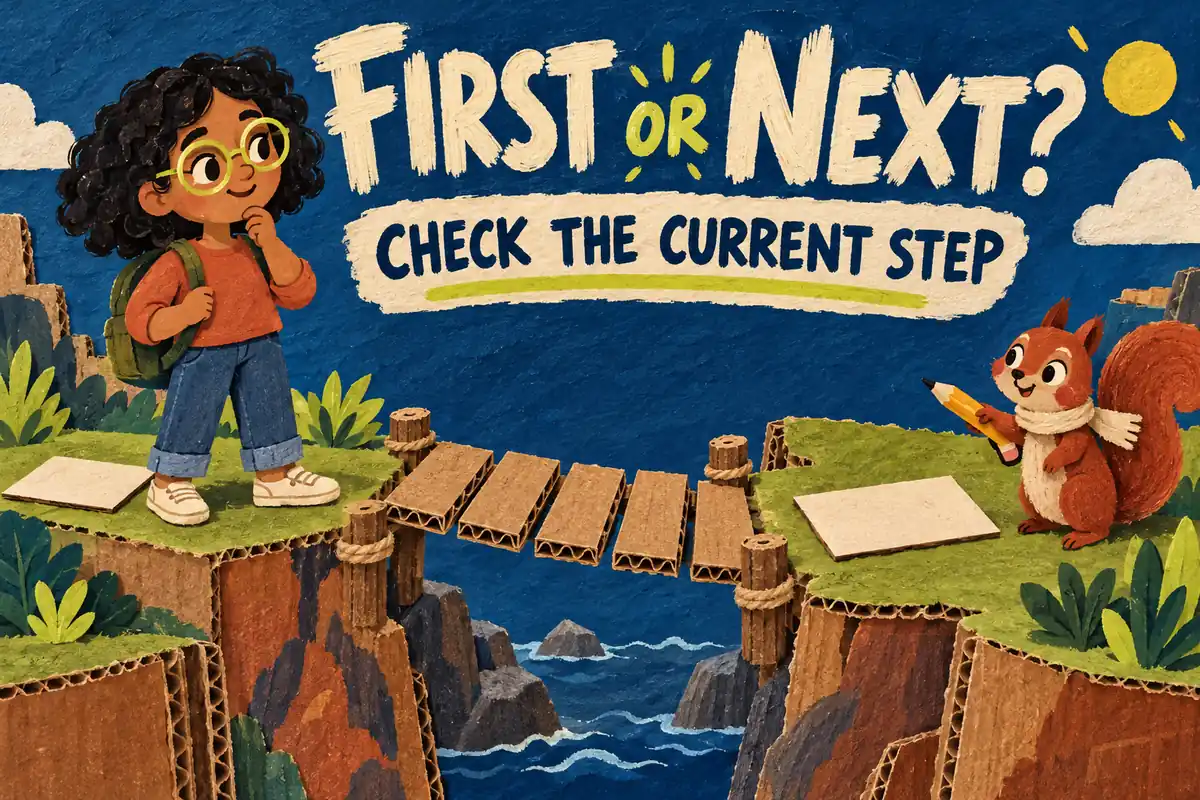
When reading an ASWB FIRST or NEXT prompt, identify the requested action and the point the situation has reached before choosing among the available responses. FIRST directs your attention to the beginning of the relevant sequence, while NEXT requires you to account for the actions and results already described in that particular situation.
The requested decision still requires professional knowledge. ASWB's launch notice describes an increased emphasis on applying professional knowledge through problem-solving and reasoning, and its guidebook landing page identifies the official guidebook as a resource for question structure and exam-category outlines. The worked booking timeline (CSV) below uses an invented reading-circle room booking to make the sequencing idea visible without a clinical case or practice question. No exam item is reproduced. Its rules belong only to this teaching example, and the blank reasoning record (CSV) lets you record your own reading process without copying a question or its answer choices.
Locate the requested action and its starting point
Read beyond the capitalized word to identify the action being requested and any limits on the decision. FIRST action, FIRST information to obtain and NEXT step after a stated result can direct attention to different parts of a problem, even when the surrounding subject sounds familiar.
Then separate events that have happened from actions being considered. Keep proposed actions in a separate part of your notes. If a passage says someone plans to contact a person, your reading notes should retain that as a plan, while an explicit completed contact and its stated result belong in the history you must account for. You can capture that difference with a few private notes rather than rewriting the passage.
Mark the stated facts. Add the requested decision, any completed actions and a relevant unresolved point, then check whether your preferred response relies on a detail that was never supplied or a result that has not occurred.
Follow one nonclinical sequence through its current state
Our fictional reading-circle organizer uses a venue with an author-created booking procedure, requiring permission to use the space before checking a suitable slot. A suitable slot must then have its access arrangements confirmed before a booking is finalized, and invitations wait until that booking confirmation has been received. These dependencies define this example only. They are not social-work practice rules.
The worked timeline records permission and slot availability as completed, access arrangements as unverified, booking as not started and invitations as held, with a separate dependency column explaining why each later action is waiting. At the beginning, permission is the first unresolved dependency under the invented procedure. At the recorded current stage, it is complete. The next unresolved check concerns access arrangements for the available slot, so jumping straight to invitations would assume both the access confirmation and a finalized booking that the timeline does not supply.
| Stage | State | Timing |
|---|---|---|
| Venue permission | Completed | Before slot |
| Suitable slot | Completed | Before access |
| Access check | Unverified | Before booking |
| Booking | Not started | Before invites |
| Invitations | Held | After booking |
Use completed actions without freezing the situation
A NEXT prompt can require you to use information obtained from an earlier step, so restarting the sequence automatically may disregard a result the passage deliberately supplied. Check what was completed. Also check whether that result is still relevant to the current facts, because completion by itself does not guarantee that circumstances remain unchanged.
Suppose our organizer learns that the previously available room is no longer offered for that date. The slot check is unresolved again, so the earlier completed availability check cannot support finalizing that room's booking, and the original dependency list helps explain why an earlier step needs attention. This change is written into a separate changed-fact record (CSV) rather than silently added to the original case. Compare the two records. The difference shows how a stated new fact can change the current stage, while an imagined closure, missing permission or extra venue policy would introduce information that neither original record supplied.
Distinguish the kind of decision before applying a sequence
Sequencing helps you account for actions already taken, but an item can ask for a different kind of judgment. Read the requested result again. A request for the best explanation or most likely interpretation cannot be answered merely by choosing the earliest action in a memorized list, and a familiar topic does not settle the question's purpose.
Avoid fixed answer positions. In social-work study, keep immediate safety considerations, assessment of the stated situation and selection of an intervention distinguishable in your reasoning. The supplied facts, the role involved and the actual request determine the analysis, so the presence of an assessment option alone does not establish that it answers every FIRST or NEXT prompt.
Ask a qualified instructor when unsure. When an explanation depends on professional knowledge you cannot justify, record that knowledge gap for review rather than treating a task word as a substitute for it.
Review your explanation without inventing a hidden fact
After working with study material you are authorized to use, compare your reasoning with its supplied explanation and identify the point where the two diverge. The blank file has separate fields for the requested decision, stated facts, completed actions, unresolved dependency and any assumption you added, followed by a place to record the concept that needs review.
Preserve the source reference privately. If your reasoning starts with a fact absent from the material, remove that assumption and reconsider the request using the stated situation. This blank record asks for your own paraphrase of the reading issue and a source location, not copied question text, answer choices or a reconstructed exam item.
Mark that distinction explicitly. A mismatch can also reveal a knowledge gap rather than a reading error. For example, misunderstanding which action was completed calls for checking the wording, while being unable to explain a relevant professional principle calls for content study, and neither diagnosis establishes readiness or predicts a passing score.
Take the unresolved point into your next study session
Use one audit row to decide what to revisit in your next session, then add the result after you have checked it. Leave the result blank until then. The worked booking files are narrated teaching records rather than a scored drill, and the blank file's review date and observed learning result remain empty for you to complete.
The official guidebook landing page offers the route to exam-category outlines, references and preparation information, while our ASWB Clinical study hub identifies Clinical study resources. Bachelors, Masters and Advanced Generalist candidates should use their own category's official preparation guidance, and any unresolved professional reasoning should go to a qualified social-work instructor.
2027 preparation edition. Public informational sources checked October 12, 2026. FIRST/NEXT explanations and booking records are author-created reading instruction, not an official scoring algorithm, clinical advice or exam questions. No guidebook PDF, worksheet or linked assessment was inspected. The current exam emphasizes applied knowledge. The internal hub covers Clinical only. Qualified social-work instruction remains necessary for substantive professional decisions. Current-source and live checks required before release.

Related to This Article
More math articles
- Mexican American and Asian American Citizenship and Resistance
- Public opinion’s influence on officials
- Heat, Temperature, and Pressure
- Commerce Clause
- PPE, Bloodborne Pathogens, Sharps, and Area Safety
- Infinitely Close But Never There
- How to Find Missing Angles of Triangles
- The Best Grade 8 Math Book for California Students
- How to Use Area Models to Find Equivalent Fractions
- Top Proven Strategies To Increase Your SAT Math Score

















What people say about "ASWB First vs Next Questions: Read the Decision the Item Asks For (2027 Prep)"?
No one replied yet.