Social Darwinism, the Gospel of Wealth, and Their Critics
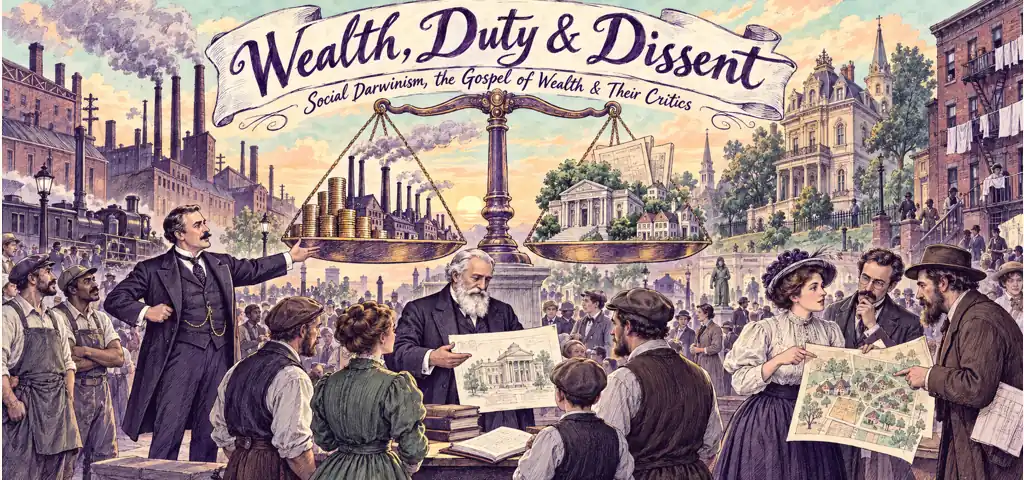
Chapter 3 of the CLEP History of the United States II study guide on Effortless Math covers Social Darwinism, the Gospel of Wealth, and Their Critics: the key terms, the core ideas, and worked examples showing how this topic is tested on the exam.
CLEP History of the United States II, Chapter 3
Industrial inequality seeks an explanation
By the 1880s, enormous fortunes stood beside tenements, unstable wages, and industrial injury. Americans argued about how wealth was distributed but about what that distribution meant. Some treated economic success as evidence of ability and competition as a source of progress. Others defended wealth only if its holders used it for public improvement. Critics blamed land monopoly, unregulated competition, inherited privilege, or wasteful consumption and proposed reforms ranging from a single tax to cooperative commonwealth. These arguments mattered because an economic system gains durability through stories about justice, responsibility, and what government may properly do.
Social Darwinism transfers an analogy
British philosopher Herbert Spencer applied evolutionary language to social development and coined "survival of the fittest". In the United States, sociologist William Graham Sumner defended individual liberty, private property, and limited government while warning that aid to one group burdened the "forgotten man" who paid. The broad label Social Darwinism describes arguments that competition and unequal outcomes reflected natural development and that intervention might preserve the less fit. Not every defender of laissez-faire used biology, and Charles Darwin did not write a program for American industrial policy. The term joins related ideas but can become misleading if treated as one organized creed.
The Gospel of Wealth gives riches a duty
In his 1889 essay "The Gospel of Wealth", Andrew Carnegie accepted unequal accumulation as a product of industrial competition but argued that the millionaire should act as a trustee for society. Rather than leave vast fortunes to heirs or distribute money indiscriminately, the wealthy should administer surplus during their lifetimes for institutions that enabled self-improvement: libraries, universities, museums, and concert halls. Carnegie's doctrine defended the system that produced great fortunes while imposing a moral responsibility on their owners. It was paternalistic because donors, not democratic communities, decided what counted as beneficial use.
Social Darwinism and philanthropy are not identical
Both arguments could legitimize concentrated wealth, but they did so differently. A strict competitive defense might say inequality is a natural and useful outcome that government should not disturb. The Gospel of Wealth said concentration improved production yet created an obligation to return surplus wealth through carefully managed philanthropy. One emphasized noninterference; the other celebrated private social intervention by elites. Neither required workers to possess greater control over firms or taxation to redistribute fortunes. A test question may place them together as defenses of industrial capitalism, but a strong comparison retains this difference in moral duty.
Success literature offered a moral defense
Horatio Alger's popular stories followed disadvantaged young men whose honesty, persistence, and fortunate encounter with a benefactor opened a path to respectability. They celebrated character and mobility, not a statistical claim that every poor person became a millionaire. Russell Conwell's lecture "Acres of Diamonds" likewise told listeners that opportunity might lie close at hand and defended acquiring wealth by providing useful goods or services. Conwell paired this opportunity message with an obligation to use wealth well. These narratives made inequality appear open to individual effort, whereas Social Darwinism emphasized competition and Carnegie emphasized elite stewardship after accumulation.
Reform thinkers assigned institutions a role
Charlotte Perkins Gilman argued in Women and Economics (1898) that women's dependence grew from a household structure that denied them independent economic standing; paid work and the social organization of domestic tasks could expand autonomy. Economist Richard T. Ely, a founder of the American Economic Association in 1885, rejected an automatic laissez-faire order and treated the state as a potentially positive instrument for education, labor reform, infrastructure, and regulation. In "The Moral Equivalent of War" (1910), William James sought the discipline and civic solidarity associated with military service through demanding nonwar national service rather than combat. These proposals addressed gender dependence, public economic capacity, and civic character, respectively.
Henry George targets unearned land value
In Progress and Poverty (1879), Henry George asked why poverty persisted amid material progress. He argued that rising land values allowed owners to capture socially created wealth through rent. His proposed "single tax" on the unimproved value of land would recover that value for public use while leaving productive labor and capital less burdened. George did not advocate government ownership of every factory or equal division of all property. His popularity showed that criticism of inequality could operate inside a language of markets, opportunity, and anti-monopoly rather than requiring revolutionary socialism.
Bellamy and Ward imagine deliberate cooperation
Edward Bellamy's novel Looking Backward (1888) pictured a future in which a cooperative national organization replaced competitive capitalism and distributed goods more equally. Bellamy clubs formed to discuss the vision. Lester Frank Ward, especially in Dynamic Sociology (1883), rejected the claim that society should simply submit to natural competition. Human intelligence, education, and government could deliberately improve social conditions. Their remedies differed, but both challenged fatalism. If institutions had been made by people, people could redesign them; inequality was not proof that nature had issued a final verdict.
Veblen examines status consumption
Thorstein Veblen's The Theory of the Leisure Class (1899) analyzed how elites displayed status through "conspicuous consumption" and conspicuous leisure. Expensive goods could be valuable socially because they signaled that the owner could afford waste, not because they met practical needs. Veblen's dry, satirical analysis challenged the idea that all consumption revealed rational utility or moral worth. His target differed from George's land rent and Bellamy's competitive system. Together the critics demonstrate intellectual variety: they diagnosed ownership, social organization, planning, and culture at different levels.
Philanthropy still depended on public institutions
Carnegie usually offered a community money for a library building only after local authorities supplied a site and promised continuing tax support, often equal to roughly one-tenth of the construction grant each year. The arrangement joined private capital to public maintenance. It spread free libraries and it shows why philanthropy was not simply a private substitute for government: residents paid to staff, heat, and stock the institution after the donor financed the structure. The condition fits Carnegie's preference for institutions that enabled self-improvement while revealing the local choices and recurring costs hidden by the word "gift".
identify the premise
Suppose a passage says that "the man of wealth" should fund libraries rather than leave his fortune to heirs.
A distinction between description and justification
Saying that competition occurred describes a process; saying that its winners deserved wealth justifies an outcome. Industrial defenders often moved between those claims without proving the second. Critics similarly differed between diagnosing harm and specifying a remedy. Chronology helps: George wrote in 1879, Ward in 1883, Bellamy in 1888, Carnegie in 1889, and Veblen in 1899. A common misconception labels every wealthy philanthropist a Social Darwinist or every critic a socialist. Instead, ask three questions: What caused inequality? Who should act? Does the remedy preserve private control, tax a particular source, plan cooperatively, or expose a cultural value?
Watch the history in motion
This short lesson adds voices, images, and chronology to the ideas you just studied.
Video: APUSH Review: Video #41: Social Darwinism And Criticisms Of Capitalism, Adam Norris.
Try four CLEP-style questions
- A speaker argues that useful service can create wealth and that ordinary Americans should look for opportunity close to home. Which interpretation best distinguishes this claim from a strict Social Darwinist defense?
- It morally links service and attainable opportunity to success.
- It treats inherited rank as the only legitimate source of wealth.
- It locates all economic outcomes in biological heredity.
- It demands national ownership of industry rather than individual enterprise.
- It assigns trustees control of every competing corporation.
- A town accepts Carnegie money for a library building after providing a site and promising annual tax support. What does the arrangement best demonstrate?
- The gift transferred all future decisions and expenses to the donor.
- The town adopted Henry George's land-value tax as its only revenue.
- A private construction grant depended on continuing local public support.
- The library operated as a profit-making industrial trust.
- Private philanthropy eliminated the need for a public institution.
- Which reform would most directly follow Charlotte Perkins Gilman's diagnosis in Women and Economics?
- Taxing only the unimproved value of urban land
- Expanding paid work and reducing women's compulsory household dependence
- Replacing competitive firms with Bellamy's single national organization
- Preserving inequality while funding donor-selected libraries
- Using luxury consumption to display exemption from productive labor
- An advertisement praises an expensive object mainly because owning it proves that the buyer can afford waste. Which critic supplies the most direct framework for analyzing the appeal?
- William Graham Sumner
- Horatio Alger
- Thorstein Veblen
- Richard T. Ely
- William James
Check your answers and reasoning
Independent preparation. CLEP is a registered trademark of the College Board, which does not endorse this lesson.

Related to This Article
More math articles
- Colorado CMAS Grade 7 Math Worksheets: 95 Free Skill-Focused PDFs with Answer Keys
- Free Grade 4 English Worksheets for Texas Students
- The Expansion of Voting Rights in the United States
- 10 Most Common TABE Math Questions
- Input-Output Tables for 5th Grade: Find the Rule
- 6th Grade M-STEP Math Worksheets: FREE & Printable
- Protests
- Free Grade 3 English Worksheets for Iowa Students
- The Best Grade 3 Math Book for Indiana Students
- The Anatomy of a Paragraph





















What people say about "Social Darwinism and the Gospel of Wealth"?
No one replied yet.