Carnegie, Rockefeller, Morgan, and Business Consolidation
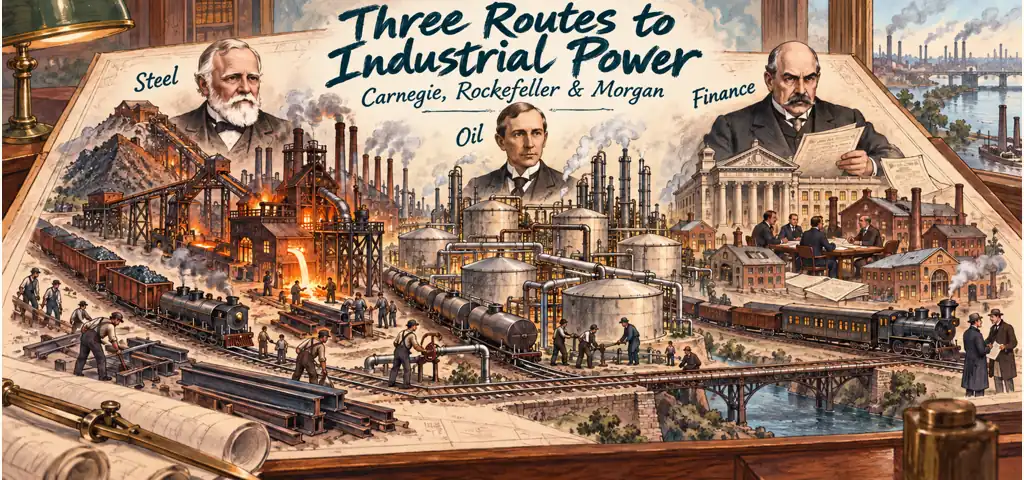
Chapter 3 of the CLEP History of the United States II study guide on Effortless Math covers Carnegie, Rockefeller, Morgan, and Business Consolidation: the key terms, the core ideas, and worked examples showing how this topic is tested on the exam.
CLEP History of the United States II, Chapter 3
Three names, three business roles
Andrew Carnegie, John D. Rockefeller, and J. Pierpont Morgan became symbols of industrial concentration, but they did not perform the same economic function. Carnegie built an integrated steel producer. Rockefeller organized oil refining and distribution into Standard Oil. Morgan used investment banking to finance, reorganize, and combine corporations. Their careers show three routes to power: production efficiency and vertical control, horizontal consolidation joined to logistical control, and financial coordination of existing enterprises. Reducing them all to "robber barons" or "captains of industry" turns a historical question into a slogan. The evidence supports mixed judgments because efficiency, coercion, innovation, and market control coexisted.
Carnegie's steel system
Carnegie entered steel after experience in railroads and telegraphy. His firms adopted improved Bessemer and open-hearth methods, continuously reinvested in newer plants, tracked costs closely, and pushed managers to raise output. Carnegie Steel integrated iron ore, coal and coke, transportation, and mills, reducing dependence on outside suppliers. Pittsburgh's access to rivers, rail, coal, and markets helped. The resulting scale lowered production costs, but labor bore severe pressure. At Homestead in 1892, Carnegie's manager Henry Clay Frick fought the Amalgamated Association, locked out workers, and used Pinkertons; the union's defeat revealed the coercive side of efficient management.
Rockefeller consolidates refining
Rockefeller focused first on refining rather than drilling because refining offered opportunities for standardization and scale. Standard Oil bought rivals, negotiated secret railroad rebates and drawbacks, built pipelines and tank cars, marketed by-products, and imposed consistent quality. Competitors could sell, accept Standard stock, or face a firm with lower costs and superior transport terms. The 1882 trust unified control of corporations operating under different state charters. Standard's kerosene prices fell over time, but falling prices do not settle whether its tactics and market dominance were fair. Efficiency and exclusion are not mutually exclusive explanations of its rise.
Morgan reorganizes finance and management
Morgan's investment bank connected wealthy investors and European capital with U.S. Enterprises. In the troubled railroad sector, "Morganization" meant refinancing debt, reducing destructive competition, placing allied bankers on boards, and imposing centralized management. The process could rescue insolvent systems and make them more predictable, but it concentrated influence in a small financial network. Morgan was not primarily an inventor or factory operator. He exercised power by determining which combinations could obtain capital and by translating ownership claims into managerial control. Finance became an organizing force within industrial capitalism, not merely a service performed after production.
U.S. Steel marks a new scale
In 1901, Morgan assembled United States Steel after purchasing Carnegie's holdings and combining them with Federal Steel and other companies. The corporation was capitalized above one billion dollars, an unprecedented figure, and controlled extensive ore, transport, furnaces, and mills. Carnegie retired extremely wealthy; Morgan and associates created a corporation larger than any one entrepreneur could personally manage. U.S. Steel illustrates the merger wave around the turn of the century and the transition from founder-led firms to bureaucratic corporations. It also shows how vertical assets could be gathered through financial consolidation rather than built by one operator.
Machines and government orders could create markets
Industries consolidated through different mixes of technology and demand. James B. Duke leased Bonsack cigarette-rolling machines, which worked much faster and more cheaply than hand rollers. He combined lower prices, national advertising, premiums, and rival purchases to build the American Tobacco Company in 1890. Heavy industry followed another route. The late-1880s "New Navy" program offered large contracts for armor plate and gun forgings. As the main domestic buyer for that specialized output, the federal government induced Bethlehem Iron and Carnegie's Homestead works to buy costly equipment and develop expertise. One market began with a labor-saving machine and advertising; the other with a concentrated public purchaser.
Consolidation changes competition
Large firms gained economies of scale, bargaining power, brand reach, and the ability to survive price wars. They could spread research and marketing costs over many units and plan production across facilities. Consolidation also raised barriers to entry, reduced independent competitors, and gave executives greater power over railroads, suppliers, communities, and workers. Market dominance did not eliminate all competition: new technologies, foreign producers, substitute products, and regional firms remained. The better question is not whether competition vanished absolutely, but how the terms of competition changed when a few corporations controlled essential facilities, credit, or distribution.
match evidence to strategy
Consider three records: a steel ledger comparing cost per ton across mills; a refinery contract granting favorable railroad rates; and a bank agreement exchanging new bonds for control of a failing railroad.
Myth, philanthropy, and institutional history
Biographies matter because individual choices affected tactics, labor policy, and public image. They do not explain industrialization alone. Patents, natural resources, courts, corporations, workers, railroads, consumers, and public policy made these empires possible. Carnegie later endowed libraries and educational institutions; Rockefeller funded universities and medical research; such philanthropy had substantial effects but did not retroactively resolve disputes over how fortunes were accumulated. Chronologically, Standard's trust formed in 1882, Homestead erupted in 1892, and U.S. Steel appeared in 1901. The sequence moves from entrepreneurial consolidation toward enduring managerial and financial institutions.
Watch the history in motion
This short lesson adds voices, images, and chronology to the ideas you just studied.
Video: The Rise of INDUSTRIAL CAPITALISM [APUSH Review Unit 6 Topic 6] Period 6: 1865-1898, Heimler's History.
Try four CLEP-style questions
- A banker exchanges new bonds for a railroad's old debt and receives authority to place allied directors on its board. Which change most directly increases the banker's control?
- Ownership of the railroad's coal deposits
- A rebate granted to independent shippers
- A pool that leaves every manager fully autonomous
- Governance power attached to the financial reorganization
- A patent on locomotive machinery
- Why did Rockefeller's control of pipelines and favorable railroad terms strengthen Standard Oil?
- They lowered transport costs and disadvantaged independent refiners.
- They guaranteed independent refiners the same shipping rates, reducing incentives for consolidation.
- They made pipeline ownership less important by establishing uniform national railroad charges.
- They let Standard profit chiefly as a crude-oil producer without maintaining refineries.
- They shifted Standard's advantage from transportation to patents on oil-drilling machinery.
- Which comparison of Carnegie and Morgan is most accurate?
- Carnegie regulated interstate rates, while Morgan founded a labor union.
- Carnegie specialized in oil refining, while Morgan operated homesteads.
- Both men gained power only by inventing new machines.
- Both opposed the formation of U.S. Steel.
- Carnegie integrated steel production; Morgan financed corporate reorganizations and combinations.
- Which evidence best explains how James B. Duke turned a production innovation into corporate consolidation?
- He acquired iron mines so that tobacco growers could bypass railroads.
- He restricted cigarette sales to local stores to avoid economies of scale.
- He paired high-speed cigarette machinery with lower prices, national promotion, and purchases of competitors.
- He used Navy armor contracts as a substitute for consumer advertising.
- He organized independent producers into a pool without controlling their firms.
Check your answers and reasoning
Independent preparation. CLEP is a registered trademark of the College Board, which does not endorse this lesson.

Related to This Article
More math articles
- How to Write Equation of Parallel and Perpendicular Lines?
- Vetoes and veto overrides
- 4th Grade NHSAS Math Worksheets: FREE & Printable
- How to Motivate your Child to Learn Math?
- Other Topics Puzzle – Challenge 98
- ParaPro Math Practice Test Questions
- Top 10 3rd Grade IAR Math Practice Questions
- 10 Most Common 5th Grade Common Core Math Questions
- Algebra Puzzle – Critical Thinking 12
- How to Add and Subtract Fractions? (+FREE Worksheet!)




















What people say about "Carnegie, Rockefeller, Morgan, Consolidation"?
No one replied yet.