Corporations, Trusts, and Vertical versus Horizontal Integration
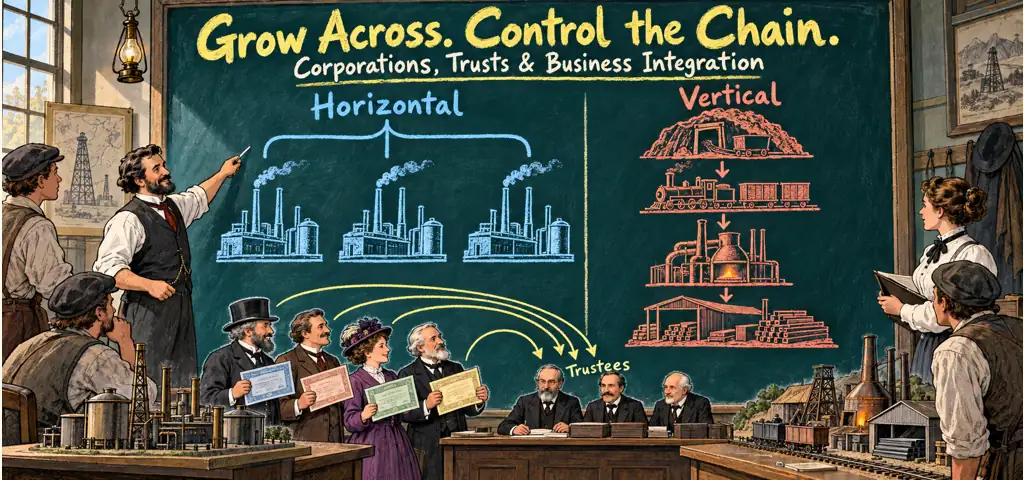
Chapter 3 of the CLEP History of the United States II study guide on Effortless Math covers Corporations, Trusts, and Vertical versus Horizontal Integration: the key terms, the core ideas, and worked examples showing how this topic is tested on the exam.
CLEP History of the United States II, Chapter 3
Why size required a legal structure
A steel mill or national railroad required more money and continuity than one owner or partnership could easily provide. A corporation was a legal entity that could own property, make contracts, sue, borrow, and continue beyond the lives of individual investors. It raised capital by selling shares and usually protected shareholders with limited liability: an investor risked the investment rather than all personal property for corporate debts. State charters and general incorporation laws defined these powers. The corporate form did not automatically create monopoly. It created a durable vehicle capable of gathering capital and separating ownership from day-to-day management.
Managers coordinate complex firms
As businesses acquired plants, sales offices, rail connections, and thousands of employees, salaried managers developed departments for purchasing, production, accounting, marketing, and personnel. Information moved up and commands moved down a hierarchy. Professional management allowed owners dispersed across the country to invest without operating the enterprise personally. It also created an agency problem: managers might pursue goals different from shareholders, workers, or consumers. The rise of the managerial corporation changed the meaning of business leadership from supervising one shop to coordinating flows of materials, money, labor, and data across multiple units.
Horizontal integration controls a stage
Horizontal integration joins firms performing the same stage of production. An oil refiner acquiring competing refineries is the classic example. The strategy can create economies of scale, spread fixed costs, standardize output, and reduce duplicated facilities. It can also remove competitors, strengthen control over prices, and increase bargaining power over suppliers and railroads. A horizontal merger does not mean the firm owns its raw materials or retail outlets; it means it expands across the same level. The exam often tests this geometry. Think of a row of competitors becoming one larger unit.
Vertical integration controls the chain
Vertical integration links different stages of one production and distribution process. A steel company might own iron mines, coal fields, coke ovens, rail transport, furnaces, and sales operations. Coordination can reduce transaction costs, ensure supplies, control quality, and protect production from outside price shocks. It also requires large capital and managerial capacity and can shut independent suppliers out of important channels. Think of a column extending from raw material downward to final sale. A firm can pursue both vertical and horizontal strategies, so the labels describe relationships among units rather than permanent identities of companies.
Pools and cartels are agreements, not one company
Competing firms sometimes formed pools or cartels, agreeing to divide markets, set rates, or limit output while remaining legally separate. Railroad pools attempted to stabilize destructive rate competition, but members had incentives to cheat by secretly discounting. Courts often refused to enforce such agreements, and the Interstate Commerce Act later prohibited railroad pooling. A pool differs from a merger because ownership remains separate. This weakness encouraged stronger structures that placed control in fewer hands. The historical sequence is not perfectly linear, but failed cooperation often pushed business leaders toward legal consolidation.
The trust concentrates control
In the Standard Oil trust agreement of 1882, stockholders in participating corporations transferred their shares to a small group of trustees and received trust certificates. The companies remained legally distinct, but trustees exercised unified control. "Trust" soon became a popular term for many large combinations, even when their legal forms differed. States and courts challenged some trusts, and New Jersey's permissive corporation law helped make the holding company an alternative. A holding company owned enough stock in other corporations to control them. Trust and holding company are therefore related consolidation devices, not exact synonyms.
Later corporations separated ownership from control
The great merger wave from 1895 to 1904 primarily combined competitors within one industry. As share ownership spread, Adolf Berle and Gardiner Means argued in 1932 that salaried managers could control large corporations even while owning little stock themselves. That separation of ownership from control raised questions about whom executives served. Many mergers of the 1960s then produced conglomerates: one parent acquired businesses in unrelated industries, partly because antitrust policy made direct-competitor mergers harder. A conglomerate diversified; it did not simply repeat horizontal or vertical integration.
draw the business map
Suppose Firm X buys three rival refineries and then purchases pipelines and retail distributors.
Efficiency and power belong in the same analysis
Large combinations could lower unit costs, stabilize supply, fund research, and deliver uniform products. Consumers sometimes benefited from lower prices. Yet a company with market power could discriminate among buyers, block entry, influence lawmakers, dictate terms to suppliers, or later raise prices. "Big" is not identical to "monopolistic," and low prices do not prove fair competition. The important question is structure and conduct: how much of the market did a firm control, how did it gain that position, what efficiencies resulted, and what alternatives remained? Those questions drove the emerging antitrust debate of the 1880s and 1890s.
Watch the history in motion
This short lesson adds voices, images, and chronology to the ideas you just studied.
Video: The Rise of INDUSTRIAL CAPITALISM [APUSH Review Unit 6 Topic 6] Period 6: 1865-1898, Heimler's History.
Try four CLEP-style questions
- A manufacturing partnership needs a legal structure that can keep its property and contracts intact when individual owners die or sell their interests. Which feature of incorporation most directly answers that need?
- A pool's agreement to divide markets
- A trust's transfer of voting shares to trustees
- The corporation's existence as a continuing legal entity
- Vertical ownership of suppliers and distributors
- A tariff that raises the price of imported goods
- Why might a manufacturer pursue vertical integration?
- To preserve every supplier as an independent competitor
- To avoid coordinating transportation and inventory
- To divide markets informally without acquiring assets
- To control supplies and distribution across production stages
- To eliminate the need for managerial organization
- Which statement correctly compares a pool with a trust?
- A pool coordinates separate firms; a trust centralizes control in trustees.
- A pool controls raw materials, while a trust applies only to retailers.
- Both terms describe individual household businesses.
- A pool joins firms under one owner, while a trust prohibits coordination.
- Both structures were created by the Homestead Act.
- In the 1960s, a corporation that already made electrical equipment buys a rental-car company and a food processor. The acquisitions are best classified as
- a pool among legally separate competitors
- vertical integration of one production chain
- a trust limited to a single product market
- conglomerate diversification across unrelated industries
- horizontal integration at one stage of production
Check your answers and reasoning
Independent preparation. CLEP is a registered trademark of the College Board, which does not endorse this lesson.

Related to This Article
More math articles
- The Best Grade 4 ELA Practice Tests for Colorado Students
- DNA, Genes, and Chromosomes
- Shop Safety, PPE, and First Checks
- Word Problems Involving Comparing Ratio
- Why Inequality Persists
- How to Use Right-Triangle Trigonometry
- What Is a Good ALEKS Score?
- Best Note-Taking Tablet for College Students
- Why Math Matters in Your Future IT Career?
- What Topics Are Covered in Algebra 1?


















What people say about "Trusts, Vertical and Horizontal Integration"?
No one replied yet.