The Second Industrial Revolution and the National Market
Chapter 3 of the CLEP History of the United States II study guide on Effortless Math covers The Second Industrial Revolution and the National Market: the key terms, the core ideas, and worked examples showing how this topic is tested on the exam.
CLEP History of the United States II, Chapter 3
A different scale of production
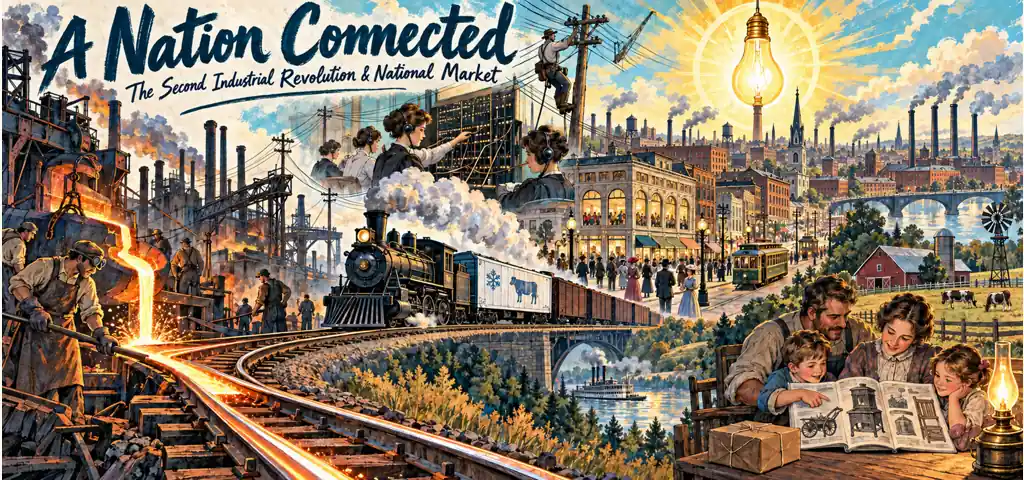
A city street in 1900 carried evidence of an industrial transformation: steel-framed buildings, electric lights, telephone wires, streetcars, factory-made clothing, and food shipped in refrigerated cars. Industrialization had begun well before the Civil War, but the decades after 1865 brought a Second Industrial Revolution marked by heavy industry, large-scale enterprise, applied science, and national distribution. Steel, petroleum, electricity, chemicals, and communications joined railroads as leading systems. The change was not simply "more factories". It involved new energy sources, materials, management, finance, and networks that allowed firms to produce standardized goods in extraordinary volume.
Steel becomes infrastructure
The Bessemer converter blew air through molten iron, burning away carbon and other impurities. Later open-hearth methods gave producers more control. Together they lowered costs and made steel more consistent. Railroads consumed steel rails, cities raised steel-framed buildings, and machine makers used it for tools, wire, and equipment. Production also depended on coal, iron, transport, engineers, workers, and investors willing to finance costly plants. Cheap steel then supported heavier locomotives, longer bridges, and taller buildings. Safety elevators made upper floors commercially useful. The relationship ran both ways: railroads created demand for steel, while stronger steel increased railroad capacity and durability.
Oil and electricity reorganize daily life
Petroleum refining first grew around kerosene for light and lubrication; the internal-combustion economy later made gasoline central. Electrical innovation moved from devices to systems. Generators, wires, switches, meters, lamps, and stations had to work together. At Menlo Park, Thomas Edison organized paid machinists, chemists, draftsmen, and experimenters instead of working as a lone tinkerer. His Pearl Street station began serving part of New York City in 1882. Alternating-current networks later carried power farther. Electricity extended working and shopping hours, powered streetcars and factory machinery, and reshaped cities. An invention mattered economically only when infrastructure, capital, standards, and customers turned it into a dependable service.
Communication compresses distance
The telegraph already moved messages faster than people. Alexander Graham Bell's 1876 telephone patent added live voice communication. When key Bell patents expired in 1893-1894, independent companies multiplied and built exchanges in towns the Bell system had overlooked. Competition widened access, though rival networks did not always connect. Typewriters, adding machines, and improved printing expanded clerical work. Managers coordinated orders, inventories, prices, and train movements across several locations. Networks did not erase geography; they lowered the cost of distance. A Chicago wholesaler could answer a distant retailer without waiting for mail, a dispatcher could direct traffic across a rail division, and financial markets could react to news from another region.
Mass distribution creates national consumers
Railroads and telegraphs connected producers, wholesalers, and retailers. Refrigerated cars let Chicago packers ship dressed beef instead of live cattle. Each car carried more saleable meat because shippers no longer moved hooves, hides, and other waste or fed animals during the trip. Grain elevators standardized commodities, while branded packages promised consistency. Montgomery Ward and Sears catalogs reached rural households; department stores gathered many products under one urban roof. Advertising built national brand recognition. This system widened choice and sometimes lowered prices through scale, but it weakened some local producers and tied households to distant firms. A national market meant connected decisions and distribution, not identical regional experiences.
Why the United States industrialized rapidly
No single cause is sufficient. The country possessed coal, iron, oil, timber, and agricultural supplies; a growing population and expanding cities created consumers and workers; immigration added labor and skills; patents and technical education encouraged invention; corporations and banks mobilized capital; and public policy supplied tariffs, land, contracts, and transport infrastructure. Managers exploited economies of scale, lowering average costs when expensive plants produced large quantities. These advantages were uneven. Capital-intensive firms gained power over smaller competitors, industrial regions grew faster than others, and workers bore injury, pollution, long hours, and unstable employment. Growth and inequality were parallel outcomes of the same system.
interpret an output table
Suppose a table shows steel output rising sharply between 1870 and 1900 while average rail prices fall and track mileage expands.
Chronology and a fundamental distinction
Use a few dates to order the change: the transcontinental railroad in 1869, Bell's telephone patent in 1876, Edison's Pearl Street station in 1882, the Wright flight in 1903, Taylor's Principles of Scientific Management in 1911, and Ford's moving assembly line in 1913. Factories and railroads were not new after 1865; their scale, integration, and technical reach changed. Nor did lone geniuses create entire systems. Bell and Edison mattered, but laboratories, patent lawyers, investors, machinists, installers, and customers turned devices into networks. The Second Industrial Revolution reorganized institutions and work as well as machines.
Watch the history in motion
This short lesson adds voices, images, and chronology to the ideas you just studied.
Video: The Industrial Economy: Crash Course US History #23, CrashCourse.
Try four CLEP-style questions
- A city installs safe passenger elevators in several new commercial buildings but continues using load-bearing masonry walls. Which result is most likely?
- The change makes land value irrelevant to downtown construction.
- Elevators remove the need for structural framing or foundations.
- The buildings can rise indefinitely because vertical access determines structural strength.
- Steel producers lose demand because elevators perform the frame's load-bearing work.
- Elevators ease access, but masonry walls still limit economical height.
- An inventor patents an efficient electric lamp, but a city has no generating stations, distribution wires, meters, installers, or repair crews. What is the best prediction?
- The lamp will have limited effect until infrastructure makes electric service dependable.
- The patent alone will make electric service universal at once.
- Customers will receive electricity through the existing telegraph without new capital.
- The absence of a network will reduce the lamp's need for maintenance and standards.
- Competing power systems will disappear before any paying market develops.
- A national wholesaler used railroads to replenish stock and telegraph lines to revise orders after a price change. What distinction does this example best illustrate?
- Railroads standardized prices, while telegraphs standardized product quality.
- Railroads created consumer demand, while telegraphs eliminated regional markets.
- Railroads served only manufacturers, while telegraphs served only retailers.
- Railroads moved cargo; telegraphs sped the information coordinating it.
- Railroads reduced fixed costs, while telegraphs increased the weight of shipments.
- Steel output and railroad mileage rose together while the cost of durable rails fell. Which conclusion is most defensible from these trends?
- Railroad construction caused every increase in steel productivity.
- Railroad demand and cheaper steel plausibly reinforced each other.
- Falling material costs ended rate discrimination among shippers.
- Steel producers expanded independently of transport demand.
- The national market no longer required finance or management.
Check your answers and reasoning
Independent preparation. CLEP is a registered trademark of the College Board, which does not endorse this lesson.

Related to This Article
More math articles
- 10 Most Common 6th Grade SBAC Math Questions
- Utah Algebra 1 Free Worksheets: Printable Algebra 1 Practice, Answers Included
- 6th Grade MCAS Math FREE Sample Practice Questions
- Embark on Your ParaPro Math Mastery: Introducing the “ParaPro Math for Beginners” Companion eBook
- In-Depth Analysis of Vector Function Derivatives: Theory and Practical Applications
- The Ultimate PSAT Math Course (+FREE Worksheets & Tests)
- How to Find Fractional and Decimal Percentages
- The Best Grade 8 Math Book for Hawaii Students
- CLEP U.S. History I 034: Articles of Confederation and Western Lands
- Voting Rights Act of 1965






















What people say about "The Second Industrial Revolution"?
No one replied yet.