CLEP U.S. History I 034: Articles of Confederation and Western Lands
Lesson 7.2 of Chapter 7 of the U.S. History to 1877 study guide on Effortless Math covers CLEP U.S. History I 034: Articles of Confederation and Western Lands: the key terms, the core ideas, and worked examples showing how this topic is tested on the exam.
U.S. History to 1877 | Chapter 7 | Lesson 7.2
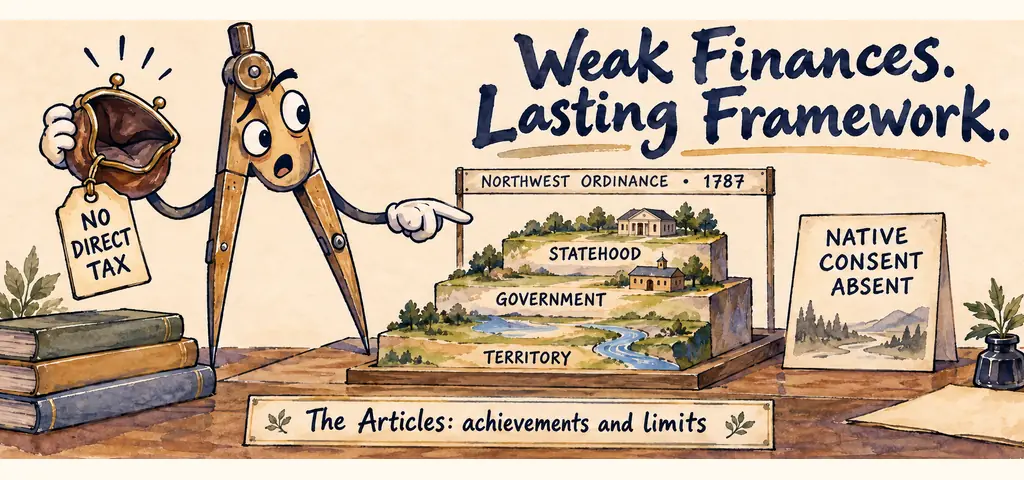
The Articles of Confederation, drafted during war and fully ratified in 1781, created a “league of friendship” among states. Each state had one vote in a one-house Congress. There was no separate national executive or general federal judiciary. Congress could conduct diplomacy, declare war, borrow, and request money, but it could not tax individuals directly or regulate interstate and foreign commerce. Major measures required nine states. Amendments required unanimity.
Those limits reflected revolutionary fear of centralized power, not simple incompetence. States retained sovereignty, and Congress depended on their cooperation. During war it struggled to finance the army, issuing depreciating paper and requisitioning funds that states often failed to supply. Afterward, it could negotiate treaties but not reliably compel states to honor them, giving Britain excuses to retain western forts.
The confederation achieved important western policy. The Land Ordinance of 1785 established a rectangular survey and a process for selling land, including provisions supporting schools. The Northwest Ordinance of 1787 created a territorial government and a path to equal statehood rather than permanent colonial status. Article VI prohibited slavery and involuntary servitude in the territory except as punishment for crime, yet its proviso authorized the return of people whose labor was lawfully claimed in an original state. Existing bondage, indenture evasions, fugitive claims, and uneven enforcement made the antislavery rule consequential but incomplete.
These ordinances also converted Native homelands into surveyed national property without Native consent. Congress’s state-making success was inseparable from settler expansion and war. The Articles were therefore neither a complete failure nor an adequate long-term system. They could organize territory and win diplomatic recognition, but could not reliably raise revenue or coordinate commercial policy.
See the history take shape
This Russell's History lesson supplies a second explanation of the same period. Note where chronology, cause, and perspective connect.
Video: Articles of Confederation and the Northwest Ordinance, Russell's History.
Check your understanding
- Under the Articles, Congress lacked direct power to
- borrow money on national credit
- declare war
- conduct diplomacy
- organize western territories
- tax individuals
- The Northwest Ordinance established
- continuing territorial dependence on the original states after population growth
- a staged path from territorial government to admission as an equal state
- federal recognition of Native sovereignty over the entire Northwest Territory
- territorial representation in Congress before the population thresholds were reached
- immediate statehood for settlements organized by western land companies
- Select all that apply. Features of the Articles included
- one state, one vote
- direct federal income tax
- no separate executive
- unanimous amendments
- one-house Congress
- Evaluate one achievement and one weakness of the Confederation Congress.
Write a brief response using a named fact from the lesson.
Open the answers and reasoning
Independent preparation. CLEP is a registered trademark of the College Board, which does not endorse this lesson.

Related to This Article
More math articles
- 7th Grade IAR Math Worksheets: FREE & Printable
- Joint committees
- Best Calculator For 11th Grade Students
- The Best Grade 5 Math Book for South Carolina Students
- How to Estimate Quotients Using Compatible Numbers for One-digit Divisors
- Top 10 STAAR Grade 8 Math Books: A Comprehenisve Review
- Number Properties Puzzle – Challenge 16
- How to Find Integers Equivalent Quotients
- Top 10 Tips to Overcome TExES Core Subjects Math Anxiety
- Free Grade 6 English Worksheets for Florida Students










What people say about "The Articles of Confederation and Western Lands"?
No one replied yet.