CLEP U.S. History I 035: Economic Crisis and Shays’ Rebellion
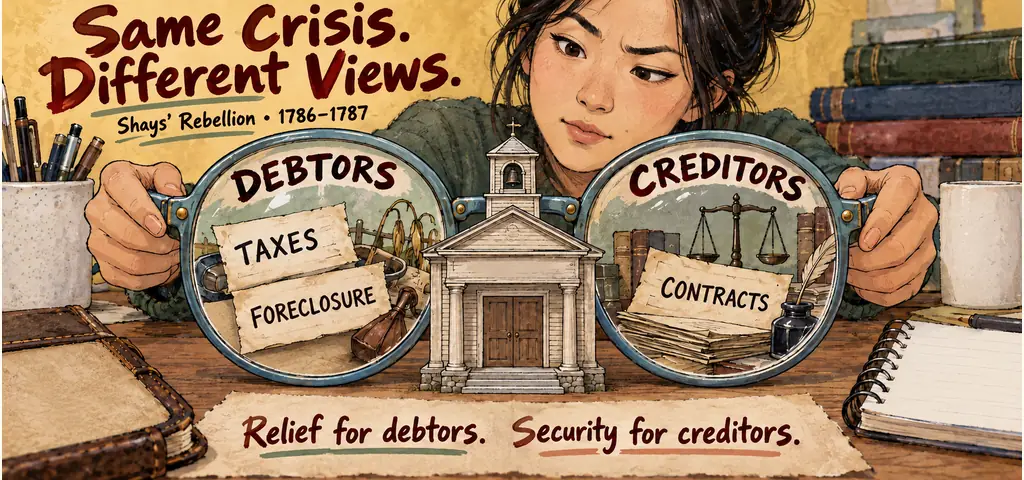
Lesson 7.3 of Chapter 7 of the U.S. History to 1877 study guide on Effortless Math covers CLEP U.S. History I 035: Economic Crisis and Shays’ Rebellion: the key terms, the core ideas, and worked examples showing how this topic is tested on the exam.
U.S. History to 1877 | Chapter 7 | Lesson 7.3
Peace brought commercial disruption rather than immediate prosperity. British markets restricted some American trade, imported goods competed with domestic producers, and wartime debt remained. States taxed residents to pay creditors. Hard currency was scarce, especially in rural districts where farmers traded largely through local credit. Debtors demanded paper money, tax relief, or delay. Creditors feared inflation and broken contracts.
Political conflict reflected real but unequal burdens. State securities purchased cheaply by speculators might be redeemed at full value through taxes collected from farmers. Coastal merchants and rural households experienced the same fiscal policy differently. Legislatures in some states issued paper money. Others, including Massachusetts, pursued hard-money taxation.
In 1786 and 1787, western Massachusetts farmers led by Daniel Shays and others closed courts to prevent foreclosures and debt proceedings. The movement used tactics familiar from pre-Revolutionary crowd politics and petitioning. Governor James Bowdoin’s government, supported by a privately financed force, defeated the insurgents near the federal armory at Springfield. Participants called themselves Regulators and defended revolutionary liberty. Opponents saw armed minority rule.
Nationalists used the rebellion as evidence that the confederation could not maintain order or protect property. George Washington and other elites became more willing to support reform. Yet exaggerating the rebellion’s danger served their political argument. Massachusetts itself suppressed it, and debtor grievances were not imaginary. Shays’ Rebellion mattered because competing definitions of republicanism: popular relief versus stable law and credit: became attached to the question of national power.
Watch, then test the claim
History Heroes traces the people and chronology behind this lesson. Listen for the evidence that sharpens the written account, then try the questions below.
Video: The Critical Period: The Articles of Confederation, Shays Rebellion, and Northwest Ordinance of 1787, History Heroes.
Check your understanding
- Western Massachusetts farmers closed courts chiefly to stop
- collection of federal customs duties
- ratification of interstate commercial treaties
- sale of federal western land
- debt and foreclosure proceedings
- payment of Continental Army pensions
- Nationalists used Shays’ Rebellion to argue for
- restoration of hereditary monarchy
- stronger national government
- cancellation of public and private credit
- renewal of parliamentary taxation
- replacement of written constitutions by legislative supremacy
- Select all that apply. Postwar distress involved
- hard-currency shortages
- state taxes
- universal prosperity
- trade disruption
- private debt
- Explain why debtors and creditors could give different republican interpretations of the same policy.
Write a brief response using a named fact from the lesson.
Open the answers and reasoning
Independent preparation. CLEP is a registered trademark of the College Board, which does not endorse this lesson.

Related to This Article
More math articles
- The Spanish-American and Philippine-American Wars
- Fifth-Grade Math in Missouri (MAP): 49 Free Printable Worksheets, One Concept Per Page
- 6th Grade STAAR Math Worksheets: FREE & Printable
- Top Ten Cameras for Classroom Recording
- Word Problems: Addition and Subtraction for 4th Grade
- CLEP U.S. History I 052: Implied Powers and Interstate Commerce
- The Ultimate ATI TEAS 7 Math Formula Cheat Sheet
- How to Interpret Scientific Data
- FTCE Middle Grades Math 5-9 Flashcards
- 8th Grade ACT Aspire Math FREE Sample Practice Questions










What people say about "Economic Crisis and Shays' Rebellion"?
No one replied yet.