CLEP U.S. History I 036: Constitutional Bargains and Slavery
Lesson 7.4 of Chapter 7 of the U.S. History to 1877 study guide on Effortless Math covers CLEP U.S. History I 036: Constitutional Bargains and Slavery: the key terms, the core ideas, and worked examples showing how this topic is tested on the exam.
U.S. History to 1877 | Chapter 7 | Lesson 7.4
Delegates meeting at Philadelphia in 1787 were authorized to revise the Articles but chose to propose a new government. The Virginia Plan favored representation by population and a strong national structure. Smaller states feared permanent domination. The Connecticut, or Great, Compromise created a House apportioned by population and a Senate with equal state representation.
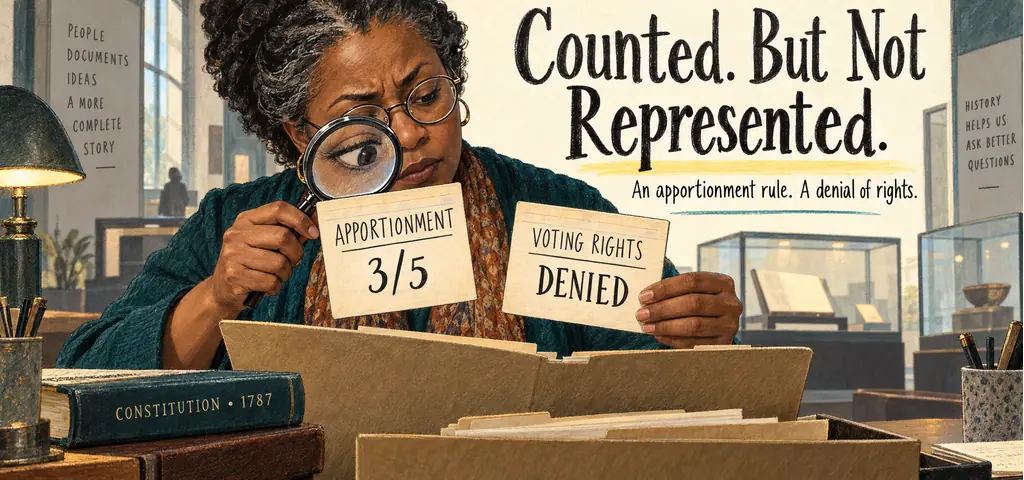
Slavery shaped representation, taxation, commerce, and political power. Southern delegates wanted enslaved people counted when allocating House seats, though those people could not vote. Opponents resisted. The Three-Fifths Compromise counted three-fifths of the enslaved population for representation and direct taxation. This did not say an enslaved person was “three-fifths human.” It was a political formula that increased slaveholding states’ representation while treating human beings as population controlled by enslavers.
Another bargain prevented Congress from prohibiting the international slave trade before 1808, while allowing a tax on importation. The fugitive slave clause required the return of people who escaped enslavement across state lines. The Constitution avoided the words “slave” and “slavery,” but protected the institution through these provisions. At the same time, it granted Congress power that could later be used against the international trade.
Compromise made agreement possible by distributing power and postponing conflict. Calling compromise necessary does not make every term morally neutral. Enslaved people had no seat at the convention, yet their stolen labor and political counting shaped the new government. The bargain strengthened a union in which antislavery and slaveholding interests would continue to struggle.
Watch the topic in context
Use this lesson from CrashCourse to review the period and its central historical problem. Pause when the video reaches the turning point named above.
Video: The US Constitution, 3/5, and the Slave Trade Clause: Crash Course Black American History #9, CrashCourse.
Check your understanding
- The Great Compromise created
- proportional representation in both chambers
- equal state representation in both chambers
- a unicameral Congress retaining one state, one vote
- proportional House and equal-state Senate
- a Senate apportioned by population and a House with equal state votes
- The Three-Fifths Compromise most directly increased
- House seats and presidential electors allocated to slaveholding states
- federal voting rights exercised by enslaved people counted for apportionment
- congressional authority to abolish slavery within individual states
- representation chosen directly by free Black and enslaved residents
- national voting rights for women in states that restricted the franchise
- Select all that apply. Constitutional protections for slavery involved
- immediate emancipation
- delayed trade prohibition
- apportionment counting
- political advantage for enslavers
- fugitive return
- Explain why the phrase “three-fifths of a person” misstates the compromise while still recognizing its injustice.
Write a brief response using a named fact from the lesson.
Open the answers and reasoning
Independent preparation. CLEP is a registered trademark of the College Board, which does not endorse this lesson.

Related to This Article
More math articles
- Weighted Average & GPA Calculator (Free)
- Understanding Betting Odds
- Purpose vs. Point of View
- Super PACs
- Fordism, Consumer Credit, and Weakness beneath the Boom
- Free Grade 3 English Worksheets Aligned to Common Core (CCSS)
- The Best Grade 7 Math Book for Arizona Students
- New Mexico NM-MSSA Third-Grade Math: 49 Free Printable Worksheets, Chapter by Chapter
- HiSET Math Practice Test Questions
- How to Graph the Sine Function?














What people say about "Constitutional Bargains and Slavery"?
No one replied yet.