CLEP U.S. History I 037: Federalism, Separation of Powers, and Republican Government
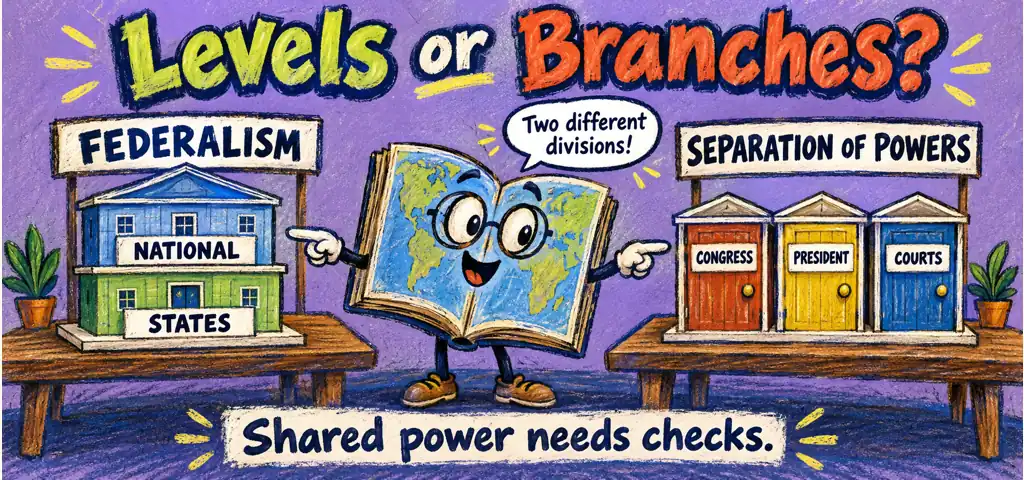
Lesson 7.5 of Chapter 7 of the U.S. History to 1877 study guide on Effortless Math covers CLEP U.S. History I 037: Federalism, Separation of Powers, and Republican Government: the key terms, the core ideas, and worked examples showing how this topic is tested on the exam.
U.S. History to 1877 | Chapter 7 | Lesson 7.5
The Constitution created a federal system: authority was divided between the national government and the states. The national government received enumerated powers including taxation, commerce regulation, war, diplomacy, and laws necessary and proper for carrying out its responsibilities. Federal law and treaties were supreme over conflicting state law within constitutional authority. States retained broad powers over property, criminal law, elections, and daily governance.
Separation of powers is a different division. Legislative power went to Congress, executive power to the president, and judicial power to federal courts. Checks and balances allowed each branch to restrain others: presidential veto, congressional impeachment and appropriations, Senate confirmation and treaty consent, and judges holding office during good behavior. The framers sought energy and restraint, not three isolated departments.
Representation filtered popular power. Voters directly elected the House, state legislatures originally selected senators, electors chose the president, and appointment produced federal judges. These layers reflected concern about sudden majorities as well as practical federal compromise. The Constitution was republican because authority ultimately rested on the people and representatives, but it was not a direct democracy.
The document also contained ambiguity. The necessary and proper clause and commerce power could support broad national action. Enumerated powers could support limits. No list could settle every future conflict. Institutions created arenas in which competing interests would interpret the Constitution. Its endurance came partly from structure and partly from amendment, political practice, judicial interpretation, and conflict.
A focused video lesson
CrashCourse offers a visual route through this topic. As you watch, compare its explanation with the source limits in the written lesson.
Video: Separation of Powers and Checks and Balances: Crash Course Government and Politics #3, CrashCourse.
Check your understanding
- Federalism divides authority between
- military and civilian officials
- two chambers of Congress
- executive and judicial branches
- voters and their representatives
- national and state governments
- Senate confirmation of appointments is an example of
- judicial review
- direct democracy
- checks and balances
- reserved state powers
- popular sovereignty alone
- Select all that apply. Enumerated national powers include
- taxation
- interstate commerce
- war
- unlimited authority over every local matter
- diplomacy
- Use one example to distinguish federalism from separation of powers.
Write a brief response using a named fact from the lesson.
Open the answers and reasoning
Independent preparation. CLEP is a registered trademark of the College Board, which does not endorse this lesson.

Related to This Article
More math articles
- The Best Grade 4 ELA Practice Tests for Rhode Island Students
- The Best Grade 8 ELA Practice Tests for New Hampshire Students
- A wage change creates substitution and income effects in labor supply
- Common Core Algebra 1 Free Worksheets: 64 Free Printable PDFs Aligned to CCSS Algebra 1
- 5th Grade K-PREP Math Worksheets: FREE & Printable
- How to Unravel the Essential Properties of Rectangles
- FREE 7th Grade MAP Math Practice Test
- Get Started Now: Build Your Test App Without Code in Hours
- Full-Length GED Math Practice Test
- Free Grade 6 English Worksheets for Utah Students




















What people say about "Federalism and the Separation of Powers"?
No one replied yet.