The Best Grade 3 Math Book for California Students
California is the largest and most varied state in the country, but third grade math arrives the same way for every eight- and nine-year-old in it. Third grade is the year math changes character. The addition and subtraction of the early grades give way to multiplication, division, and the first real fractions, and for a lot of California kids it is the first time math feels genuinely difficult.
It is also, in California, the first year of the state test. That combination of harder math and a brand-new test is why third grade deserves a parent’s attention. The reassuring part is that none of it is out of reach. With a clear book and a steady routine, a California third grader can meet this year with real confidence, and this guide walks through exactly how.
What third grade math covers in California
California teaches math through the California Common Core State Standards, and third grade math is assessed each spring through the CAASPP, the California Assessment of Student Performance and Progress. For most children, the CAASPP in third grade is the first standardized test they ever sit. That can make the year feel higher-stakes than it really is, but it is also a good reason to make sure the math underneath is solid.
The third grade course itself is a major step up from second grade. It covers multiplication and division within 100, fractions as numbers, place value and rounding, multi-digit addition and subtraction, area and perimeter, telling time, measurement, graphs, and the beginnings of geometry. The California standards ask for true understanding, not just memorized answers, and that is exactly where a clear, patient book helps most.
The third grade math topics that matter most
Third grade math is wide, but a handful of topics carry most of the year’s weight. Here is a closer look at what your California third grader will work on, and why each piece matters for the math that comes later.
Multiplication and division
This is the headline of third grade and the skill the whole year is built around. Children learn what multiplication actually means — equal groups, arrays, and repeated addition — and then work toward knowing every fact within 100 from memory by the end of the year. Division is taught right alongside it as the inverse operation, so the two reinforce each other. Almost every topic in later math, from multi-digit multiplication to fractions to algebra, leans on this foundation, which is why it is worth slowing down until it is truly solid rather than rushing ahead.
Fractions as numbers
Third grade is where fractions stop being just “a slice of pizza” and become real numbers with a place on the number line. Students learn to represent fractions, find equivalent fractions, compare two fractions, and recognize whole numbers written as fractions. This is one of the most important, and most rushed, topics in all of elementary math. A child who truly understands fractions in third grade carries a real advantage into every grade that follows, because fraction work only grows from here.
Place value, rounding, and larger addition and subtraction
Children round whole numbers to the nearest ten and hundred, and add and subtract fluently within 1,000 using strategies based on place value. This is the number sense that makes estimation, mental math, and checking your own work possible. It also keeps the arithmetic from first and second grade sharp, so those earlier skills do not quietly fade while the bigger new topics take center stage.
Two-step word problems
Third grade asks students to solve word problems that take two steps rather than one — for example, multiplying to find a total and then subtracting part of it. This is where reading, reasoning, and arithmetic all meet, and it is often the hardest part of the year for a child who can do the calculations but freezes at the wording. A clear book teaches a reliable way to break a word problem into smaller steps, which removes much of the fear and turns word problems into something a third grader can approach with confidence.
Area and perimeter
Area is introduced in third grade and connected directly to multiplication: counting the unit squares inside a rectangle is the same as multiplying its two sides. That connection is a real “aha” moment for many students. Children also measure perimeter, the distance around a shape, and begin to see how two shapes can share the same area but not the same perimeter. Together these topics turn multiplication into something a child can actually see and touch.
Patterns and the properties of operations
Third graders look for patterns in the addition and multiplication tables, and they start using the properties of operations — that the order of factors does not change a product, and that a harder multiplication can be broken into smaller, easier ones. These ideas are quiet, but they are a child’s first real taste of the kind of reasoning that becomes algebra later on, and a clear book makes them feel natural rather than abstract.
Time, measurement, and data
Third graders tell time to the nearest minute and solve elapsed-time problems, measure and estimate liquid volume and mass, and read and build picture graphs and bar graphs. These are the practical, everyday corners of third grade math, and they give a child plenty of chances to use the multiplication, division, and addition they are learning in situations that feel real.
Geometry and shapes
Students sort shapes by their attributes, look closely at quadrilaterals and what makes a square, a rectangle, or a rhombus, and partition shapes into equal parts. That last skill quietly reinforces fractions, because dividing a shape into four equal pieces is just another way of seeing one fourth. Geometry in third grade is hands-on, and it ties the year’s other topics together.
Signs your third grader is struggling with math
Third graders do not always announce “I do not understand.” More often it shows up in smaller, quieter ways. Here are the signs worth watching for:
- Multiplication facts that never seem to stick, even after weeks of exposure
- Counting on fingers for problems the class has long since moved past
- Homework that takes far longer than it should, or regularly ends in frustration
- Saying “I am just bad at math”, a worrying belief to form at age eight or nine
- Avoiding math, hiding worksheets, or going quiet whenever the subject comes up
- Getting the right answer but being unable to explain how they got there
If you are seeing a few of these, it is not a reason to panic, and it is almost never a sign your child cannot do math. It usually means one topic went by too fast and the next was built on top of it before the first had landed. The fix is calm and reliable: go back, explain that topic clearly, and practice it until it is genuinely easy.
The book we recommend for California third graders
For a California student working through third grade math, the book we recommend is California CAASPP Grade 3 Math Made Ridiculously Simple.
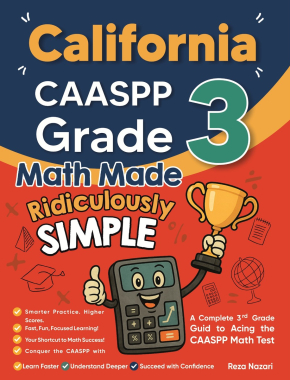
The book is built for understanding, not just for answers. Every topic opens with a clear explanation in plain language. Then a worked example shows each step in full, with nothing skipped. Then the student practices, with answer keys for immediate feedback. It explains the “why” behind multiplication, fractions, and the rest, which is exactly what the California standards reward.
Because the explanations are complete, the book teaches the student directly, with no tutor required. That makes it a strong resource for homeschoolers, for summer catch-up, and for any third grader whose class has moved ahead before a topic clicked.
Add the workbook for extra practice
The book builds understanding. A workbook builds fluency. We pair the Made Ridiculously Simple book with the California CAASPP 3rd Grade Math Workbook.
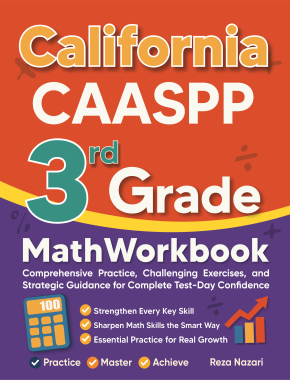
The workbook gives a student plenty of extra practice, organized by topic and aligned to the CAASPP. Multiplication facts in particular need repetition to become automatic, and the workbook is where that repetition happens. Once the book has explained a concept, the workbook is where it turns into second nature. Used together, they are a complete pair: one teaches, the other locks it in.
A week-by-week study plan
A plan turns good intentions into real progress. Here is a simple four-week cycle a California family can repeat through the school year or over the summer.
Week 1, Multiplication and division. Read each topic in the book, work the examples together, then practice in the workbook. Aim for half an hour, four times this week. This is the foundation, so do not rush it.
Week 2, Fractions. Move slowly. The number line and equivalent fractions take time to settle. Keep practicing a few multiplication facts each day so they do not slip while attention is elsewhere.
Week 3, Place value, rounding, and addition and subtraction within 1,000. These come quicker for most third graders, so use any spare time this week to revisit anything shaky from weeks one and two.
Week 4, Area, perimeter, time, measurement, data, and shapes. Finish the cycle with a mixed review from the workbook, so your child practices choosing the right method, not just repeating one.
Then repeat the cycle on whatever still feels hard. Most third graders need two or three passes through fractions and multiplication before those feel automatic, and that is completely normal.
How to study with them
A few simple habits make the book and workbook far more effective:
- Keep sessions short and regular. Half an hour, four or five times a week, beats one long weekend cram.
- Always learn from the book first, then practice the same topic in the workbook.
- Check answers as you go, so small mistakes get fixed while the topic is still fresh.
- Practice multiplication facts in tiny daily doses. Five minutes a day adds up remarkably fast.
- Do not move on until a topic feels easy, not just familiar.
When third grade is done, fourth grade math comes next. Our guide to the best Grade 4 math book for California students carries the same approach forward.
Questions California families ask
How is third grade math tested in California?
Third grade math is assessed each spring through the CAASPP. For most children it is the first standardized test they take, and the skills it checks lead straight into fourth grade.
Why is third grade math such a big jump?
It is the year multiplication, division, and fractions all arrive at once. Children move from adding and subtracting to a whole new way of thinking about numbers, and that shift catches many of them off guard.
My child cannot remember the multiplication facts. Is that normal?
Completely normal. Multiplication facts become automatic through short, frequent practice, not through pressure. A few minutes every day works far better than one long session a week.
Do I need both the book and the workbook?
They do different jobs. The book teaches each concept clearly; the workbook provides the repetition that makes it stick, which third grade math, with all its facts to memorize, especially needs. Together they are a complete pair.
Can my child use these without a tutor?
Yes. The book is written to teach the student directly, with self-contained explanations and answer keys, and the workbook is built for independent practice.
When should we start?
Whenever you notice a topic slipping is the right time. Many California families also use the summer before or after third grade to get ahead or fill gaps without the pressure of the school year.
How much time does this take?
About half an hour, four or five times a week. Third grade math rewards consistency far more than long hours.
My child says they are “bad at math.” What should I do?
Take it seriously, but do not accept it as fact. That belief almost always comes from one confusing stretch, not from real ability. A few early wins with a clear book usually turns it around.
Will this help with the CAASPP specifically?
Yes. The book and workbook are aligned to California’s standards and the CAASPP, so practicing the content is also practicing for the test, without it ever feeling like test prep.
The bottom line
California third graders face a real step up: multiplication, division, fractions, and their first state test, all in a single year. None of it is beyond them. California CAASPP Grade 3 Math Made Ridiculously Simple explains every topic clearly, and the matching workbook makes it stick. Get third grade right, and fourth grade begins on solid ground.

Related to This Article
More math articles
- CLEP U.S. History I 103: Presidential and Congressional Reconstruction
- Top 10 ALEKS Math Prep Books (Our 2023 Favorite Picks)
- Free Grade 6 English Worksheets for Mississippi Students
- ASTB Math Practice Test Questions
- How to Solve Systems of Equations: 3 Methods Explained
- Signals and screens build trust differently
- FREE 5th Grade MCAS Math Practice Test
- Cooley’s Looking-Glass Self
- Free Grade 3 English Worksheets for South Carolina Students
- 5th Grade MAP Math FREE Sample Practice Questions













What people say about "The Best Grade 3 Math Book for California Students"?
No one replied yet.