CLEP U.S. History I 100: Black Military Service and the Destruction of Slavery
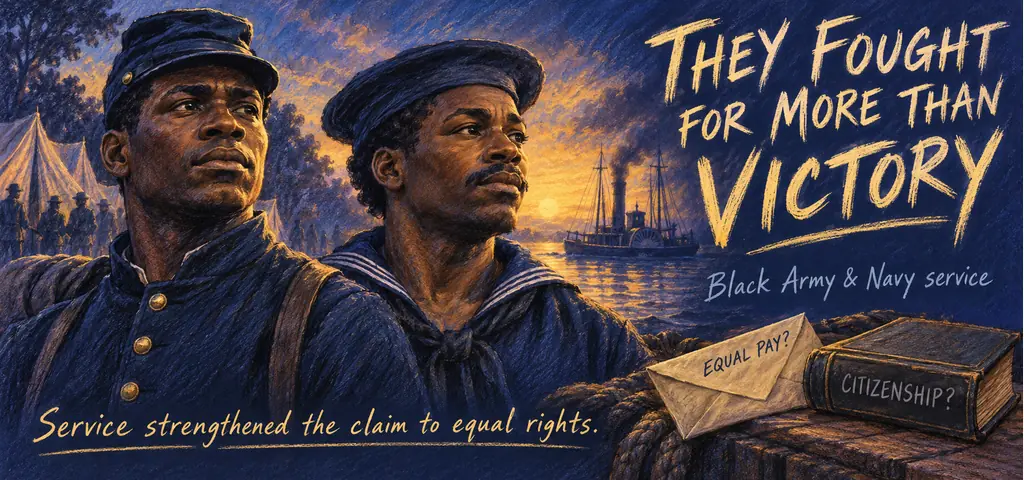
Lesson 18.5 of Chapter 18 of the U.S. History to 1877 study guide on Effortless Math covers CLEP U.S. History I 100: Black Military Service and the Destruction of Slavery: the key terms, the core ideas, and worked examples showing how this topic is tested on the exam.
U.S. History to 1877 | Chapter 18 | Lesson 18.5
Official wartime tabulations list approximately 179,000 Black men in the U.S. Army, and the Library of Congress summarizes Army and Navy service together as around 200,000. The naval component is commonly estimated near 20,000. These are overlapping ways to report the same broad mobilization, not two Army totals to add together. Many servicemen had escaped slavery. Others came from free communities. Service strengthened demands for citizenship and equal rights. Black troops initially received lower pay and faced discriminatory assignments. Confederate policy threatened captured Black soldiers and their white officers with enslavement or execution, and massacres such as Fort Pillow revealed the danger.
The 54th Massachusetts’s assault on Fort Wagner became a symbol of courage and sacrifice, but Black service was much broader than one regiment. Troops guarded supply lines, fought in major operations, occupied southern territory, and helped make emancipation irreversible. Their service joined military outcome to the postwar question: could a nation accept Black sacrifice while denying Black citizenship?
Pay equality illustrates how military and civic claims reinforced one another. Congress eventually equalized pay retroactively for many Black soldiers, but the rules governing eligibility reflected assumptions about prior freedom and service. Black troops and communities protested unequal treatment while continuing to fight. Their service supplied manpower, weakened Confederate labor control, extended Union authority, and created a documented claim that citizenship must follow sacrifice.
Modeled significance Do not key significance only to troop numbers. Black enlistment added manpower, undermined Confederate labor, asserted a claim to citizenship, and changed the war’s meaning.
Watch the topic in context
Bill of Rights Institute traces the people and chronology behind this lesson. Listen for the evidence that sharpens the written account, then try the questions below.
Video: Freedom, Protection, Pay, and a Call to Military Duty: African American Soldiers in the Civil War, Bill of Rights Institute.
Check your understanding
- Federal authorization for Black enlistment appeared explicitly in
- the Kansas-Nebraska Act’s territorial provisions.
- Lincoln’s final Emancipation Proclamation.
- the Supreme Court’s Dred Scott opinion.
- the fugitive-slave provisions of the Compromise of 1850.
- the boundary terms of the Oregon Treaty.
- Black soldiers’ wartime service most directly strengthened postwar claims to
- restoration of plantations to former Confederate owners.
- recognition of the Confederacy as an independent nation.
- longer naturalization periods for European immigrants.
- national citizenship and equal civil rights.
- state authority to require segregated public facilities.
- Select all barriers faced by Black troops:
- unequal pay,
- discriminatory assignments,
- Confederate threats,
- racist violence,
- complete exclusion after 1863.
- Explain two ways Black service weakened slavery.
Write a brief response using a named fact from the lesson.
Open the answers and reasoning
Independent preparation. CLEP is a registered trademark of the College Board, which does not endorse this lesson.

Related to This Article
More math articles
- Top 10 DAT Quantitative Reasoning Practice Questions
- Colorado Algebra 1 Free Worksheets: Printable Algebra 1 Practice with Full Solutions
- 5th Grade OSTP Math Worksheets: FREE & Printable
- Number Properties Puzzle -Critical Thinking 1
- Reading and Interpreting Bar Graphs for 4th Grade
- Studying Inequality Responsibly
- Marginal is not average or total
- What’s The Best Laptop for Online Teaching?
- ISEE Upper-Level Math Formulas
- The Role Played by Infinity in Limits




















What people say about "Black Military Service and the End of Slavery"?
No one replied yet.