CLEP U.S. History I 099: Soldiers, Civilians, Women, and the Home Fronts
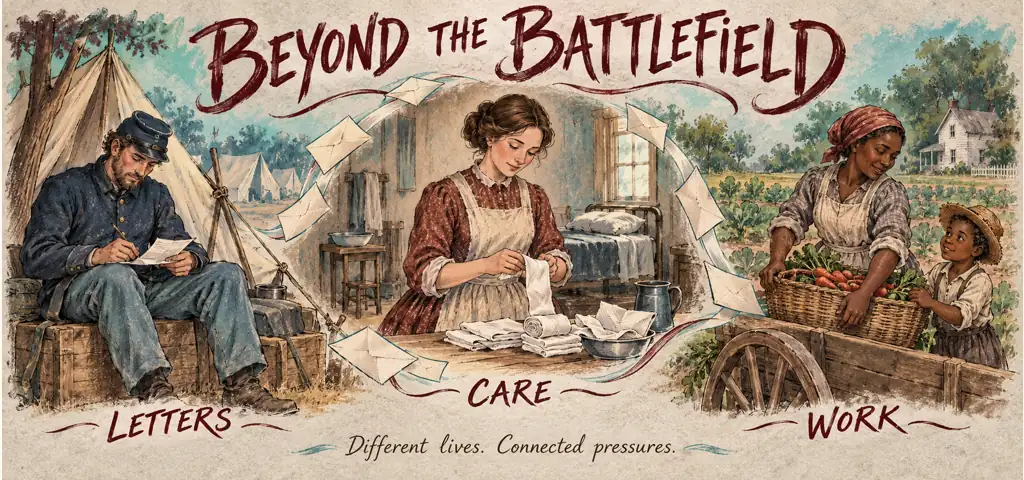
Lesson 18.4 of Chapter 18 of the U.S. History to 1877 study guide on Effortless Math covers CLEP U.S. History I 099: Soldiers, Civilians, Women, and the Home Fronts: the key terms, the core ideas, and worked examples showing how this topic is tested on the exam.
U.S. History to 1877 | Chapter 18 | Lesson 18.4
More than 2.8 million men and a few hundred women served in the Union and Confederate armies, according to the National Archives’ current service-record overview. That figure remains approximate because Confederate records are incomplete and service in more than one regiment can generate more than one compiled file. Naval service is a separate record system. The traditional estimate of at least 620,000 military deaths comes from wartime tabulations. Later demographic reconstruction suggests at least 750,000 deaths attributable to the war. These are different methods, so a careful answer labels the estimate instead of adding or treating the numbers as exact. Disease killed more soldiers than battle wounds because crowded camps, contaminated water, limited germ knowledge, and uneven sanitation turned mobilization into a health crisis.
Service experience differed by army, rank, region, race, and stage of war. Volunteers could frame enlistment through Union, liberty, local honor, slavery, white supremacy, or defense of home. Conscription, peer pressure, bounty systems, and economic need later shaped recruitment. Combat produced fear and comradeship, but marching, waiting, hunger, sickness, and letter writing occupied far more days than battle. Desertion might express opposition, family emergency, poor supply, or collapsing confidence. One motive cannot explain every case. Black military service faced separate discrimination and Confederate threats, developed further in Topic 18.5.
Women sustained both war efforts in unequal ways. White women managed farms and shops, entered clerical and factory work, organized soldiers’ aid, nursed, and negotiated military occupation. A small number served in disguise. Northern voluntary commissions mobilized donations and pushed sanitation, while paid nurses still confronted gender hierarchy. Confederate women faced requisition, inflation, occupation, and food scarcity with especially severe pressure as transportation and enslaved labor systems broke down. Enslaved women withdrew labor, carried intelligence, protected families in flight, and negotiated Union camps, yet emancipation also brought displacement, hunger, and danger. Expanded responsibility did not automatically yield equal pay, suffrage, or permanent occupational access.
The Union and Confederate home fronts shared conscription, taxation, casualty, and family separation but not equal capacity. The Union possessed deeper credit, food supply, transport, and industrial production, though hardship varied sharply among workers, immigrant neighborhoods, border communities, and areas under invasion. The Confederacy’s blockade, weak transport, currency collapse, impressment, and loss of enslaved labor drove much more extreme inflation and scarcity. The Richmond Bread Riot of April 1863 joined food protest to anger over speculation and government failure. Such protest affected military capacity by challenging legitimacy, disrupting supply, and pulling soldiers’ attention toward families at home.
Conscription made inequality visible. Both governments allowed substitution for part of the war, and the Union Enrollment Act initially permitted commutation, provoking the charge of a “rich man’s war and a poor man’s fight.” The New York City draft riots of July 1863 began with attacks on enrollment and expanded into arson, looting, and racist terror against Black New Yorkers, including the destruction of the Colored Orphan Asylum. Draft grievance helps explain the outbreak but cannot excuse or erase the selection of Black victims. Federal troops returning from Gettysburg helped restore order.
Watch, then test the claim
This Ernest Dollar lesson supplies a second explanation of the same period. Note where chronology, cause, and perspective connect.
Video: Women on the Southern Home Front During the Civil War, Ernest Dollar.
Check your understanding
- What does the July 13 telegram establish most directly?
- Local officials had ended the crisis through negotiation before federal troops were needed.
- Opponents relied chiefly on a successful court challenge to suspend the Enrollment Act.
- Federal enrollment continued while city streets remained orderly, open, and under local control.
- The fires described by the senders involved military property rather than civilian buildings.
- Draft resistance had become an urban emergency marked by arson and a request for troops.
- Which generalization best describes women’s wartime work?
- Hospital nursing grew while women’s management of farms declined in both sections.
- Confederate shortages largely removed women from paid and public production.
- Women performed varied military and civilian work shaped by region and legal status.
- Service in military disguise became the main form of women’s participation in both armies.
- Enslaved women entered flight and intelligence roles mainly after federal occupation ended.
- Select all home-front pressures:
- inflation,
- conscription,
- food shortages,
- occupation,
- family separation.
- Explain how one wartime letter or telegram can be valuable evidence without representing an entire army, city, or home front.
Write a brief response using a named fact from the lesson.
Open the answers and reasoning
Independent preparation. CLEP is a registered trademark of the College Board, which does not endorse this lesson.

Related to This Article
More math articles
- Free Grade 5 English Worksheets for SBAC Students
- 4th Grade MAP Math Practice Test Questions
- Cyclins and CDKs: How They Control the Cell Cycle
- Escalation, Search and Destroy, and the Credibility Gap
- Vermont VTCAP Grade 7 Math Worksheets: 95 Free Printable PDFs Organized by Skill
- How to Find the Constant of Variation
- Channels and Carriers: Facilitated Diffusion and Saturation
- Dominant Culture, Subcultures, and Countercultures
- Rounding Numbers for 5th Grade: Nearest Ten, Hundred, and Thousand
- How to Piece Together Areas: Compound Figures with Triangles, Semicircles, and Quarter Circles














What people say about "Soldiers, Civilians and the Home Fronts"?
No one replied yet.