Majority Rule and Minority Rights
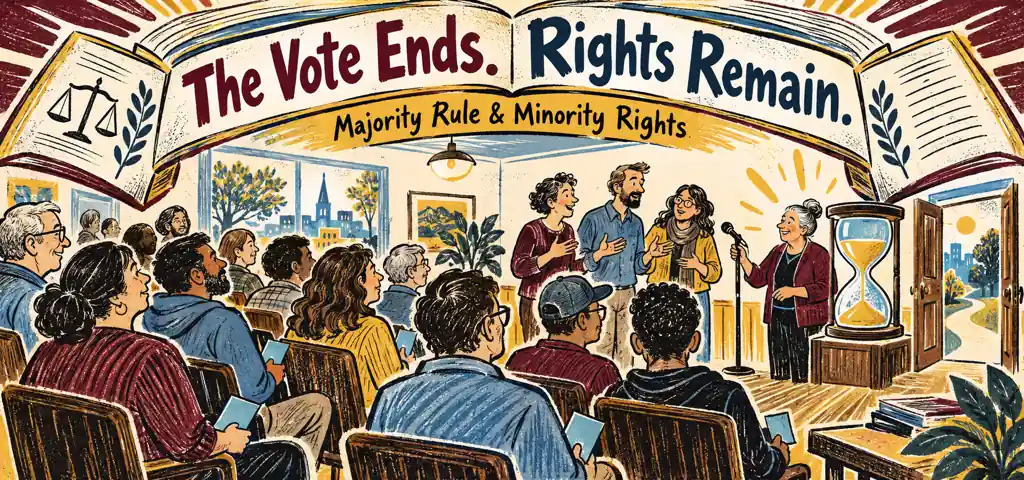
Majority rule is a general democratic principle for settling collective decisions, but not every American election requires more than half the votes. Many elections use plurality rules, under which the candidate with the most votes wins even below 50 percent, and presidential selection operates through the Electoral College. Whatever decision rule applies, constitutional democracy does not make the winning side all-powerful. Minority rights preserve protected speech, worship, association, fair process, and continued political competition.
The constitutional system balances responsiveness with restraint. Legislative chambers ordinarily decide questions by a majority of members voting, while bicameralism, separated powers, federalism, specified supermajority rules, and entrenched rights can slow action or place choices beyond an ordinary legislative majority. Minority protection does not guarantee the minority’s preferred policy. It protects specified liberties and fair participation while leaving most ordinary policy to lawful competition. The original constitutional system protected rights incompletely and excluded many people. Later amendments and constitutional doctrine expanded enforceable protections.
The governing rule for majority rule and minority rights
Distinguish a policy loss from a rights violation. If 52 percent of legislators choose one lawful tax rate and 48 percent prefer another, the losing side has not necessarily suffered a constitutional injury. If the winners prohibit opponents from criticizing the tax or organizing for the next election, the majority threatens protected political activity. The question is whether the minority merely lost under the governing decision rule or was denied a right or fair process.
Majority Rule and Minority Rights: the legal or political boundary
A plurality is not a majority: 45 percent can win a three-candidate race without exceeding half the vote. Judicial enforcement of higher-law rights against a majority-supported statute is likewise not a cancellation of democracy. It is part of constitutional democracy’s allocation of authority. Yet not every unfair or unpopular result is unconstitutional. The First and Fourteenth Amendments in the National Archives’ Constitution transcript, together with Constitution Annotated’s discussions of incorporation, public forums, and political association, show how particular rights make that general limit enforceable.
Reason through an example of majority rule and minority rights
A classmate claims that majority rule and minority rights always produces the same result, so correct the claim with one example and a relevant limit.
Video lesson: Majority Rule and Minority Rights
Heimler's History gives a focused explanation of this topic in Balancing MAJORITY and MINORITY Rights [AP Gov Review, Unit 3 Topics 11 & 12].
If the player does not load, watch this lesson directly on YouTube.
Connect this lesson to the larger course
For a broader map connecting majority rule and minority rights to civil liberties, civil rights, and equal protection, use the AP U.S. Government and Politics learning hub.

Related to This Article
More math articles
- Political violence
- Grade 8 ELA Tests: A Clear Parent Guide to Reading, Writing, and Test-Day Readiness
- Math Assessment Test for College
- 6th Grade SBAC Math Worksheets: FREE & Printable
- SSAT Math-Test Day Tips
- What Kind of Math Needed for Owning Your Own Business?
- Comparing and Ordering Decimals for 5th Grade: Step-by-Step Guide
- Top 10 5th Grade Georgia Milestones Assessment System Math Practice Questions
- How to Analyze Cross Sections of 3D Solids: A Step-by-Step Guide
- Accuplacer Math Worksheets: FREE & Printable






















What people say about "Majority Rule and Minority Rights"?
No one replied yet.