CPA REG Basis: Keep Tax Basis Separate From Book Value (2027 Prep)
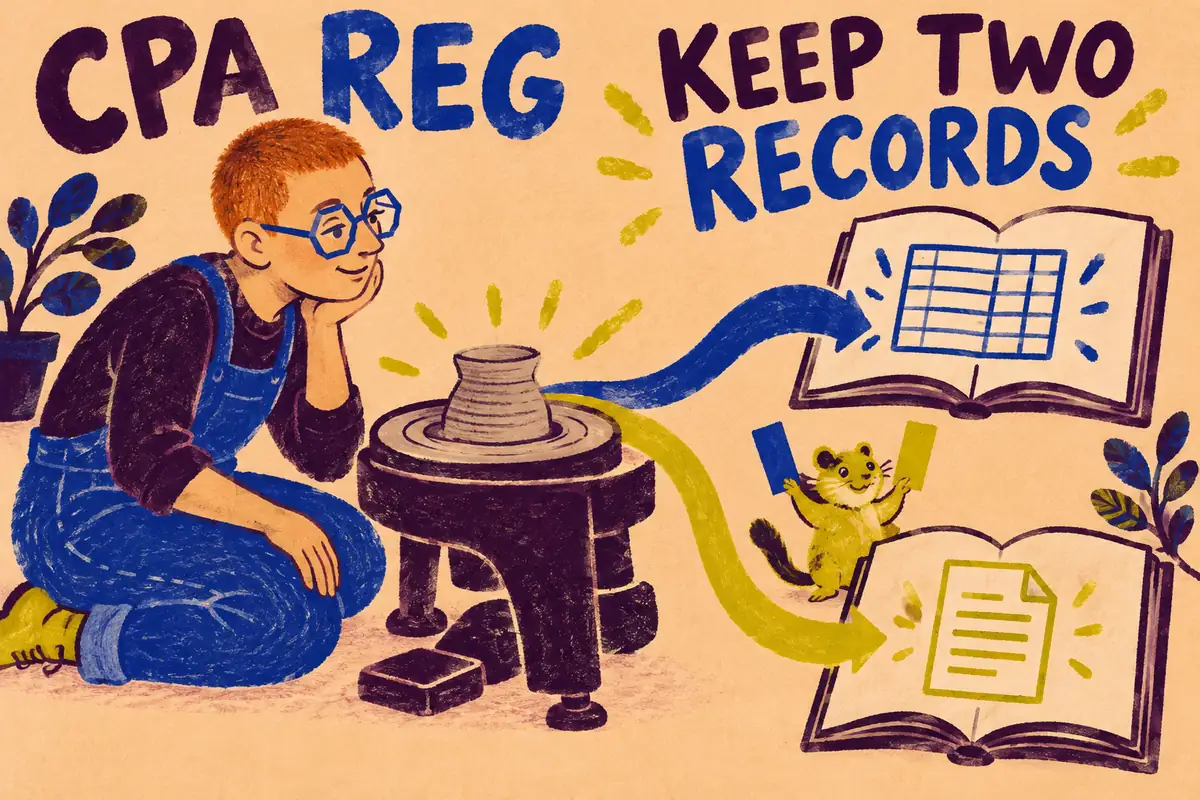
Keep an asset's financial-statement carrying amount and adjusted tax basis in separate records, because book depreciation and tax basis adjustments can follow different rules even when the original purchase cost is the same. A shared starting amount is no guarantee that the ending balances match.
Our fictional Sable Clay Studio example uses the 2026 tax year and a production wheel, with its original inputs in the original equipment assumptions (CSV). The tax depreciation amount is supplied. We are reconciling stated amounts, without determining a real taxpayer's deduction or predicting which rules will be tested in a future CPA attempt.
Identify the asset, period and starting cost
Sable's author-created purchase record gives a $30,000 price, $900 freight and $600 installation, all for one wheel acquired and ready for use on January 1, 2026. The total is $31,500. We assume those amounts form both its initial book cost and its initial tax basis, with no other acquisition adjustments.
The section 1012 cost-basis rule states the general cost rule with statutory exceptions, while IRS Topic 703 on asset basis explains that purchase-related amounts can enter basis and that other acquisition types may follow different rules. The IRS Publication 551 HTML guidance lists freight and installation among cost-basis items. Other acquisitions are outside this model. The fact that two records start at $31,500 does not extend that assumption to every way an asset can be acquired.
Follow the book calculation on its own terms
For this model, the book record uses straight-line allocation over seven years, no residual value and one full year of depreciation for 2026. Dividing $31,500 by seven gives $4,500. Subtracting that year's accumulated depreciation from the supplied initial book cost leaves a December 31 carrying amount of $27,000.
Those are book assumptions. They do not establish a tax recovery period or an allowable deduction. The OpenStax summary of long-term asset accounting distinguishes acquisition cost and depreciation over an anticipated useful life, which helps explain why a book estimate cannot simply be copied into a tax schedule. Nothing in the example values the wheel at its current selling price.
Use the supplied tax adjustment rather than the book expense
The fictional tax input supplies $6,300 as the allowable depreciation for the same wheel and tax year, under the applicable method and elections. That amount is an assumption. We do not derive it from a MACRS table, determine bonus-depreciation treatment, make a section 179 election or claim that every $31,500 asset receives this deduction.
With no other tax-basis adjustments in the model, subtracting $6,300 from $31,500 leaves $25,200. The book carrying amount remains $27,000. The worked basis reconciliation (CSV) therefore records a $1,800 excess of book carrying amount over adjusted tax basis, equal to the difference between the $6,300 tax adjustment and the $4,500 book depreciation.
That $1,800 is a basis difference. It is not the tax due, cash saved or a deferred-tax liability measured in dollars, and the example supplies no tax rate or complete financial-reporting analysis from which to determine those amounts.
Check the amount that could have been deducted
Now consider a separate author-created tax-return note that reports only $4,400 of depreciation claimed for 2026. The allowable amount stays $6,300. Using the smaller claimed figure as the only basis reduction would produce $27,100, which is $1,900 higher than the model's $25,200 adjusted tax basis.
The section 1016 basis-adjustment rule includes a depreciation adjustment that is not less than the allowable amount, subject to its stated provisions. Publication 551's depreciation discussion explains the underclaimed case directly: when less was taken than was available under the chosen method, basis is reduced by the amount that could have been taken. The allowable amount still reduces basis.
This comparison assumes the supplied allowable amount is valid and the claimed amount does not exceed it. The statutory treatment of excessive deductions has additional detail, so the lesson is not a blanket instruction to subtract whichever number appears larger in two unrelated records.
| Measure | Calculation | Result |
|---|---|---|
| Initial book cost and tax basis | 30,000 + 900 + 600 | $31,500 |
| Book depreciation | 31,500 / 7 | $4,500 |
| Book carrying amount | 31,500 – 4,500 | $27,000 |
| Adjusted tax basis | 31,500 – 6,300 | $25,200 |
| Book amount minus tax basis | 27,000 – 25,200 | $1,800 |
| Wrong claimed-only result | 31,500 – 4,400 | $27,100 |
| Overstatement from claimed-only reduction | 27,100 – 25,200 | $1,900 |
Keep three different depreciation amounts labeled
The book depreciation is $4,500, the fictional claimed tax deduction is $4,400 and the supplied allowable tax depreciation is $6,300. They have different jobs. The book number produces the $27,000 carrying amount, while the allowable amount supplies the reduction used for the model's $25,200 adjusted tax basis.
The $1,900 underclaimed difference and the $1,800 book-tax basis difference are also distinct. One compares claimed and allowable tax depreciation. The other compares the ending book and tax measures, so substituting one difference for the other would change the question being answered.
No return correction is prescribed. The record does not determine whether an actual filing needs amendment, an accounting-method change or another procedure, and an arithmetic reconciliation cannot settle a taxpayer's eligibility, elections or documentation.
Preserve the evidence needed for a real comparison
The blank basis-evidence record (CSV) keeps the asset, tax year, initial cost, book policy, claimed amount, allowable amount and adjustments beside their sources. Actual source checks remain blank. A complete real-world analysis would need the acquisition record and applicable depreciation history, rather than treating our invented inputs as a verified tax schedule.
Our example excludes improvements, dispositions, impairment, credits, casualty events and other basis adjustments. It isolates the depreciation distinction. The title's 2027 preparation label does not change the example's expressly stated 2026 tax year or establish the tax law applicable to a different transaction or exam date.
The official exam-content page lists separate effective preparation editions. Detailed REG task alignment remains unverified. Use current authorized instruction for your intended attempt and retain the distinction between a supplied calculation assumption and evidence that the assumption is valid.
2027 preparation edition, fictional example tax year 2026. Public informational HTML and statutory text checked October 12, 2026. Cornell LII currency notice reports code through Public Law 119-118, published October 2, 2026. IRS Publication 551 is the December 2025 edition. Sable, its records and all figures are original educational assumptions. The supplied $6,300 allowable amount is not an actual deduction determination. No real return, method election, tax liability or professional approval verified. No linked PDF, worksheet or assessment inspected.

Related to This Article
More math articles
- The Best Grade 6 ELA Practice Tests for California Students
- Writ of certiorari
- Dividing Multi-Digit Numbers for 4th Grade
- Tips for Learning Mathematics for the Humanitarians
- The Best Grade 2 Math Worksheets for Indiana Students
- Top 10 5th Grade Georgia Milestones Assessment System Math Practice Questions
- The CRCST Exam and Certification Roadmap
- TExES Core Subjects Math Formulas
- 4th Grade ISASP Math Worksheets: FREE & Printable
- Ratios, Rates, and Proportions in Science




















What people say about "CPA REG Basis: Keep Tax Basis Separate From Book Value (2027 Prep) - Effortless Math"?
No one replied yet.