CPA TCP Entity Choice: Compare Assumptions Before Tax Outcomes (2027 Prep)
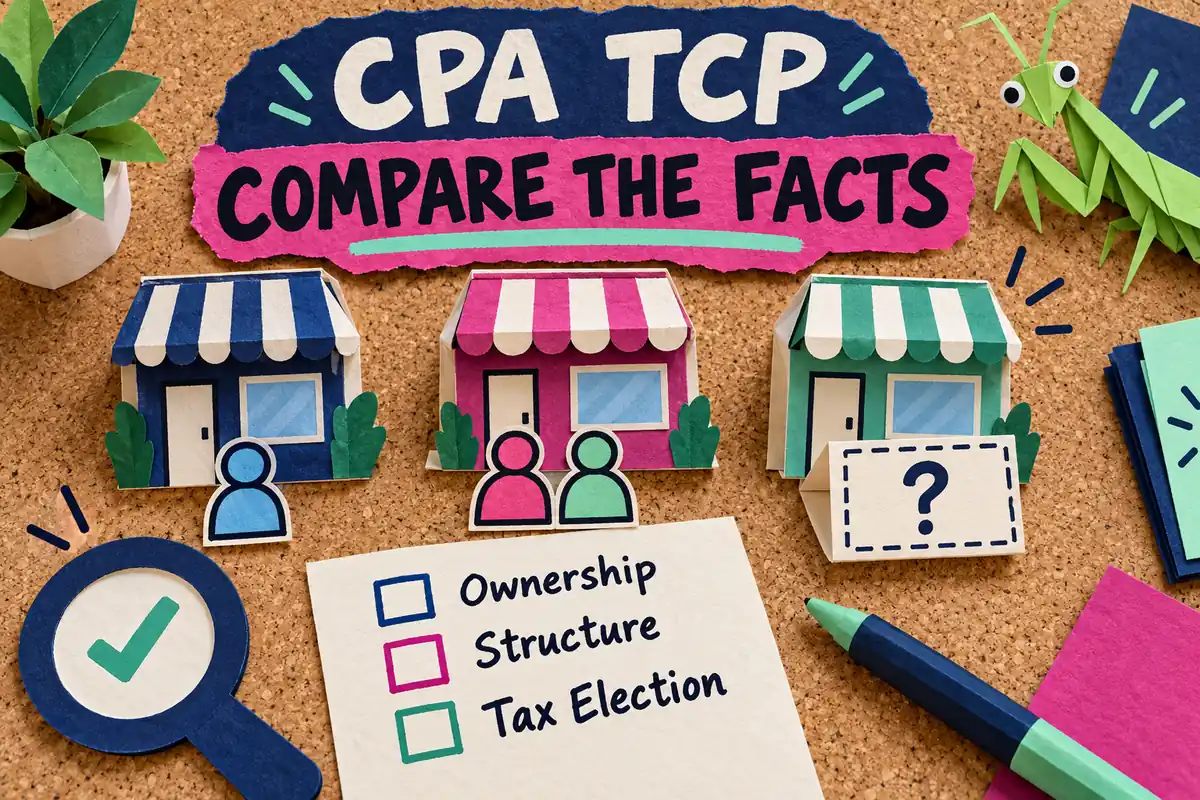
An entity-choice comparison begins with the business's legal form, owners and effective tax elections. Those facts establish the classification you are comparing before a profit forecast can support a tax calculation.
Consider a business called an LLC. The name leaves several federal income tax possibilities open, and one owner could be an individual or another company. Our three fictional businesses show why a chart that jumps from the initials LLC straight to an individual's tax return can send the rest of the analysis down the wrong path.
Write down what the example actually supplies
All three businesses in this original model are newly formed domestic eligible LLCs in 2026, with stable ownership throughout the period and no classification or S elections. They are ordinary commercial ventures. Special foreign, exempt-organization and preexisting-entity rules are outside the model.
Marsh Ink LLC has two unrelated individual members, while Harbor Print LLC has one owner, Cedar Corporation, which is a C corporation. Ana alone owns Willow Bindery LLC.
These are supplied facts. We are not inferring that no election exists because someone failed to find a document, and we are not deciding whether a real business has satisfied every state formation requirement. No state jurisdiction, taxable profit, owner compensation or tax amount is supplied.
Classify the cases before filling in tax amounts
Under the domestic defaults in 26 CFR 301.7701-3 in the eCFR, Marsh Ink is a partnership because it has two members, while Harbor Print and Willow Bindery are disregarded as separate from their single owners. The original classification records (CSV) preserve the owners' identities beside those outcomes so the two single-owner rows remain distinguishable.
Cedar owns Harbor. The IRS single-member LLC guidance addresses corporate ownership directly. Harbor's disregarded classification places its activity with Cedar for federal income tax purposes under the stated facts, rather than turning Cedar into an individual sole proprietor. Willow's individual owner is a different taxpayer, and an appropriate reporting analysis would need Ana's actual activities and other relevant facts.
Leave the tax amounts blank. Default classification alone does not supply taxable income, the owner's tax rate, loss limitations or the total tax arising from the activity.
| Business | Owner facts | Income tax default |
|---|---|---|
| Marsh Ink | Two unrelated individuals | Partnership |
| Harbor Print | One C corporation: Cedar | Disregarded with Cedar |
| Willow Bindery | One individual: Ana | Disregarded with Ana |
Keep income tax and other obligations separate
The IRS explanation of LLC classification states that an LLC is formed under state law and that classification depends on membership and elections. It also identifies a single-member LLC as separate for employment tax and certain excise tax purposes despite its disregarded income tax treatment.
That distinction matters for Harbor. A learner who writes that the business disappears for every tax purpose has extended one classification beyond its scope. The example supplies no employees or excise-tax activities, so we cannot decide particular filing or payment obligations.
Our two-member case also has a boundary. The IRS entity-classification FAQ identifies a special rule for certain married owners in community-property states, whereas Marsh's owners are explicitly unrelated. Retain that fact when studying the default instead of carrying the case's outcome into a different ownership arrangement.
Test a proposed election without assuming it succeeds
Suppose someone proposes a standalone S election for Harbor while Cedar remains its C-corporation owner. Corporate shareholders are excluded under the IRS S corporation requirements, so Cedar's ownership blocks the proposal under those requirements before any promised savings calculation becomes useful.
Cedar remains a C corporation. Harbor's current disregarded classification is still the model's given starting point, and we have supplied no ownership restructuring or change to Cedar's status.
Willow needs a different check. Having one individual owner alone does not establish every S requirement or a valid election, so its row remains a default-classification result. A full proposed-election analysis would need eligibility, consent and effective-date evidence, rather than simply changing the row heading.
Check the election route too. Paragraph (c)(1)(v)(C) of the regulation treats a timely S election by a qualifying eligible entity as a deemed association election, subject to its requirements. A blanket instruction that every LLC must separately file both elections would miss that provision.
Give nontax factors their own evidence fields
A classification table cannot settle the owners' decision. Marsh may need to examine who controls new borrowing, while Harbor may care about Cedar's plans for a future investor. Those are possible questions for the model, not facts already established about either business.
The planning-factor map (CSV) separates tax classification from control rights, investor terms, state-law exposure and the costs of changing arrangements. Each row asks for the missing evidence. It gives no automatic liability shield, permission to admit an investor or conclusion about conversion costs.
For example, an owner who has signed a personal guarantee needs that document examined as part of the exposure analysis. The letters LLC do not answer the contract question by themselves, and federal income tax classification supplies no state-law verdict.
Build a comparison whose assumptions can be checked
Use the blank entity-choice decision record (CSV) to name the business, period, owner type, proposed alternative and effective classification. Then record the tax inputs and nontax constraint that would make a comparison meaningful. Source verification and approval fields are deliberately empty.
For Harbor, the first useful entry is Cedar's identity and C status, followed by the absence of elections as an explicit model assumption. For a real file, those entries would need supporting records and a current rule check. No forecast can repair a mistaken owner type.
This is a classification-first study method. It produces explained starting points and a list of unresolved planning facts, without selecting the lowest-tax entity for any of the businesses. The official CPA content and preparation-edition page provides preparation-edition labels, while detailed future TCP task alignment and a matching TCP hub remain unverified here.
2027 preparation edition, original fictional business period 2026. Public IRS and eCFR HTML checked October 12, 2026. The eCFR identifies its text as authoritative but unofficial and displays Title 26 current through October 8, 2026, not a verification of later changes. No actual taxpayer liability, entity recommendation, election, state-law outcome or detailed future TCP task coverage established. Matching hub, fresh sources and release checks remain required. No linked form, PDF, worksheet or assessment inspected.

Related to This Article
More math articles
- Human Ecology and Urban Spatial Models
- The Ultimate 7th Grade GMAS Math Course (+FREE Worksheets)
- What Skills Do I Need for the ALEKS Math Test?
- Sharecropping, the Crop-Lien System, Convict Leasing, and the New South
- Grade 3 Math: Estimating Sums and Differences
- The Best Grade 5 Math Book for Iowa Students
- Free Grade 4 English Worksheets for Rhode Island Students
- Press freedom
- How to Use Exponents to Write down Multiplication Expressions?
- Understanding Betting Odds



















What people say about "CPA TCP Entity Choice: Compare Assumptions Before Tax Outcomes (2027 Prep) - Effortless Math"?
No one replied yet.