Solutions and Concentration: Molarity, Dilution, and Solubility
A flask labeled 0.200 M tells you an amount of solute per liter of solution. It does not say how quickly the solute dissolves or whether more can dissolve. Concentration, dissolving rate, and solubility describe different features of a solution.
A solution is a homogeneous mixture. Concentration describes how much of a component is present relative to a stated amount of solution or mixture. Molarity is moles of solute per liter of solution. Solubility describes an equilibrium limit under specified conditions, and dilution lowers concentration by adding solvent without changing solute amount.
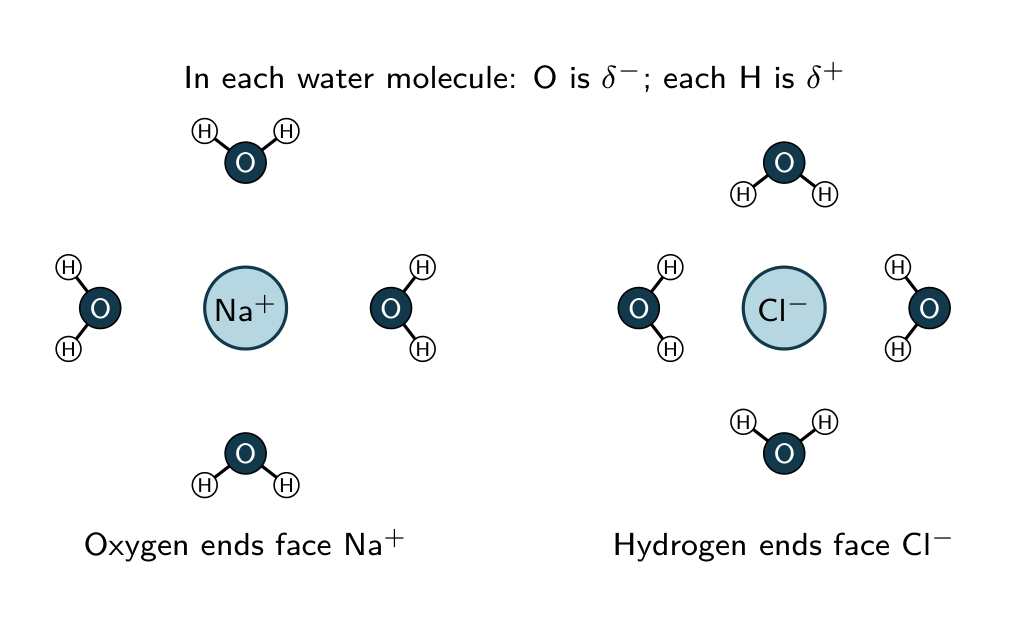
Which volume belongs in molarity?
Molarity is
\[ M=\frac{n_{\text{solute}}}{V_{\text{solution in L}}}. \]
The denominator is final solution volume. Dissolving a solute in 250 mL of water does not necessarily produce exactly 250 mL of solution.
For example, 0.0500 mol of solute in a final solution volume of 0.2500 L gives \(0.200\,\mathrm{mol/L}\). When preparing a specified volume in a supervised laboratory, follow the appropriate volumetric procedure and reach the final calibration mark after dissolution and temperature adjustment.
Worked example: plan a dilution
What volume of 1.00 M stock contains enough solute to make 100.0 mL of 0.200 M solution? Conservation of solute gives
\[ M_1V_1=M_2V_2,\qquad V_1=\frac{(0.200)(100.0)}{1.00}=20.0\,\mathrm{mL}. \]
The selected stock volume is diluted to a final volume of 100.0 mL. Do not interpret that instruction as adding exactly 100.0 mL of water. This is a calculation example, and actual preparation requires the chemical-specific supervised method.
How does solubility differ from dissolving rate?
Stirring can help a solid dissolve faster by bringing fresh solvent into contact with its surface. It does not by itself increase the equilibrium amount that can remain dissolved at the same temperature.
A saturated solution is in equilibrium with the solute phase at the stated conditions. Solubility depends on the substances and temperature. Gas solubility also depends on gas partial pressure, and many gases become less soluble in water as temperature rises.
What should a concentration label specify?
| Expression | Basis |
|---|---|
| Molarity | Moles per liter of solution |
| Mass percent | Solute mass divided by total mixture mass |
| Mass/volume percent | Grams of solute per 100 mL of solution |
Read the basis before calculating. A percentage without its intended mass, volume, or mass/volume meaning can be ambiguous.
Can you apply the idea?
-
Find molarity for 0.0200 mol in 0.1000 L of solution.
Check your answer
\(0.200\,\mathrm{M}\).
-
During ordinary dilution with no reaction or loss, what happens to solute moles?
Check your answer
They remain constant.
-
A stock volume is diluted from 25.0 mL to 100.0 mL. How does concentration change?
Check your answer
It becomes one quarter of its original value.
-
Does stirring alone raise equilibrium solubility at fixed temperature?
Check your answer
No. It can change the time needed to approach equilibrium.
-
What volume is used in the denominator of molarity?
Check your answer
The final solution volume in liters.
-
What does 5.0% by mass mean?
Check your answer
5.0 g of the specified component per 100 g of total mixture.
Watch the idea explained
Solutions: Crash Course Chemistry #27, CrashCourse.
This selected excerpt runs from 5:15 to 6:15. Use the supplied Henry constant for carbon dioxide to calculate dissolved amount and equivalent gas volume.
Where does this fit?
Use the chemistry learning hub to choose a lesson or practice test. Connect this topic with gas laws and states of matter, net ionic equations, chemical equilibrium, acids, bases, and ph.
Continue with a chemistry study guide

Related to This Article
More math articles
- Mississippi MAAP Algebra 1 Free Worksheets: 64 Free Skill-by-Skill Algebra 1 PDFs with Answer Keys
- Overview of the TSI Mathematics Test
- Patronage and the spoils system
- Function Grapher — Plot y = f(x) Online (Free)
- Measurement, Instruments, and Safety
- How to Solve Word Problems of Adding Two Numbers Up to 7 Digits
- Supply, Demand, and Prices
- Grade 6 Math Flashcards (Free Online: Formulas, Terms & Concepts)
- Poker Math Made Simple: Probability, Odds, and EV
- 3rd Grade MCAS Math Worksheets: FREE & Printable



















What people say about "Solutions and Concentration: Examples and Practice"?
No one replied yet.