Supply, Demand, and Prices

Why does a bottle of water cost more at a concert than at a store? Why do prices rise when something is hard to get? The answer is supply and demand — the most important idea in all of economics, and one the test comes back to again and again.
Demand is how much of something buyers are willing to buy at each price. Supply is how much sellers are willing to produce at each price. Together they set the market price — the price where the amount buyers want equals the amount sellers offer.
The Law of Demand and the Law of Supply
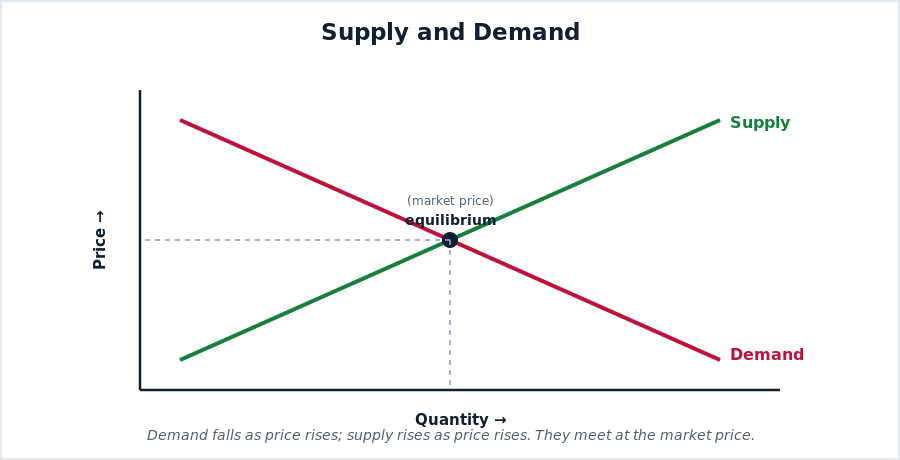
Two simple rules do most of the work. The law of demand says that as the price of something goes up, buyers want less of it (and as price falls, they want more). The law of supply says that, other things equal, sellers offer more as price rises because the higher price increases the incentive to produce and sell; it does not guarantee a larger profit when costs also change. Put the two together on a graph, and they cross.
Equilibrium: The Market Price
The point where the supply and demand lines cross is the equilibrium, the market price. At that price, the quantity buyers want to buy exactly matches the quantity sellers want to sell. If the price is above equilibrium, a surplus tends to put downward pressure on price. If it is below equilibrium, a shortage tends to put upward pressure on price. Those adjustments can move a market toward equilibrium, although contracts, policies, and other frictions may slow or alter the process.
What Shifts Supply and Demand
Prices change when something shifts supply or demand. Demand rises if a product becomes more popular, if incomes go up, or if there are more buyers — pushing the price up. Supply rises if production gets cheaper or there are more sellers — pushing the price down. The concert water is expensive because demand is high (thirsty fans) and supply is limited (one vendor). Recognizing which side shifted tells you which way the price moves.
Watch: A Short Video Lesson
CrashCourse gives a clear overview to go with this lesson:
A Routine for Supply and Demand Questions
- Law of demand: higher price, buyers want less.
- Law of supply: higher price, sellers offer more.
- Equilibrium is where the two meet — the market price.
- A shortage pushes prices up; a surplus pushes prices down.
Practice
- According to the law of demand, what happens to the quantity buyers want as price rises?
- According to the law of supply, what do sellers do as price rises?
- What is the equilibrium price?
- What happens to price when there is a shortage?
- What happens to price when there is a surplus?
- If a product suddenly becomes very popular, what happens to its price?
Answers
- They want less of it.
- They offer more of it.
- The price where the quantity demanded equals the quantity supplied.
- It rises.
- It falls.
- It rises (demand increased).
Where This Fits in Your Social Studies Prep
Supply and demand build on fundamental economic concepts and connect to government policy and market failures. See every topic on the Social Studies Prep Hub.

Related to This Article
More math articles
- Calculate a marginal value from a table
- Tensions between liberty and public safety
- Difference Quotient Calculator (Free)
- How to Find Arc Length and Sector Area? (+FREE Worksheet!)
- Ultimate Guide to Proving Angles Congruent: Techniques and Tips
- 10 Most Common ASVAB Math Questions
- The Best GED Math Book to Pass on Your First Try
- The Best Algebra 1 Book for Georgia Students
- Top 10 Tips to Overcome SAT Math Anxiety
- Volume Calculation Method of Cross-Sections






















What people say about "Supply, Demand, and Prices"?
No one replied yet.