Free ParaPro Math Practice Test: 20 Questions and Answers
Check your required assessment before using exam rules. ParaPro (1755) and ParaPathways (5757, with Mathematics subtest 5759) are different assessments. Adoption and qualifying scores vary by state or district. Confirm the test code with your employer and the ETS state requirements. For example, Rhode Island approves only ParaPathways from March 1, 2026; this is a state-specific change, not evidence of one nationwide transition date.
Review 20 independent ParaPro-style math questions with worked explanations. Use this short set to find skills worth reviewing, then follow the related lessons. It is not an official ETS assessment, a full-length test, or a scaled-score predictor. Confirm whether your employer requires ParaPro or ParaPathways before applying exam-day rules.
Before you begin:
- Answer each question before reading its explanation.
- Record the skill and method behind each missed question.
- Keep this practice result separate from official ETS scores.
- Check the assessment code, timing, calculator rules, and qualifying scores required by your state or district.
Use these 20 independently prepared math practice questions to identify skills to review. This set is not an official ETS test, a full assessment, or a predictor of your scaled score. Check each explanation after answering, then return to the matching lesson for any missed skill.
Use the related lessons to review a missed method, then try a different problem on the same skill. Check your required assessment’s official content outline for topics beyond this short set.
20 Sample ParaPro Math Practice Questions
1- Mr. Jones saves $2,500 out of his monthly family income of $55,000. What fractional part of his income does he save?
☐A. \(\frac{1}{22} \)
☐B. \(\frac{1}{11} \)
☐C. \(\frac{3}{25} \)
☐D. \(\frac{2}{15} \)
2- Four one-foot rulers can be split among how many users to leave each with \(\frac{1}{6} \) of a ruler?
☐A. 4
☐B. 6
☐C. 12
☐D. 24
3- Simplify the expression.
\((6x^3-8x^2+2x^4 )-(4x^2-2x^4+2x^3 )\)=?
☐A. \(4x^3-12x^2\)
☐B. \(4x^4+4x^3-12x^2\)
☐C. \(8x^3-12x^2\)
☐D. \(x^4+4x^3-12x^2\)
4- In two successive years, the population of a town is increased by \(15\%\) and \(20\%\). What percent of the population is increased after two years?
☐A. \(32\%\)
☐B. \(35\%\)
☐C. \(38\%\)
☐D. \(68\%\)
5- What is the surface area of the cylinder below?

☐A. \(48 {\pi} \space in^2\)
☐B. \(57 {\pi} \space in^2\)
☐C. \(66 {\pi} \space in^2\)
☐D. \(288 {\pi} \space in^2\)
6- A cruise line ship left Port A and traveled 80 miles due west and then 150 miles due north. At this point, what is the shortest distance from the cruise to port A in miles? ____________
7- A shirt costing $200 is discounted \(15\%\). After a month, the shirt is discounted another \(15\%\). Which of the following expressions can be used to find the selling price of the shirt?
☐A. \((200) (0.70)\)
☐B. \((200) – 200 (0.30)\)
☐C. \((200) (0.15) – (200) (0.15)\)
☐D. \( (200) (0.85) (0.85)\)
8- Solve: \(5 + 8 \times (- 2) – [4 + 22 \times 5] \div 6 = \)?
☐A. \(-30\)
☐B. \(-20\)
☐C. \(-10\)
☐D. 0
9- Which of the following points lies on the line \(x+2y=4\)?
☐A. \((-2, 3)\)
☐B. \((1, 2)\)
☐C. \((-1, 3)\)
☐D. \((-3, 4)\)
10- 5 less than twice a positive integer is 83. What is the integer?
☐A. 39
☐B. 41
☐C. 42
☐D. 44
11- 11 yards 6 feet and 4 inches equal to how many inches?
☐A. 388
☐B. 468
☐C. 472
☐D. 476
12- Mr. Carlo’s family is choosing a menu for their reception. They have 3 choices of appetizers, 5 choices of entrees, 4 choices of cake. How many different menu combinations are possible for them to choose from?
☐A. 12
☐B. 32
☐C. 60
☐D. 120
13- The average of five consecutive numbers is 38. What is the smallest number?
☐A. 38
☐B. 36
☐C. 34
☐D. 12
14- What is the difference between the smallest 4-digit number and the biggest 4-digit number?
☐A. 6666
☐B. 6789
☐C. 8888
☐D. 8999
15- How many tiles of 8 \(cm^2\) are needed to cover a floor of dimension 6 cm by 24 cm?
☐A. 6
☐B. 12
☐C. 18
☐D. 24
16- A ladder leans against a wall forming a \(60^ \circ \) angle between the ground and the ladder. If the bottom of the ladder is 30 feet away from the wall, how long is the ladder?
☐A. 30 feet
☐B. 40 feet
☐C. 50 feet
☐D. 60 feet
17- The average weight of 18 girls in a class is 60 kg, and the average weight of 32 boys in the same class is 62 kg. What is the average weight of all the 50 students in that class?
☐A. 60
☐B. 61.28
☐C. 61.68
☐D. 62.90
18- An angle is equal to one-fifth of its supplement. What is the measure of that angle?
☐A. 20
☐B. 30
☐C. 45
☐D. 60
19- In a stadium, the ratio of home fans to visiting fans in a crowd is 5:7. Which of the following could be the total number of fans in the stadium?
☐A. 12,324
☐B. 42,326
☐C. 44,566
☐D. 66,812
20- If \(40\%\) of a class are girls, and \(25\%\) of girls play tennis, what percent of the class play tennis?
☐A. \(10\%\)
☐B. \(15\%\)
☐C. \(20\%\)
☐D. \(40\%\)
Answers:
1- A
2,500 out of 55,000 equals to \(\frac{2500}{55000}= \frac{25}{550}= \frac{1}{22} \)
2- D
\(4 \div \frac{1}{6} = 24 \)
3- B
Simplify and combine like terms.
\((6x^3-8x^2+2x^4 )-(4x^2-2x^4+2x^3 ) {\Rightarrow} (6x^3-8x^2+2x^4 )-4x^2+2x^4-2x^3 {\Rightarrow}
4x^4+4x^3-12x^2\)
4- C
the population is increased by \(15\%\) and \(20\%\).
\(15\%\) increase changes the population to \(115\%\) of the original population.
For the second increase, multiply the result by \(120\%\).
\((1.15) \times (1.20) = 1.38 = 138\%\)
38 percent of the population is increased after two years.
5- C
Surface area of a cylinder \(= 2\pi r(r+h)\),
The radius of the cylinder is (3) inches ((6 div 2)) and its height is 8 inches. Therefore,
Surface Area of a cylinder \(= 2\pi (3) (3 + 8) = 66\pi\)
6- 170
Use the information provided in the question to draw the shape.

Use Pythagorean Theorem: \(a^2 + b^2 = c^2 \)
\(80^2 + 150^2 = c^2 {\Rightarrow} 6400 + 22500 = c^2 {\Rightarrow} 28900 = c^2 {\Rightarrow} c = 170\).
7- D
To find the discount, multiply the number by \((100\% –\) rate of discount).
Therefore, for the first discount we get: \((200) (100\% – 15\%) = (200) (0.85) = 170\)
For the next \(15\%\) discount: (200) (0.85) (0.85)
8- A
Use PEMDAS (order of operation):
\(5 + 8 \times (-2) – [4 + 22 \times 5] \div 6 = 5 + 8 \times (-2) – [4 + 110] \div 6 = 5 + 8 \times (-2) – [114] \div 6 = 5 + (-16) – 19\)
\(5 + (-16) – 19 = -11 – 19 = -30\)
9- A
\(x+2y=4\). Plugin the values of \(x\) and \(y\) from the choices provided. Then:
A. \((-2,3) x+2y=4(\rightarrow )-2+2(3)=4(\rightarrow )-2+6=4\) This is true!
B. \((1,2) x+2y=4(\rightarrow )1+2(2)=4(\rightarrow )1+4=4\) (This is NOT true!)
C. \((-1,3) x+2y=4(\rightarrow )-1+2(3)=4(\rightarrow )-1+6=4\) (This is NOT true!)
D.\( (-3,4) x+2y=4(\rightarrow )-3+2(4)=4(\rightarrow )-3+8=4 \)(This is NOT true!)
10- D
Let \(x\) be the integer. Then:
\(2x – 5 = 83\)
Add 5 both sides: \(2x = 88\)
Divide both sides by\( 2: x = 44\)
11- C
\(11 \times 36 + 6 \times 12 + 4 = 472\)
12- C
To find the number of possible menu combinations, multiply number of options for each factor:
3 \(\times \) 5 \(\times \) 4 \(=\) 60
13- B
Let \(x\) be the smallest number. Then, these are the numbers:
\( x, x+1, x+2, x+3, x+4 \)
\( average = \frac{sum of terms}{number of terms} \Rightarrow 38 = \frac{x+(x+1)+(x+2)+(x+3)+(x+4)}{5} \Rightarrow 38= \frac{5x+10}{5} \Rightarrow 190 = 5x+10 \Rightarrow 180 = 5x \Rightarrow x=36 \)
14- D
The smallest 4, digit number is 1000, and the biggest 4, digit number is 9999. The difference is: 8999
15- C
The area of the floor is: \(6 cm \times 24 cm = 144 cm^2 \)
The number of tiles needed\( = 144 \div 8 = 18\)
16- D
The relationship among all sides of a special right triangle
\(30^ \circ -60^ \circ – 90^ \circ \) is provided in this triangle:

In this triangle, the opposite side of the \(30^ \circ \) angle is half of the hypotenuse.
Draw the shape for this question:
The ladder is the hypotenuse. Therefore, the ladder is 60 ft.

17- B
\(average = \frac{sum of terms}{number of terms}\)
The sum of the weight of all girls is: \(18 \times 60 = 1080\) kg
The sum of the weight of all boys is: \(32 \times 62 = 1984\) kg
The sum of the weight of all students is: \(1080 + 1984 = 3064\) kg
\( average = \frac{3064}{50}=61.28\)
18- B
The sum of supplement angles is 180. Let \(x\) be that angle. Therefore,
\(x + 5x = 180\)
\(6x = 180\), divide both sides by \(6: x = 30\)
19- A
In the stadium, the ratio of home fans to visiting fans in a crowd is 5:7. Therefore, total number of fans must be divisible by \(12: 5 + 7 = 12\).
Let’s review the choices:
A. 12,324: \(12,324 \div 12 = 1027\)
B. 42,326: \(42,326 \div 12 = 3,527.166\)
C. 44,566: \(44,566 \div 12 = 3,713.833\)
D. 66,812: \(66,812 \div 12 = 5,567.666\)
Only choice A when divided by 12 results in a whole number.
20- A
The percent of girls playing tennis is:
\(40 \% \times 25\% = 0.40 \times 0.25 = 0.10 = 10\%\)
Looking for the best resource to help you succeed on the ParaPro Math test?
More from Effortless Math for ParaPro Test …
Have you chosen the self-study method to prepare for ParaPro math?
So, you can include the use of The Ultimate ParaPro Math Course (+ FREE Worksheets & Tests) in your study plan.
Worried about forgetting ParaPro math formulas?
Take ParaPro Math Formulas with you everywhere and review them so that the formulas stay in your mind.
Your success in the ParaPro math test depends on sufficient practice and familiarity with common test questions. So we set out to provide the Top 10 ParaPro Math Practice Questions for ParaPro test takers.
Optional ParaPro Review Books
Have any questions about the ParaPro Test?
Write your questions about the ParaPro or any other topics below and we’ll reply!
Recommended EffortlessMath Books
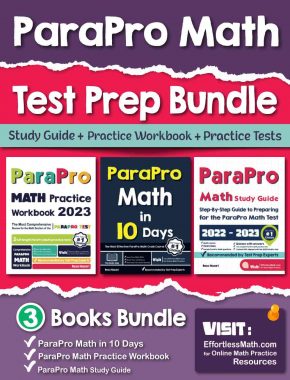
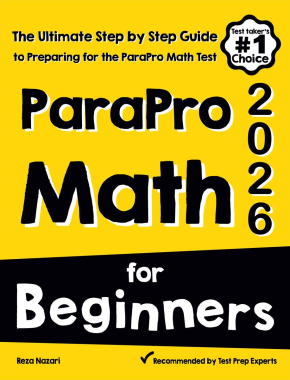
For a workbook to study alongside this practice test, the ParaPro Math for Beginners (resource currently unavailable) is an optional review resource. Check the product page and your required assessment code before purchasing. For another review option, see the ParaPro Math Test Prep Bundle.
What Math Is on the ParaPro?
The ParaPro Assessment has 90 selected-response questions in three subjects: reading, writing and math, about 30 questions each. You get 150 minutes for the whole test, and it is taken on a computer. In each subject, about two-thirds of the questions test basic skills and about one-third ask you to use those skills in a classroom setting, such as checking a student’s work.
Here is what the math questions cover, based on the official ETS test outline:
| Topic area | What it includes |
|---|---|
| Number sense and basic algebra | Whole numbers, fractions, decimals, percents, exponents, order of operations, place value, estimation, word problems, one-step equations, number patterns |
| Geometry and measurement | Telling time, unit conversions, basic shapes, perimeter, area and volume, points on the coordinate plane |
| Data analysis | Reading and making tables, charts and graphs, trends over time, mean, median and mode |
The math is mostly middle school level. Most people who struggle do so with fractions, percent word problems and unit conversions, so give those extra practice after you check your answers below.
Frequently Asked Questions
What kind of math is on the ParaPro test?
ParaPro math covers number sense and basic algebra, geometry and measurement, and data analysis. Expect fractions, decimals, percents, order of operations, simple equations, perimeter and area, unit conversions, and reading tables or graphs. Many questions are set in a classroom, such as finding the average of five quiz scores or helping a student check a fraction problem.
How many questions are on the ParaPro test?
The ParaPro Assessment (test code 1755) has 90 questions, with about 30 each in reading, writing and math, and you get 150 minutes for the whole test. ParaPathways is a different assessment with separately timed subtests, so confirm with your district which test code you need before you plan your practice time.
Can you use a calculator on the ParaPro test?
For the ParaPro Assessment (1755), ETS does not list a calculator as allowed, so plan to do all the math by hand. Practice adding fractions, finding percents and working with decimals on paper. If your district requires ParaPathways instead, check the current ETS instructions for that test, since the rules can differ by assessment.
Is the ParaPro test hard?
Most ParaPro math is at a middle school level, so it is quite manageable with review. The hardest part for many adults is getting back into fractions, percents and formulas after years away from school. Try the 20 practice questions, note which skills you missed, and spend a few short sessions on those topics before test day.
How do I prepare for the ParaPro test?
Start by confirming your test code and the qualifying score your state or district requires. Then take a practice set, such as these 20 math questions, without a calculator. Write down each missed skill, review the lesson for it, and retry similar problems. A week or two of short daily practice is often enough to refresh the core math.
Related EffortlessMath Lessons
If a topic on this practice test feels rusty, these short lessons go deeper:

Related to This Article
More math articles
- The Ultimate 6th Grade ISASP Math Course (+FREE Worksheets)
- How to do the Decomposition of Fractions
- Florida B.E.S.T. Algebra 1 Free Worksheets: Printable B.E.S.T.-Aligned Algebra 1 Practice with Answer Keys
- How to Support Grade 5 Reading at Home: 12 Smart Strategies That Build Independence
- 8th Grade PSSA Math FREE Sample Practice Questions
- Top 10 GRE Math Books: To Help You Succeed on the GRE Math Test
- FREE AFOQT Math Practice Test
- The Best Grade 4 ELA Practice Tests for South Dakota Students
- 5 Best GED Math Study Guides
- Major political events










What people say about "Free ParaPro Math Practice Test With Answers (20 Qs)"?
No one replied yet.