Acids, Bases, and pH: Strength, Concentration, and Logarithms
A pH of 3 and a pH of 4 differ by one pH unit, but the corresponding hydrogen-ion activities differ by a factor of ten. The logarithmic scale compresses many acidity into manageable numbers.
In Brønsted-Lowry theory, an acid donates a proton and a base accepts one. The pH scale is defined from hydrogen-ion activity. Introductory dilute-solution calculations often approximate activity using molar concentration. Acid strength describes the extent of ionization under specified conditions, while concentration describes how much acid is present per solution volume.
How do you calculate an introductory pH?
For a sufficiently dilute aqueous solution in the classroom concentration model, use
\[ \mathrm{pH}\approx-\log_{10}[\mathrm{H_3O^+}], \]
with the concentration entered numerically in mol/L. If \([\mathrm{H_3O^+}]=1.0\times10^{-3}\,\mathrm{mol/L}\), the calculated pH is 3.00. The two significant figures in the concentration correspond to two decimal places in the logarithmic result.
Conversely, a pH of 4.00 corresponds approximately to \(1.0\times10^{-4}\,\mathrm{mol/L}\) hydronium in that model.
Worked example: compare two solutions
Solution A has pH 3.00, and solution B has pH 5.00. The two-unit difference corresponds to
\[ 10^{5.00-3.00}=100. \]
Solution A has 100 times the hydrogen-ion activity of solution B. The lower pH indicates greater acidity. The factor compares the activities represented by the pH values, not the total number of acid molecules in unspecified volumes.
How are pH and pOH connected?
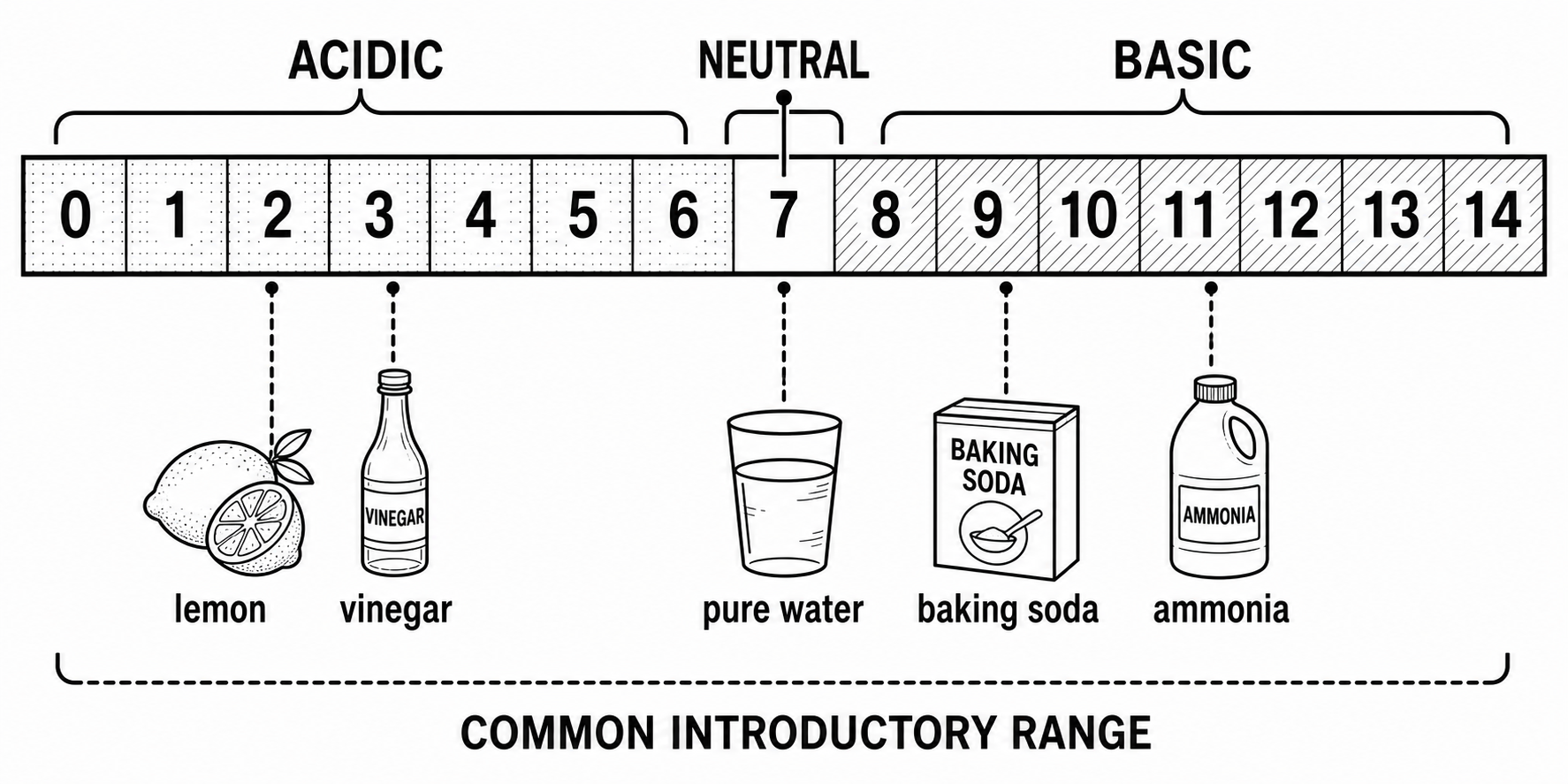
At 25 degrees Celsius, the introductory water relation gives \(\mathrm{pH+pOH}\approx14.00\). A pOH of 3.00 therefore corresponds to pH 11.00. The neutral condition is equal hydrogen-ion and hydroxide-ion activities, giving pH approximately 7.00 at that temperature.
The water ionization constant changes with temperature. Neutral pH is therefore not always 7. A pH scale diagram showing 0 through 14 is a common introductory range, and values outside that range can occur.
Why are strong and concentrated different words?
A strong acid ionizes extensively in water under the usual introductory conditions. A concentrated solution contains a large amount per unit volume. A dilute strong acid and a concentrated weak acid are both possible descriptions.
- Identify the acid-base model and temperature.
- Distinguish given analytical concentration from equilibrium hydronium concentration.
- Use the appropriate equilibrium or strong-acid approximation.
- Check the logarithm, sign, and requested precision.
Never use taste or direct contact to classify a laboratory acid or base.
Can you apply the idea?
-
In Brønsted-Lowry theory, what does a base do?
Check your answer
It accepts a proton.
-
Find pH for \([\mathrm{H_3O^+}]=1.0\times10^{-2}\,\mathrm{M}\) in the dilute-solution model.
Check your answer
\(2.00\).
-
At 25 degrees Celsius, pOH is 4.00. Find pH.
Check your answer
10.00, using the introductory sum of 14.00.
-
How does hydrogen-ion activity change when pH decreases by one unit?
Check your answer
It increases by a factor of ten.
-
Does the word strong specify an acid solution’s concentration?
Check your answer
No. Strength and concentration describe different properties.
-
Is pH 7 neutral at every temperature?
Check your answer
No. Neutrality depends on equal hydrogen-ion and hydroxide-ion activities, and the neutral pH changes with temperature.
Watch the idea explained
pH and pOH: Crash Course Chemistry #30, CrashCourse.
This selected excerpt runs from 3:34 to 4:39. Water molecules can donate and accept protons, forming hydronium and hydroxide.
Where does this fit?
Use the chemistry learning hub to choose a lesson or practice test. Connect this topic with net ionic equations, buffers and titrations, solutions and concentration, electrochemical cells.
Continue with a chemistry study guide

Related to This Article
More math articles
- Trigonometry Books: Compare 3 Effortless Math Titles
- How to Graph Solutions to Linear Inequalities?
- Grade 3 Math: Even and Odd Numbers
- The Ultimate 7th Grade PARCC Math Course (+FREE Worksheets)
- How to Divide Rational Expressions? (+FREE Worksheet!)
- How to Combine Like Terms? (+FREE Worksheet!)
- Roles, Conflict, Strain, and Exit
- Presidential relations with Congress
- 8th Grade WVGSA Math Worksheets: FREE & Printable
- Reaganomics, Union Decline, Inequality, and Deregulation




















What people say about "Acids, Bases, and pH: Examples and Practice"?
No one replied yet.