Buffers and Titrations: Endpoint vs. Equivalence
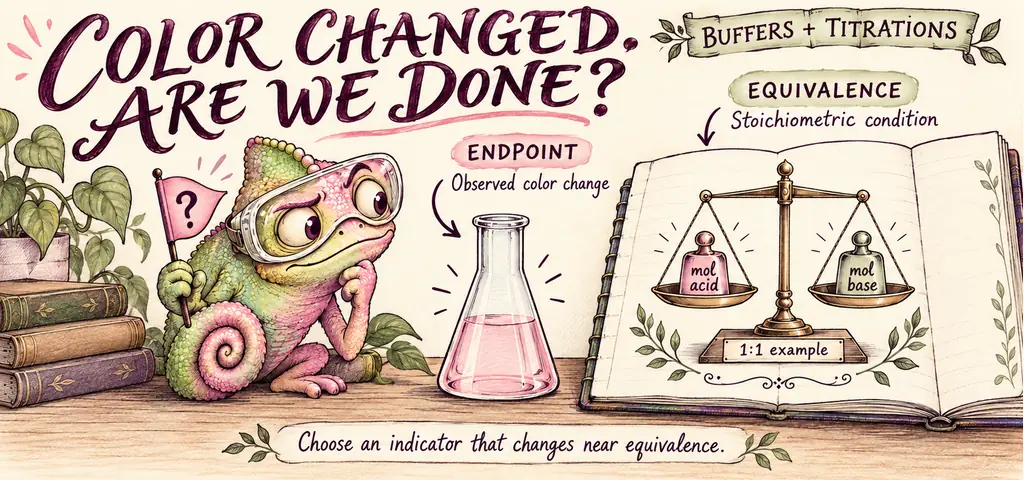
A buffer contains appreciable amounts of a weak acid and its conjugate base, or a weak base and its conjugate acid. It resists modest pH changes by consuming added acid or base. Titration determines an unknown amount using a measured reacting solution. Equivalence is stoichiometric completion, while an endpoint is the observed signal used to detect it.
A buffer can absorb a small addition of acid with a modest pH change. It has a limited capacity, however. A titration explores how composition and pH change as a measured amount of another reagent is added.

How does a conjugate pair resist pH change?
In an acetic acid-acetate buffer, acetate reacts with added acid, and acetic acid reacts with added base. Both components must be present in useful amounts. Enough added acid can consume most of the acetate and exhaust the buffer’s capacity in that direction.
Under the usual buffer approximations, the Henderson-Hasselbalch equation is
When the conjugate-base and acid amounts are equal in the same volume, their ratio is one and the logarithm is zero. The buffer pH is then approximately the acid’s pKa.
Worked example: use titration stoichiometry
A 25.00 mL sample of a monoprotic acid reaches equivalence after addition of 20.00 mL of 0.1000 M sodium hydroxide. Assume a one-to-one acid-base reaction.
The initial acid amount is the same. Divide by the original acid-sample volume:
The combined final mixture volume is not the denominator for the original acid concentration.
Why are endpoint and equivalence different?
Equivalence describes the reaction’s stoichiometric relationship. An indicator endpoint is the color change you observe. Choose an indicator whose transition range falls within the steep part of the titration curve near equivalence.
The equivalence-point pH depends on the reacting acid and base. A weak acid titrated with a strong base commonly gives a basic equivalence solution because its conjugate base reacts with water. Equivalence does not automatically mean pH 7.
How should you approach a titration calculation?
- Write the balanced acid-base reaction.
- Convert the delivered titrant volume to moles.
- Apply the stoichiometric ratio at equivalence.
- Use the original sample volume for its original concentration.
- State whether the observed endpoint is being used as an approximation to equivalence.
Can you apply the idea?
-
Which pair can form an acid buffer?
Check your answer
A weak acid and an appreciable amount of its conjugate base.
-
What happens when the base-to-acid ratio in the buffer equation is one?
Check your answer
The logarithm is zero, so pH is approximately pKa.
-
Can a buffer resist unlimited added acid?
Check your answer
No. Its reactive components can be depleted.
-
What is the difference between endpoint and equivalence?
Check your answer
Endpoint is an observed signal. Equivalence is the stoichiometric condition.
-
How many moles are in 10.00 mL of 0.2000 M titrant?
Check your answer
\(0.002000\,\mathrm{mol}\).
-
Is every equivalence-point solution neutral?
Check your answer
No. The acid-base properties of the species remaining at equivalence determine its pH.
Watch the idea explained
Buffers, the Acid Rain Slayer: Crash Course Chemistry #31, CrashCourse.
This selected excerpt runs from 2:26 to 3:29. A buffer contains a weak acid and its conjugate base.
Where does this fit?
Use the chemistry learning hub to choose a lesson or practice test. Connect this topic with acids, bases, and ph, electrochemical cells, net ionic equations, organic chemistry basics.
Sources for Further Study
OpenStax Chemistry 2e provides further reading on buffer composition, capacity, and pH and acid-base titration curves and indicators.
Continue with a chemistry study guide

Related to This Article
More math articles
- Education and Social Reproduction
- Best Laptop for High School Students in 2026
- Praxis 8003 Fraction Division: Read the Model, Then Choose the Operation (2027 Prep)
- Full-Length 8th Grade Common Core Math Practice Test-Answers and Explanations
- Chapter 21: Assembly, Association, and Petition
- The Best Grade 3 Math Book for Utah Students
- FREE 5th Grade MCAS Math Practice Test
- Quotient Quickies: How to Navigate Decimal Division with Estimations
- Algebra Puzzle – Challenge 48
- How to Solve the Frequency Distribution Table?






What people say about "Buffers and Titrations: Endpoint vs. Equivalence"?
No one replied yet.