Environmental Chemistry: Carbon, Water and Nutrients
Environmental chemistry studies substances, reactions, and transport in air, water, soil, and living systems. It follows chemical forms and quantities as matter moves between reservoirs. Concentration, exposure, reaction conditions, and timescale all matter. A useful environmental explanation connects a source to a pathway and a measurable effect.
Carbon moves among air, water, organisms, and rocks. Following that movement helps explain why a change in one place can affect another. Environmental chemistry combines chemical reactions with the movement of matter through connected systems.
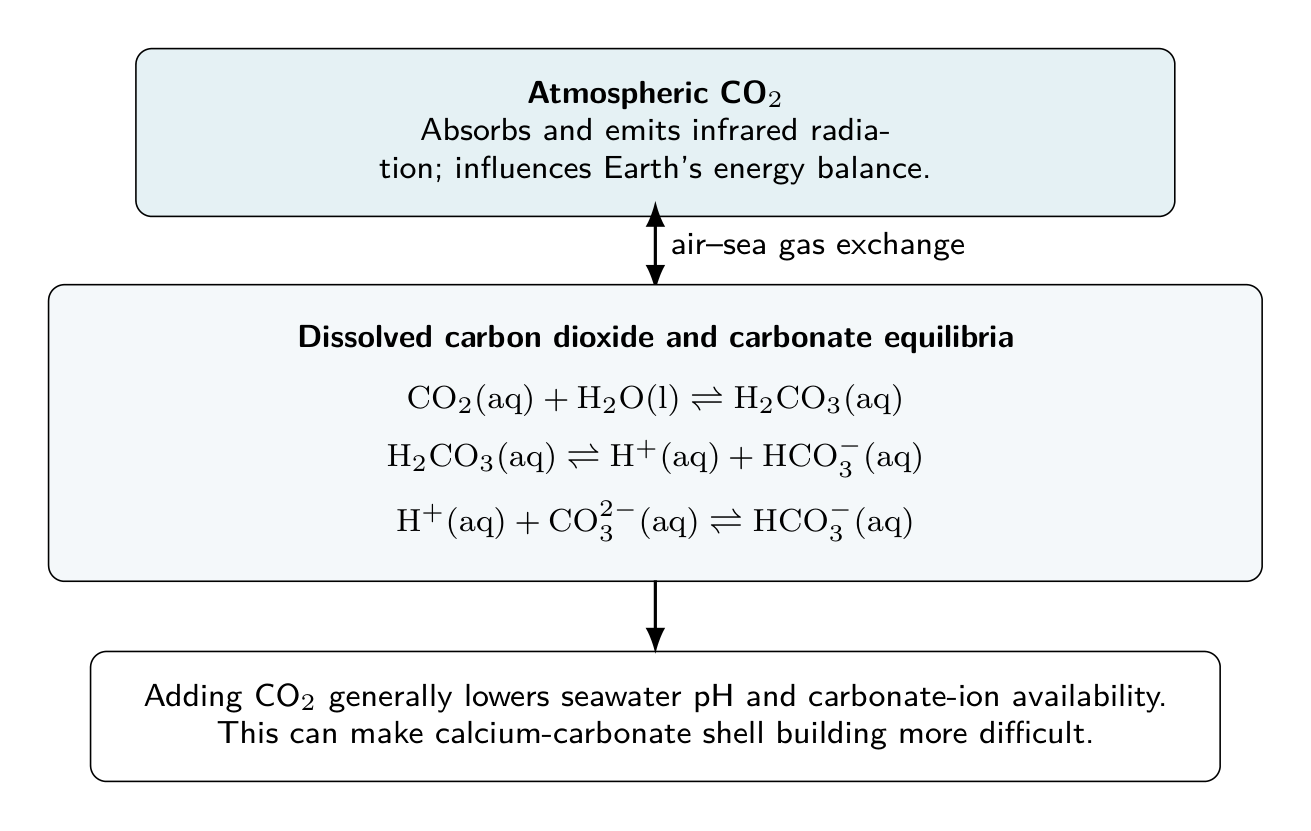
How does carbon move between reservoirs?
Photosynthesis incorporates carbon dioxide into organic matter. Respiration and decomposition return carbon to the surroundings in forms that depend on the conditions. Combustion transfers carbon from fuels into combustion products, including carbon dioxide when combustion is complete.
The ocean exchanges carbon dioxide with the atmosphere. Dissolved carbon dioxide participates in acid-base equilibria involving carbonic acid, bicarbonate, and carbonate. Adding carbon dioxide can lower seawater pH without making the seawater acidic in the everyday sense of falling below pH 7.
Worked example: trace an oxygen-loss pathway
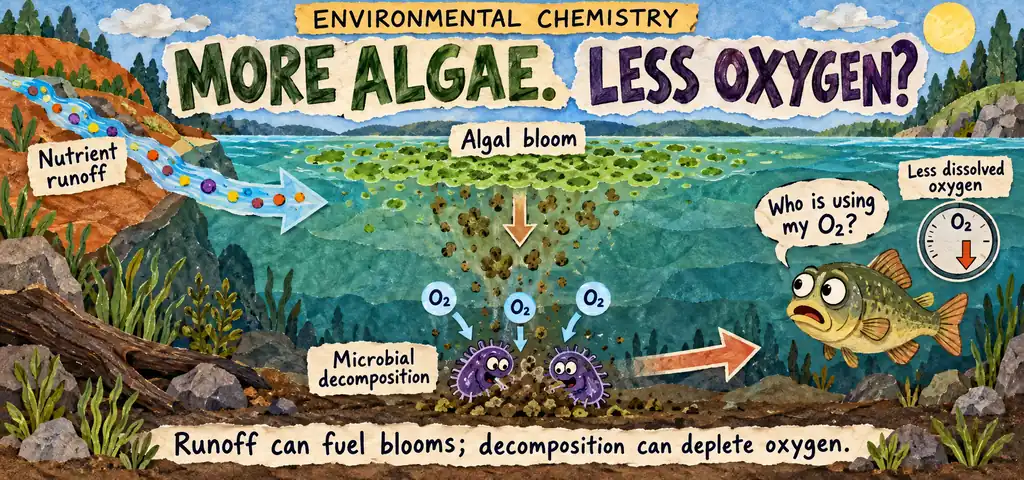
Consider a hypothetical lake receiving increased nutrient runoff. Extra available nutrients can support an algal bloom when other growth conditions permit. When algae die, microbial decomposition can consume dissolved oxygen. That oxygen loss can stress aquatic organisms.
The claim is a chain of processes: nutrient input, increased biomass, decomposition, and oxygen consumption. Evidence might include measured nutrient concentrations, bloom observations, and dissolved-oxygen readings over time. A photograph of green water alone cannot establish every link.
How do you interpret concentration data?
A water sample contains 2.0 mg of a dissolved substance in 1.0 L. Its concentration is \(2.0\,\mathrm{mg/L}\). If a reported concentration falls, ask whether material was removed, chemically transformed, or simply diluted by added water.
A lower concentration does not necessarily mean a lower total amount. Compare both concentration and volume when total loading matters.
| Concentration | Water volume | Total dissolved amount |
|---|---|---|
| 2.0 mg/L | 1000 L | 2.0 g |
| 1.0 mg/L | 3000 L | 3.0 g |
Multiply concentration by volume to find total amount: 2.0 mg/L × 1000 L = 2000 mg = 2.0 g. The second sample has a lower concentration but contains more dissolved substance.
What makes a cause-and-effect explanation convincing?
- Name the source and the chemical form involved.
- Trace transport and reactions.
- Identify the affected reservoir or organism.
- Use measurements that test the proposed links.
- Consider competing explanations and the relevant timescale.
A pollution-control strategy should be assessed across its full process, including energy use and waste production. Moving a substance elsewhere is different from removing or transforming it.
Can you apply the idea?
-
Name a process that transfers carbon from atmospheric carbon dioxide into organic matter.
Check your answer
Photosynthesis.
-
Does ocean acidification require seawater pH to fall below 7?
Check your answer
No. It describes a decrease in pH, even while seawater remains on the basic side of neutral under those conditions.
-
How can an algal bloom contribute to oxygen depletion after algae die?
Check your answer
Microbial decomposition can consume dissolved oxygen.
-
A concentration decreases while water volume triples. Can total dissolved amount still increase?
Check your answer
Yes. Total amount depends on both concentration and volume.
-
What unit expresses milligrams of dissolved substance per liter?
Check your answer
mg/L.
-
Why does one photograph rarely establish an entire environmental causal chain?
Check your answer
It captures a limited observation. Measurements of sources, processes, and effects are needed to test the links.
Watch the idea explained
The Global Carbon Cycle: Crash Course Chemistry #46, CrashCourse.
This selected excerpt runs from 4:59 to 6:27. Respiration returns carbon to air and water; dissolved carbon can participate in aquatic chemistry.
Where does this fit?
Use the chemistry learning hub to choose a lesson or practice test. Connect this topic with household chemistry, materials chemistry, chemistry of life, chemistry laboratory safety.
Sources for Further Study
NOAA explains carbon dioxide uptake and ocean acidification. The EPA reviews nutrient pollution and its effects on aquatic systems.
Continue with a chemistry study guide


Related to This Article
More math articles
- Reading Scientific Data Tables
- How to Find Mean, Median, Mode, and Range of the Given Data? (+FREE Worksheet!)
- Top 10 7th Grade Common Core Math Practice Questions
- Math Games That Actually Teach: 12 Games Worth Your Time
- The Best Grade 5 ELA Practice Tests for South Dakota Students
- Adding Money Amounts for 4th Grade
- 6th Grade M-STEP Math Worksheets: FREE & Printable
- How to Prepare for the ALEKS Math Test?
- Regulation of interstate commerce
- The Ultimate 7th Grade LEAP Math Course (+FREE Worksheets)




What people say about "Environmental Chemistry: Carbon, Water and Nutrients"?
No one replied yet.