Organic Chemistry Basics: Isomers and Functional Groups
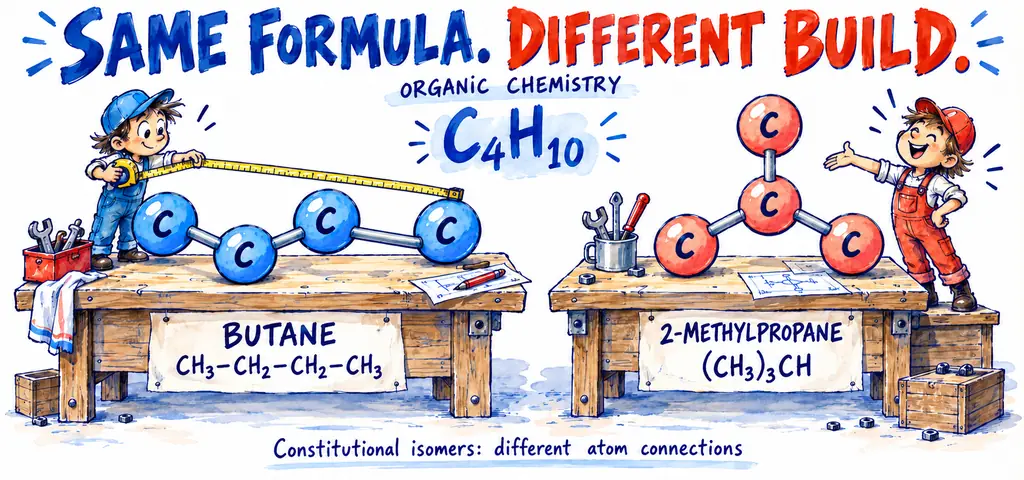
Organic chemistry studies carbon compounds, especially their structures, reactions, and relationships between structure and properties. Carbon forms varied chains, branches, and rings. Functional groups are recognizable atom arrangements associated with characteristic chemistry. Constitutional isomers share a molecular formula but differ in which atoms are connected to which.
Two molecules can have the same molecular formula and different connections between their atoms. Those structural differences can change their properties. Organic chemistry starts by reading the carbon framework and the functional groups attached to it.
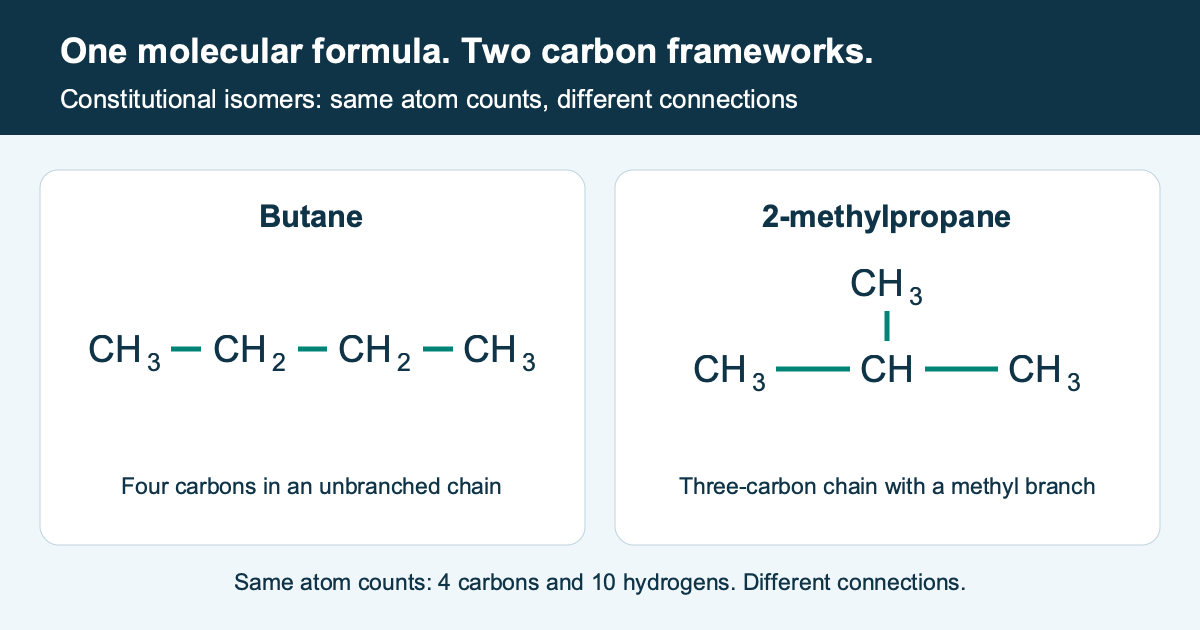
How do carbon skeletons differ?
Carbon commonly forms four bonds in neutral introductory organic structures. An alkane is an acyclic saturated hydrocarbon containing only single bonds. Methane is the simplest example; it has no carbon-carbon bond. An alkene contains a carbon-carbon double bond, and an alkyne contains a carbon-carbon triple bond. Rings and multiple bonds change the hydrogen count relative to an open saturated chain.
For an acyclic saturated hydrocarbon, the general formula is \(\mathrm{C_nH_{2n+2}}\). Apply that relationship only to the class it describes.
Worked example: two structures with one formula
The formula \(\mathrm{C_4H_{10}}\) can describe a straight four-carbon chain, butane, or a branched arrangement, 2-methylpropane. Both have four carbons and ten hydrogens. Their atom connections differ, so they are constitutional isomers.
Turning or rotating a drawing does not automatically create an isomer. Compare connectivity rather than the direction in which the chain is drawn on the page.
What can a functional group tell you?
| Group | Structural feature |
|---|---|
| Alcohol | A hydroxyl group attached to a saturated carbon |
| Carboxylic acid | A carbonyl and hydroxyl on the same carbon |
| Ester | A carbonyl connected to an oxygen bonded to another carbon group |
| Amine | A nitrogen-based group related to ammonia |
A functional group helps predict interactions and reactions, but the rest of the molecule also matters. A long hydrocarbon region can strongly affect how an alcohol interacts with water.
How do you read a skeletal formula?
Each unlabeled line end or corner usually represents carbon. Hydrogens on carbon are omitted and inferred from the usual valence, while other element symbols are shown. Read double and triple bonds explicitly, then check each carbon’s bond count.
- Trace the carbon framework.
- Identify multiple bonds and rings.
- Locate the functional groups.
- Count omitted hydrogens and check the resulting molecular formula.
The word organic describes a field of chemistry. It does not establish that a substance is safe, natural, or suitable for consumption.
Can you apply the idea?
-
What distinguishes constitutional isomers?
Check your answer
They have the same molecular formula but different atom connectivity.
-
What carbon-carbon bond distinguishes an alkene?
Check your answer
A double bond.
-
What is the formula of an acyclic saturated hydrocarbon with three carbons?
Check your answer
\(\mathrm{C_3H_8}\).
-
Does rotating an unchanged molecular drawing create a constitutional isomer?
Check your answer
No. Its connectivity remains the same.
-
In an ordinary skeletal formula, what does an unlabeled corner represent?
Check your answer
A carbon atom, with attached hydrogens inferred as needed.
-
Does classification as organic establish safety?
Check your answer
No. Safety depends on the substance, exposure, and conditions of use.
Watch the idea explained
Hydrocarbon Power!: Crash Course Chemistry #40, CrashCourse.
This selected excerpt runs from 2:25 to 3:49. Recognize methane, ethane, and propane as saturated hydrocarbons.
Where does this fit?
Use the chemistry learning hub to choose a lesson or practice test. Connect this topic with electrochemical cells, chemistry of life, buffers and titrations, household chemistry.
Sources for Further Study
OpenStax Organic Chemistry provides further reading on drawing chemical structures, alkanes and constitutional isomers, and functional groups.
Continue with a chemistry study guide

Related to This Article
More math articles
- Using a Fraction to Write down a Ratio
- Top 5 Books for math teachers
- Harnessing Properties: How to Add Three Fractions or Mixed Numbers with Ease
- FREE 6th Grade FSA Math Practice Test
- The Best Grade 5 Math Book for New York Students
- Free Michigan Grade 2 Math Worksheets for Second Graders
- Top 10 8th Grade FSA Math Practice Questions
- Congressional limits on the executive
- Right to counsel
- Implementation






What people say about "Organic Chemistry Basics: Isomers and Functional Groups"?
No one replied yet.