Multistep Chemistry Problems: Moles to Gas Volume
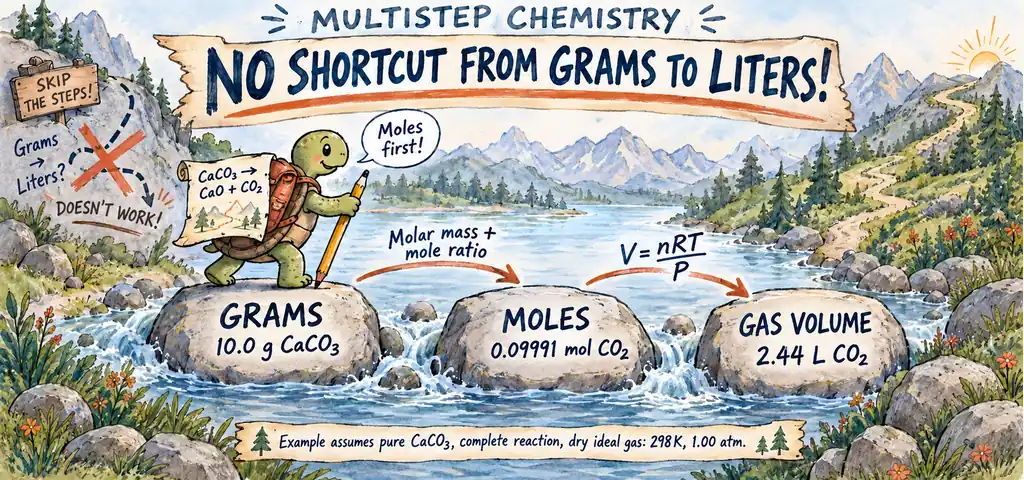
Solve a multistep chemistry problem by mapping the given quantity to the unknown through moles. A problem can begin with grams and end by asking for a gas volume. No single conversion factor connects those quantities in every situation. Identify the reaction, use its mole ratio, and then apply a gas relationship under the stated conditions.
Multistep chemical problem-solving links several physical relationships in a justified order. A balanced equation supplies mole ratios, molar mass connects mass with amount, and an appropriate gas or solution model converts the result into the requested quantity. Units and explicit assumptions make each step checkable and help locate mistakes.
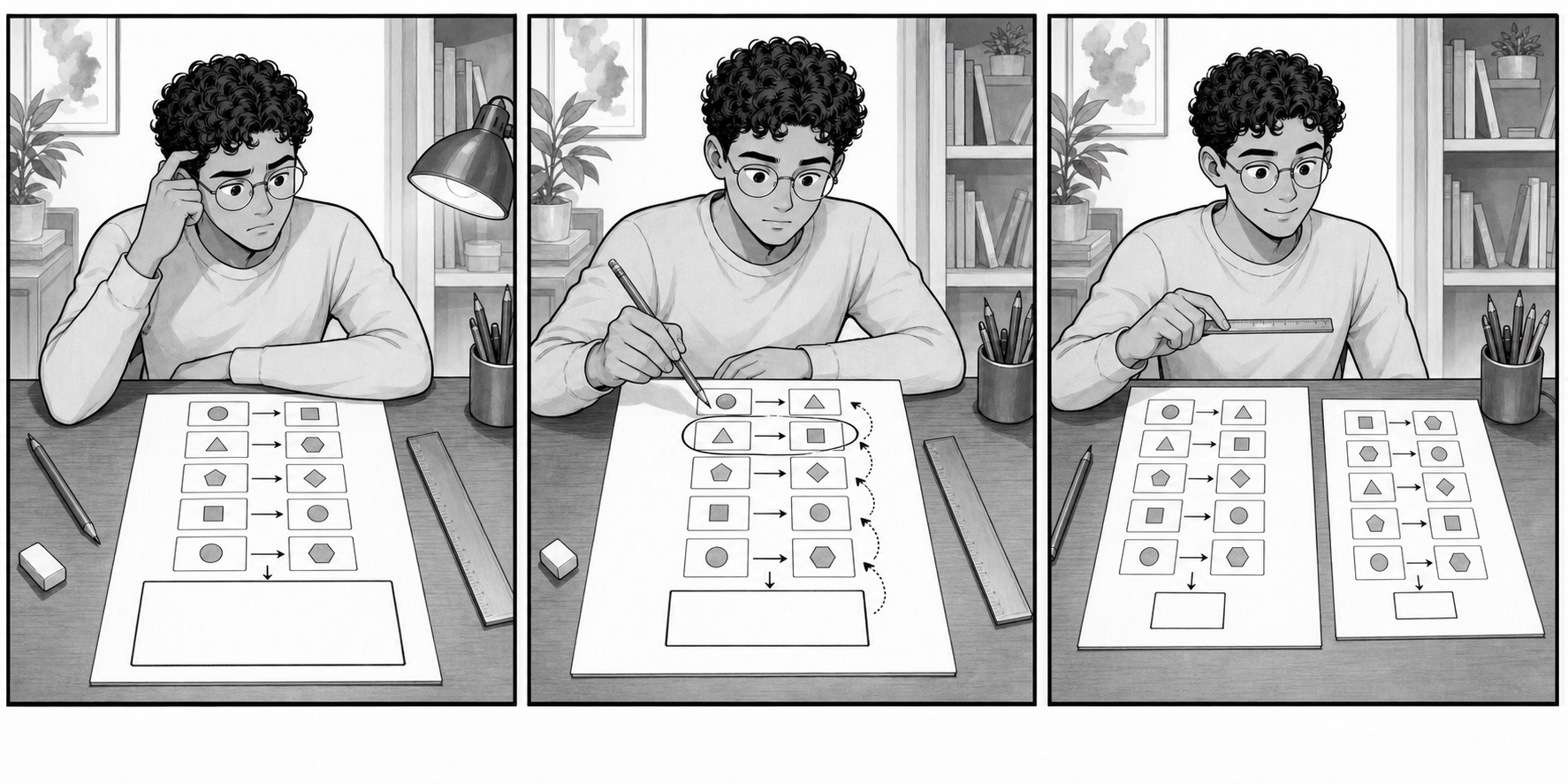
How do you choose the first relationship?
| Step | Relationship and check |
|---|---|
| Mass to moles | Divide by molar mass; grams cancel. |
| Reactant to product | Use coefficients from the balanced equation. |
| Moles to volume | Apply the gas model with compatible pressure and temperature units. |
| Final check | Check the requested unit, assumptions and reasonable size. |
Write the requested quantity and the information supplied. A mass-to-gas-volume problem usually needs a chemical formula, a balanced reaction, and the gas conditions. A titration-to-mass problem needs reaction stoichiometry and concentration information.
Do not select an equation merely because it contains a familiar symbol. Explain what the relationship contributes to the path from the given quantity to the unknown.
Worked example: solid mass to gas volume
In a theoretical decomposition calculation, 10.0 g of pure calcium carbonate reacts completely according to
\[ \mathrm{CaCO_3(s)\rightarrow CaO(s)+CO_2(g)}. \]
Use a molar mass of 100.09 g/mol. The one-to-one ratio gives
For dry carbon dioxide at 298 K and 1.00 atm, assuming ideal behavior, use \(R=0.08206\,\mathrm{L\,atm\,mol^{-1}\,K^{-1}}\). Then
Keep unrounded values through the calculation. Complete decomposition, purity, dry gas, and ideal behavior are explicit assumptions. This is a paper calculation, not a heating procedure.
How would collection over water change the problem?
If gas is collected over water, the total pressure includes water vapor. Under the stated equilibrium assumptions, use \(P_{\mathrm{gas}}=P_{\mathrm{total}}-P_{\mathrm{water\ vapor}}\) before applying the gas equation. The water-vapor pressure must match the collection temperature. This pressure correction alone does not account for gas dissolving in or reacting with the collection liquid.
Ignoring water vapor overestimates the pressure attributable to the dry gas. Whether that makes the final answer too high or too low depends on which quantity you solve for, so inspect the equation.
How do you diagnose an incorrect answer?
- Check the starting formula and balanced equation.
- Verify that mass became moles before applying a mole ratio.
- Inspect every unit cancellation.
- Check temperature scale and pressure assumptions.
- Compare the answer with an estimate.
In the example, about one tenth of a mole at room temperature and one atmosphere should occupy a few liters. An answer of thousands of liters would signal a conversion or scale error.
Can you apply the idea?
-
Why convert grams to moles before using balanced coefficients?
Check your answer
The coefficients express amount or particle ratios, not mass ratios.
-
In the example, how many moles of \(\mathrm{CO_2}\) form per mole of \(\mathrm{CaCO_3}\)?
Check your answer
One, from the balanced equation.
-
What temperature scale belongs in the ideal gas law?
Check your answer
Kelvin.
-
What extra pressure contribution matters for gas collected over water?
Check your answer
Water-vapor pressure at the collection temperature.
-
Why keep unrounded intermediate values?
Check your answer
Repeated rounding can accumulate error before the final result.
-
Name one assumption in the worked example that real measurements would need to establish.
Check your answer
Complete reaction, sample purity, dry gas, or the adequacy of the ideal-gas approximation.
Watch the idea explained
Ideal Gas Problems: Crash Course Chemistry #13, CrashCourse.
This selected excerpt runs from 4:12 to 6:17. Calculate ideal-gas molar volume and distinguish 100 kPa from 1 atm. Use the exact conversion 1 atm = 101.325 kPa; at 273.15 K, the corresponding ideal-gas molar volumes are about 22.7 L/mol and 22.4 L/mol.
Where does this fit?
Use the chemistry learning hub to choose a lesson or practice test. Connect this topic with chemistry laboratory safety, chemistry final review, materials chemistry, environmental chemistry.
Check the Methods
OpenStax Chemistry 2e explains reaction mole ratios, the ideal gas law and gas mixtures and collection over water.
Continue with a chemistry study guide

Related to This Article
More math articles
- Same-Game Parlays: Why That 50/1 Payout Is Smaller Than It Looks
- Lynching, Ida B. Wells, Washington, Du Bois, and Black Institution Building
- Calculating the Surface Area of Prisms and Cylinders
- Amicus curiae briefs
- Full-Length 8th Grade ACT Aspire Math Practice Test-Answers and Explanations
- 10 Tips for Advanced Studying Mathematics
- Top 10 ACT Math Practice Questions
- An In-depth Exploration of How to Find the Codomain
- Why Interactive Challenges Improve Math Skills More Than Memorization
- Structural Reform and the Sixteenth and Seventeenth Amendments








What people say about "Multistep Chemistry Problems: Moles to Gas Volume"?
No one replied yet.