Same-Game Parlays: Why That 50/1 Payout Is Smaller Than It Looks
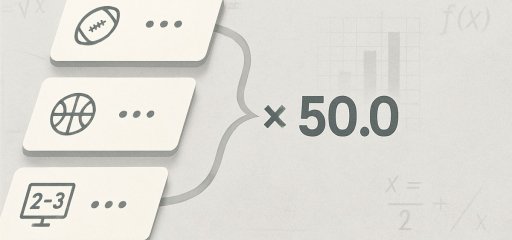
You’ve seen the screenshots. Five-dollar same-game parlay turns into a $250 cashout, the bettor posts it to X, the sportsbook reposts it, and the engagement flywheel spins for another week. What you don’t see is the math underneath, and that math is the whole reason these tickets exist on the app’s front page. Same-game parlays, or SGPs, are the highest-margin product on a modern sportsbook menu, and the gap between the payout you’re offered and the payout you’d get from a fair bookmaker can be brutal.
I’ve been digging into sports betting math for a while now, and SGPs are the one product where I still see sharp friends shrug and say “it’s just for fun.” Fine, but let’s at least understand what we’re paying for the fun.
What an SGP actually is
A same-game parlay bundles two or more bets from a single game into one ticket. Maybe you take the Chiefs moneyline, the over on total points, and Patrick Mahomes over 274.5 passing yards. All three need to hit. If any one leg loses, the whole ticket dies. If they all win, the sportsbook pays a single combined price.
Traditional parlays, the old-school kind where you’d combine three different games, assume the legs are independent. The fair price is just the product of each leg’s fair odds, adjusted for the book’s vig. SGPs can’t use that math, because the legs aren’t independent. If Mahomes throws for 350, the total is probably going over. If the Chiefs win by 21, the total is probably going over too. The outcomes lean on each other.
Correlation is the whole story
When outcomes are positively correlated, the combined probability is higher than the product of the individual probabilities. So if you naively multiplied a fair parlay price, you’d be overpaying the bettor. Sportsbooks know this. They run correlation models, some proprietary, some based on play-by-play simulations, and they shade the SGP price accordingly.
Here’s where it gets interesting. The book’s correlation estimate doesn’t have to be right. It has to be defensible enough that no regulator complains, and tilted enough that the house gets paid. In practice, books tend to under-credit positive correlation when it helps the bettor and over-credit it when it helps themselves. The result is a product that looks generous on the boost banner and is anything but.
A worked example
Take a three-leg NFL SGP: Chiefs win, over the total, Mahomes over passing yards. Suppose each leg’s fair probability looks like this:
- Chiefs win: 60% (fair price about -150)
- Over the total: 50% (fair price about +100)
- Mahomes over passing yards: 50% (fair price about +100)
Multiplied as if they were independent, the combined fair probability is 0.60 × 0.50 × 0.50 = 15%, or roughly +567 in American odds. But these legs are correlated. A realistic correlation adjustment, and yes, this is approximate, but it’s in line with what public simulators put out, pushes the true combined probability up to about 19-20%. Call it 20%. The fair price for a 20% shot is +400, or 4-to-1.
Now check what the app actually offers. Most major U.S. Books on a parlay like this will list something around +250 to +300. Let’s say +275. Here’s the comparison.
| Outcome | True probability | Fair payout | Sportsbook payout | Implied hold |
|---|---|---|---|---|
| 3-leg SGP wins | 20% | +400 (4-to-1) | +275 (2.75-to-1) | ~25% |
| Aggressive 3-leg SGP | 4% | +2400 (24-to-1) | +1500 (15-to-1) | ~36% |
| Straight moneyline (Chiefs -150) | 60% | -150 | -160 | ~4% |
Read that third column twice. A straight moneyline on the same game carries maybe a four to five percent hold. Bundle those legs into an SGP and the hold jumps to a quarter or a third of every dollar wagered. Same game. Same teams. Same outcomes. Wildly different tax.
What the industry data says
This isn’t a hypothetical. Wizard of Odds has tracked SGP pricing across major U.S. Books and consistently finds SGP holds averaging in the 20-30% range, with aggressive correlated tickets blowing past 35%. You can dig into the methodology and worked examples on the Wizard of Odds parlay analysis. Independent industry reports, the kind operators don’t love to publicize, land in the same neighborhood.
For comparison, a single-game NFL spread bet runs about 4.5% hold. NBA player props are typically 6-8%. Even traditional three-team parlays on independent games come in around 12-15%. SGPs sit alone at the top of the chart, and they’re not close to anything else on the menu.
Why sportsbooks push them so hard
If you’ve opened a sportsbook app in the last two years you’ve watched the SGP product migrate from a buried submenu to the literal front page. Every featured boost, every “trending bet,” every social-media promo seems to be a same-game parlay. There’s a reason, actually three reasons.
- Margin. SGPs are the highest-hold product in the building. A book that can shift even 10% of straight-bet volume into SGPs roughly doubles revenue on that slice.
- Recreational appeal. Casual bettors don’t care about hold. They care about the dream, five bucks turning into five hundred. SGPs sell that dream cheaply.
- Content economics. A winning SGP screenshot is a free marketing asset. Books actively reward big wins with social amplification, knowing that for every viral hit there are a thousand silent losing tickets that no one posts.
That last point is the one I find most cynical. The entire SGP marketing playbook is built on survivorship bias. You’ll see the +5000 winners on your timeline because winners post. You won’t see the +5000 losers because losing tickets don’t go viral, and you don’t tag your buddies in a screenshot of the four legs that hit before the fifth one died.
An opinion you didn’t ask for
The social-media screenshot economy has rewired how this product is sold. Books used to compete on price. Now they compete on which app produces the most postable wins per dollar of marketing spend. SGPs are perfect for that. They generate occasional huge multipliers, the screenshot looks great, and the average user has no way to compute the true odds. It’s a feedback loop that pushes the product harder than the math justifies. I don’t think most casual bettors would touch SGPs if the hold was printed next to the payout, the way an expense ratio is printed next to a mutual fund. But nobody requires that disclosure, and nobody’s going to.
There’s a reason regulators have started paying attention. The UK Gambling Commission has flagged complex bet bundles as a transparency concern, and U.S. State regulators are slowly noticing that SGP marketing tends to lean on the brightest jackpots while burying the implied price. Don’t hold your breath waiting for mandated hold disclosure, though. Two regulatory cycles away, maybe more.
How to think about it before you bet
I’m not telling anyone to never tap an SGP. They’re entertaining, the dream is real, and a $5 ticket isn’t a financial decision. But there’s a useful frame for keeping the math honest:
- Treat the payout as entertainment, not value. If the same legs as separate bets would pay you more in expected value, and they almost always do, you’re buying a lottery ticket, not making a wager.
- Watch the correlation direction. The book under-prices positive correlation more often than negative. A “team to win + opponent under their team total” ticket can be priced more fairly than “team to win + over the game total.”
- Ignore the screenshot economy. The +5000 winners you see online are the survivors of a much larger pool. Survivorship bias is doing 80% of the marketing work.
- Cap your SGP volume. If you’ve decided SGPs are your entertainment line item, fine, but don’t let them creep into the bankroll-management bucket. They belong in the same column as a movie ticket.
One personal observation: when I started actually tracking my own SGP tickets, every leg, every price, every result, versus what the same legs would have paid as straights, the gap was bigger than I’d guessed. It wasn’t close. After about three months I quietly retired SGPs from anything that wasn’t pure recreation. Your mileage may vary, but I’d encourage anyone curious to keep a spreadsheet for a season. The number tends to speak for itself.
FAQ
Are SGPs always a bad bet? Not always. There are situations where the book’s correlation model under-prices a correlated combo and a sharp bettor can find positive expected value. Those situations exist. They’re rare, they require a real model, and they aren’t the SGPs being pushed in the promo carousel.
How is an SGP different from a traditional parlay? A traditional parlay combines legs from different games, which are treated as independent. The math is straightforward multiplication of fair odds. An SGP combines legs from a single game, where outcomes are correlated, and the book uses a proprietary correlation model to set the price. The math is opaque by design.
Why do sportsbooks even allow SGPs if some legs correlate so strongly? Because they price them. A few combinations, like a player to score the first touchdown AND the team to win, are sometimes blocked outright if the correlation is extreme. Most correlated combos are simply priced to a margin that makes them profitable for the house regardless of how the correlation lands.
Is the SGP hold the same across books? No, but it’s in the same range. DraftKings, FanDuel, BetMGM, Caesars, and the rest cluster between 20% and 30% on typical recreational SGPs, with outliers in either direction. You can find slight pricing differences between books on the same combo, sometimes worth a few percent of expected value, sometimes not.
What about boosted SGPs? Boosts can occasionally turn a 30% hold into a 5-10% hold, which is more competitive but rarely a true edge. Books offer boosts because they know boosted tickets generate volume, and the residual margin is still positive on most of them. The phrase “boosted to +800” sounds like a gift. It’s usually a discount on a product that was overpriced to begin with.
Can I calculate the hold myself? Roughly, yes. Convert the offered American odds to implied probability, do the same for each leg, multiply the leg probabilities, apply a rough correlation bump (10-30% depending on how related the legs are), and compare. If the implied SGP probability is more than five or ten points higher than the offered probability, you’re looking at a sizeable hold. There are also free SGP calculators that automate this, the Wizard of Odds page linked above is a reasonable starting point.
Where can I learn more about the underlying probability math? If you want to go deeper into how to compute fair odds, correlation, and expected value from first principles, the math side is genuinely fun. There’s a primer worth reading at Effortless Math that walks through probability fundamentals, the same building blocks that sit underneath every SGP price you’ve ever seen.
Closing thought
SGPs aren’t a scam. They’re a product, priced to a margin that the average bettor doesn’t see and doesn’t ask about. The 50-to-1 ticket on your screen is real, it’ll pay if all the legs hit, but it’s not the 50-to-1 a fair bookmaker would offer on the same outcomes. Somewhere between half and two-thirds of that perceived value is being kept by the house as the price of bundling. That’s the trade. Knowing it doesn’t make you smarter than the book. It just makes you a little harder to market to, which, in 2026, might be the best a casual bettor can hope for.

Related to This Article
More math articles
- Government, Economic Systems, Globalization, and Trade
- Theme and How It Is Supported
- 4th Grade PARCC Math Worksheets: FREE & Printable
- The New Left, Counterculture, and Student Protest
- Labeling and Special Identifiers
- 8th Grade MCAS Math Worksheets: FREE & Printable
- How to Tutor Your Child in Math at Home (Parent’s Guide)
- Introduction to Limits: A First Look at Calculus for 2026
- How to Prepare for the CLEP College Mathematics Test?
- The Best Grade 4 Math Book for Georgia Students









What people say about "Same-Game Parlays: Why That 50/1 Payout Is Smaller Than It Looks - Effortless Math"?
No one replied yet.