Structural Reform and the Sixteenth and Seventeenth Amendments
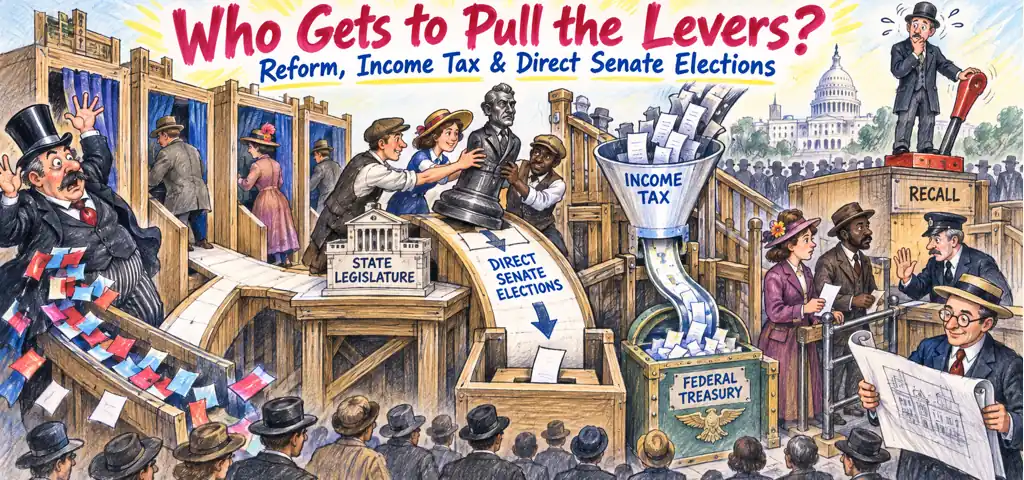
Chapter 6 of the CLEP History of the United States II study guide on Effortless Math covers Structural Reform and the Sixteenth and Seventeenth Amendments: the key terms, the core ideas, and worked examples showing how this topic is tested on the exam.
CLEP History of the United States II, Chapter 6
Structural reform changed the route to power
Progressives often argued that corrupt outcomes arose from political machinery rather than simply bad individuals. They redesigned ballots, nominations, lawmaking, municipal administration, taxation, and representation. Each reform shifted a decision from one actor to another: parties to government printers, conventions to primary voters, legislatures to citizens, state legislatures to voters choosing senators, or ward councils to professional managers. Structural change could weaken a machine while creating new barriers for people with less information, time, or legal access. Ask who gains the decision, whether a measure carried the word reform.
The Australian ballot weakened party control
Before reform, parties printed colored tickets and distributed them near polling places, making a voter's choice visible and facilitating bribery or intimidation. The Australian ballot was government printed, listed all qualifying candidates, and was marked privately at an official polling place. States adopted it widely from the late 1880s. Secrecy reduced party surveillance, but literacy requirements and complex registration could exclude voters. It was not a ticket printed and handed out by parties; ending that practice was central to the design.
Direct democracy contained three mechanisms
An initiative lets voters place a proposed law or constitutional amendment on the ballot through petitions. A referendum sends a legislative measure to voters for approval or rejection. A recall election allows voters to remove an official before a term ends. These tools did not perform the same task. Oregon voters adopted initiative and referendum in 1902, and western states became important laboratories. Reformers hoped direct lawmaking would bypass legislatures influenced by railroads and machines, although organized interests could also dominate petition and advertising campaigns.
The direct primary opened nomination
A direct primary lets a party's voters choose nominees instead of leaving selection to a convention or party committee. Wisconsin under Robert La Follette adopted a direct primary and combined it with railroad and tax regulation and consultation with university experts, a program known as the Wisconsin Idea. Primaries weakened some bosses but did not abolish parties or guarantee broad turnout. Their object was nomination, whereas initiative and referendum concern laws and recall concerns tenure in office.
Municipal plans separated authority differently
After the 1900 hurricane, Galveston adopted a commission government in which a small elected board combined legislative authority with executive control of departments. The council-manager plan, spreading after Staunton and Dayton experiments, retained an elected council that hired a professional manager for administration. Commission members themselves headed departments; a manager was appointed for expertise and answerable to the council. Both aimed to displace fragmented ward patronage with coordinated administration, but their democratic accountability differed.
Reform mayors challenged private franchises
Detroit mayor Hazen Pingree and Cleveland mayor Tom Johnson attacked streetcar and utility franchises, demanded lower fares, improved taxation, and sometimes advocated municipal ownership. Private companies depended on public streets and long franchises, so the rate question was also a question of democratic control over valuable public grants. Reformers might favor public ownership, stricter contracts, or competition. The shared issue was whether a private monopoly could convert a city franchise into unaccountable power.
The Sixteenth Amendment secured income-tax power
The Supreme Court's Pollock v. Farmers' Loan and Trust Co. Decision in 1895 treated taxes on income from property as direct taxes requiring apportionment among states by population, making a practical national income tax difficult. Ratified in 1913, the Sixteenth Amendment authorized Congress to tax incomes from whatever source without apportionment and without regard to a census. It did not itself create every later rate or abolish tariffs. It removed a constitutional obstacle so Congress could enact a graduated income tax.
The Seventeenth Amendment changed senatorial selection
The original Constitution assigned selection of United States senators to state legislatures. Reformers blamed legislative deadlocks and corporate influence and promoted popular election. States developed advisory votes and other workarounds before the Seventeenth Amendment, ratified in 1913, required direct election by each state's voters and addressed vacancies. The amendment transferred the selector, not the Senate's equal representation of states or six-year terms. Direct election should not be confused with initiative, which places laws on a ballot.
House insurgents weakened Speaker Cannon
Speaker Joseph Cannon controlled committee appointments and the Rules Committee, allowing him to block legislation. In March 1910, Republican insurgents joined Democrats to remove the Speaker from the Rules Committee and strip his power to appoint its members. Cannon remained Speaker, but institutional control shifted. The revolt resembles other structural reforms because it changed agenda-setting authority rather than deciding one substantive policy.
Woman suffrage advanced first through western states
Wyoming Territory granted women full voting and officeholding rights in 1869 and entered the Union with suffrage in its constitution in 1890. Colorado in 1893 became the first state where male voters approved full woman suffrage by referendum. Utah and Idaho followed in 1896; Washington, California, Arizona, Kansas, and Oregon joined by 1912. Western adoption reflected party competition, organized campaigns, settlement patterns, and local political calculations. It preceded congressional submission of the Nineteenth Amendment by a generation.
Disfranchisement also redesigned structure
Southern constitutional conventions imposed poll taxes, literacy tests, registration hurdles, and party exclusions after 1890. Turnout among eligible southern voters collapsed while remaining much higher elsewhere. These were structural changes too, but their purpose was to restrict rather than democratize participation. Progressive reforms such as the secret ballot and literacy-linked registration could interact with the color line. The label reform does not determine democratic effect; access and administration do.
Federal administration grew through state partnership
The Militia Act of 1903, or Dick Act, made state units that met federal training and equipment standards part of a more organized National Guard supported with federal funds. Confusion mobilizing state volunteers in 1898 helped motivate the change. Like land-grant extension or federal standards, it used national resources to regularize state institutions. Progressive state-building often combined rather than simply replaced levels of government.
Progressive structure contained racial limits
Woodrow Wilson's administration segregated previously integrated federal offices after 1913, separating Black and white clerks through work spaces, screens, lunchrooms, and washrooms. Administrative efficiency language could therefore serve racial exclusion. The episode complicates a celebratory account of expertise: the federal personnel system could become more professional in some respects while reversing equal workplace practice. Structural reform must be assessed by who received access, privacy, voice, and protection.
identify the transferred decision
A petition puts a proposed statute directly before voters; a party election selects a nominee; a charter lets a council hire an administrator.
Democratization depended on access
Ballot secrecy, direct primaries, initiative, referendum, recall, senatorial elections, and municipal redesign all made identifiable changes in political procedure. Yet lower southern turnout and segregated federal offices show that changing procedure did not automatically broaden democracy. A complete evaluation asks whether citizens could register, read the ballot, finance a campaign, circulate petitions, or enter the governing workforce. Structure is power arranged in rules.
Watch the history in motion
This short lesson adds voices, images, and chronology to the ideas you just studied.
Video: The PROGRESSIVE Era, Explained [APUSH Review], Heimler's History.
Try four CLEP-style questions
- A state adopts a direct primary, yet many citizens still cannot complete its burdensome registration process. Which conclusion best follows?
- Opening nominations to party voters also removes registration requirements for the general electorate.
- The primary transfers registration authority from state officials to party conventions.
- Nomination reform broadens access chiefly by replacing the official ballot with tickets printed by parties.
- Low registration shows that nominees are still chosen by legislative referendum rather than by party voters.
- Changing who selects nominees can weaken convention control without correcting a separate barrier to voter access.
- Citizens collect petition signatures for an election on whether a mayor should remain in office before the term expires. What change in accountability are they seeking?
- A voter-triggered judgment on continued tenure, rather than waiting for the next regular election or proving an impeachable offense
- A referendum on a statute already enacted by the city council, leaving the mayor's term unchanged
- A direct primary to select the mayor's opponent for the next regularly scheduled election
- A commission charter that assigns the mayor's department to an appointed manager
- An initiative requiring the legislature to remove the mayor without another public vote
- Why can commission government and the initiative point in opposite institutional directions even when reformers support both?
- A commission disperses department control among ward committees, while an initiative appoints one administrator.
- Both concentrate nomination and lawmaking in a professional manager.
- Commissions concentrate administration; initiatives disperse agenda-setting to petitioners.
- Commission government disperses executive authority, while the initiative centralizes proposal power in a legislature.
- Both shift governing authority from elected officers to party conventions.
- What common analytical question should be asked of direct election of senators and southern registration restrictions?
- Whether the rule removed political selection from public institutions rather than reallocating it
- Whether each reform shifted selection from voters to party conventions
- Whether the rule affected nominations but left the electorate unchanged
- Who gained or lost practical control over political selection?
- Whether expertise rather than eligibility determined access to the ballot
Check your answers and reasoning
Independent preparation. CLEP is a registered trademark of the College Board, which does not endorse this lesson.

Related to This Article
More math articles
- Order of Decimals, Mixed Numbers and Fractions
- Grade 7 ELA Tests: A Clear Parent Guide to Reading, Writing, and Test-Day Readiness
- What time do SAT Scores Come out?
- PSAT 10 Math Flashcards (Free Online: Formulas, Terms & Concepts)
- The Ultimate AFOQT Math Formula Cheat Sheet
- AP Cybersecurity Log Analysis: Follow the Evidence (2027 Prep)
- How to Graph Rational Expressions? (+FREE Worksheet!)
- ParaPro Math Flashcards (Free Online: Formulas, Terms & Concepts)
- OAE Elementary Education Math (019) Worksheets: FREE & Printable
- What Does ALEKS Stand for?





















What people say about "The Sixteenth and Seventeenth Amendments"?
No one replied yet.