Progressivism, Muckraking, Pragmatism, and Social Investigation
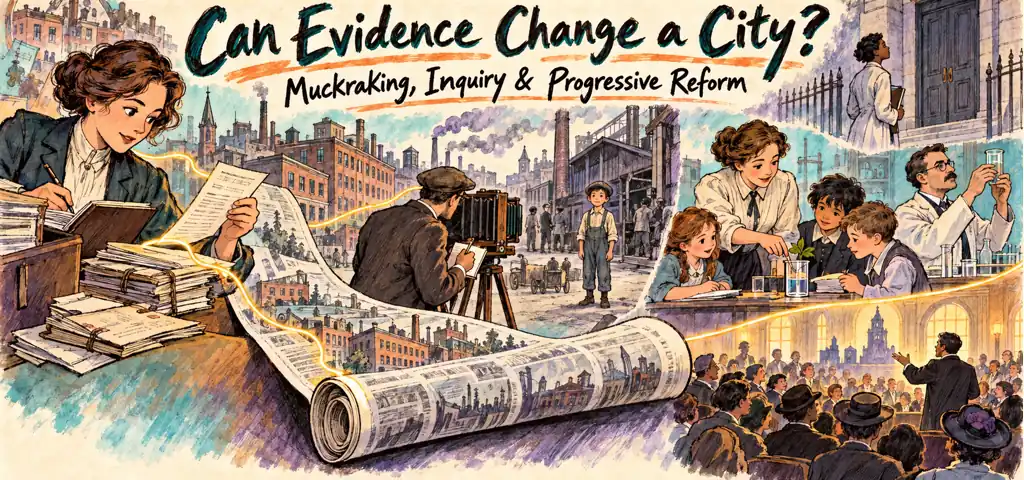
Chapter 6 of the CLEP History of the United States II study guide on Effortless Math covers Progressivism, Muckraking, Pragmatism, and Social Investigation: the key terms, the core ideas, and worked examples showing how this topic is tested on the exam.
CLEP History of the United States II, Chapter 6
Progressivism was a method before it was one platform
Progressive reformers disagreed about socialism, prohibition, race, labor, business size, and federal power. They shared greater confidence that investigation, expertise, publicity, organization, and government could address problems created by industrial society. Journalists documented corporate and municipal systems; social scientists studied neighborhoods and cultures; laboratories tested health claims; educators linked research to practice. This method could democratize knowledge, but experts also imposed racial, gender, and class assumptions. The movement is best understood as overlapping networks rather than one party program.
Muckrakers made systems visible
Henry Demarest Lloyd's Wealth Against Commonwealth (1894) attacked Standard Oil's monopoly and political influence. Ida Tarbell later reconstructed the company's history through corporate records and interviews. Lincoln Steffens examined municipal corruption; Ray Stannard Baker investigated labor and race; Upton Sinclair entered the meatpacking world. Cheap mass-circulation magazines such as McClure's could finance months of reporting and deliver serialized investigations to national readers. Publicity did not itself write a statute, but it converted dispersed injuries into evidence of an organized system.
Photography became reform evidence
Lewis Hine photographed children in mills, canneries, mines, and street trades for the National Child Labor Committee after 1908. He recorded ages, hours, tasks, and locations so images could support legislation rather than function only as art. Earlier Civil War photographs by Alexander Gardner had brought images of bodies and battlefield scenes to civilians far from the armies; the pictures appeared to be direct records even though photographers selected and captioned views. Progressive documentary work inherited photography's evidentiary authority and made the conditions of unseen workers politically legible.
Pragmatism tested ideas through consequences
William James argued that an idea's truth becomes meaningful through the practical difference it makes in experience. John Dewey extended experimental reasoning into education and democracy. A school should be a community where students learn by inquiry, activity, and reflection, not simply memorize inherited formulas. Public institutions likewise should treat policy as an experiment, measure consequences, and revise. Pragmatism did not mean that any useful claim was automatically moral or factually true. It emphasized inquiry grounded in experience and fallible results.
Social science challenged hereditary explanation
Franz Boas and his students argued that cultural and historical circumstances, not fixed racial biology, explained much human difference. Chicago sociologists Robert Park and Ernest Burgess connected urban patterns to neighborhood institutions, migration, and competition rather than inherited inferiority. Margaret Mead's later Coming of Age in Samoa used cross-cultural comparison to argue that adolescent turmoil varied by culture. These scholars did not eliminate prejudice, and some categories remain contested, but their environmental and cultural explanations opposed biological determinism.
Harvard naturalists divided over Darwinian descent
Botanist Asa Gray accepted common descent and natural selection as powerful scientific explanations while arguing that evolution could remain compatible with divine design. Zoologist Louis Agassiz rejected Darwinian descent and defended the separate creation of species. Gray therefore did not treat Darwin's account as necessarily atheistic, and Agassiz did not merely dispute the rate of evolutionary change; they disagreed over whether species descended from earlier forms at all. Their debate shows that elite American science did not respond to Darwin with one uniform position.
Medical reform joined laboratory and institution
Army surgeon Walter Reed's commission in Cuba tested Carlos Finlay's hypothesis and established that mosquitoes transmitted yellow fever. That knowledge supported mosquito control and helped make canal construction feasible. Abraham Flexner's 1910 report demanded medical schools tied to universities, laboratory science, clinical instruction, and stronger admissions. Many weak schools closed. Because philanthropic and professional standards operated in a segregated society, five of seven Black medical schools shut, leaving Howard and Meharry to train most Black physicians for decades. Higher standards improved science while narrowing access.
Standards made expertise national
Congress created the National Bureau of Standards in 1901 to maintain measurement standards and serve as a federal physical laboratory. Common measures mattered to electrical systems, manufacturing, public purchasing, and interstate trade. Standardization could seem technical, but it redistributed authority toward laboratories and trained professionals. Similar confidence appeared in food testing, engineering commissions, public-health bureaus, and municipal surveys. Progressive governance often began by making unlike local observations comparable.
Olmsted designed democratic rest
Frederick Law Olmsted's Central Park and Boston's Emerald Necklace did not preserve untouched wilderness. Designers composed winding paths, meadows, trees, water, and screened traffic to create the experience of rural scenery inside crowded cities. Olmsted believed access to such landscapes offered health, rest, and democratic contact across classes. The park was planned nature for public use, distinct from both a commercial amusement ground and a distant wilderness reserve. Its social claim depended on accessibility, even as displacement and policing could burden nearby communities.
Artists changed what counted as public reality
Ashcan artists such as Robert Henri, John Sloan, and George Bellows painted saloons, tenements, streets, and prizefights with energetic urban realism. The 1913 Armory Show then gave a broad American audience sustained exposure to European modernism, whose abstraction and fragmented form challenged inherited standards of representation. The shows were not the same movement: Ashcan painters made contemporary city life visible; modernists questioned how vision itself should be represented. Cultural revolt paralleled reform's rejection of polite surfaces.
Landscape image could be ideal or evidentiary
Albert Bierstadt assembled dramatic western views into enormous, luminous exhibition canvases for paying audiences, often rearranging terrain and light. William Henry Jackson photographed sites during federal geological surveys, and viewers treated his plates as literal records supporting knowledge of western places. Both selected vantage points and shaped perception, but their institutional purposes differed: spectacular fine-art composition versus survey documentation. The distinction warns against treating every realistic image as neutral evidence.
Realism entered fiction and memory
William Dean Howells favored fiction about ordinary middle-class lives and moral choices without romantic idealization. Mark Twain's Adventures of Huckleberry Finn used the vernacular voice of an uneducated boy, making spoken American English central to literary form. Stephen Crane's The Red Badge of Courage entered a frightened private's mind rather than celebrating battle from a commander's view. These writers shifted authority toward ordinary perception, ambiguity, and social environment.
Civil War art negotiated death and reunion
Winslow Homer's The Veteran in a New Field shows a returned Union soldier harvesting wheat, linking civilian renewal to the field of wartime death. Augustus Saint-Gaudens's Boston relief honors Robert Gould Shaw and the Black soldiers of the Fifty-fourth Massachusetts, rendering collective service rather than a solitary mounted hero. Gardner's battlefield photographs brought apparently immediate evidence of corpses to civilians. Each medium constructed memory differently: allegory, monumental commemoration, and documentary trace.
Land-grant education formed a research chain
The Morrill Act of 1862 granted federal land to support colleges teaching agriculture and mechanic arts, military tactics, and classical studies, widening practical higher education. The Hatch Act of 1887 financed agricultural experiment stations connected to land-grant colleges. The Second Morrill Act of 1890 supplied annual federal support but required states either to admit students without regard to race or establish separate land-grant institutions for Black students, strengthening a segregated system. The Smith-Lever Act of 1914 created cooperative extension linking the Department of Agriculture and colleges to county agents who carried research to farm and household practice.
Agricultural expertise needed local translation
George Washington Carver at Tuskegee urged farmers to rotate soil-depleting cotton with peanuts, sweet potatoes, and other crops and demonstrated practical uses for alternative products. Experiment-station findings did not spread automatically. Demonstration agents, bulletins, clubs, and household extension translated research into local choices. The sequence is institution, experiment, extension, adoption. It also reveals unequal resources: segregated Black colleges and agents often received less support even when serving communities facing severe soil exhaustion and credit constraints.
Education reform carried competing purposes
Manual-training advocates argued that woodworking and metalworking educated hand and mind together and dignified labor. The Smith-Hughes Act of 1917 later funded vocational agriculture, trades, and home economics in secondary schools, sometimes separating job training from academic study. Senator Henry Blair's proposed federal aid for common schools passed the Senate repeatedly in the 1880s but died when the House refused action. Federal educational capacity thus grew through specialized agricultural and vocational programs more readily than through broad equalizing aid.
Knowledge also had commercial rules
The international copyright law of 1891 protected foreign authors only when works were printed from type set in the United States, joining cultural protection to a domestic manufacturing condition. Copyright, cheap magazines, standardized measures, and national laboratories all show ideas moving through institutions and markets. Knowledge was neither free-floating nor politically neutral; printers, publishers, philanthropies, universities, and government agencies determined what could circulate and whose expertise survived.
Historians later debated reformers' motives
In The Age of Reform (1955), Richard Hofstadter argued that some middle-class professionals and local elites embraced reform partly to recover status lost to new industrial wealth. Later historians emphasized institutional problems, democratic conviction, gender, labor, race, and local diversity. The interpretation is useful as a claim about motivation, not a description reformers used for themselves. Evidence of status anxiety does not prove that food safety, corruption, or child labor were imaginary.
identify the evidence pathway
A photographer records a child's age, machine, hours, and factory address, then gives the file to a lobbying organization.
Expert reform had a double edge
Progressive investigation exposed hidden power and expanded public capacity. It also authorized experts to close schools, classify neighborhoods, define normal development, or prescribe work and family roles. Flexner strengthened medicine while Black training institutions disappeared; Second Morrill funding expanded education through segregation; vocational programs could dignify labor or channel students by class and sex. Judge the reform by asking what knowledge improved, who controlled its standards, and who gained or lost access.
Watch the history in motion
This short lesson adds voices, images, and chronology to the ideas you just studied.
Video: The PROGRESSIVE Era, Explained [APUSH Review], Heimler's History.
Try four CLEP-style questions
- Tarbell reconstructs corporate conduct from records and interviews; Hine records ages, hours, and factory addresses beside photographs. What shared reform strategy links the projects?
- Using anonymous composite cases to evoke conditions that could not be documented
- Organizing identifiable evidence so individual cases reveal a system to a wider public
- Testing a causal mechanism under controlled laboratory conditions
- Presenting individual moral drama without making a claim about institutions
- Treating journalistic prose and documentary photography principally as fine art
- A reformer designs a city park and a wilderness advocate resists a dam. What distinction prevents treating their projects as identical?
- Both seek to leave an existing landscape without designed circulation or public facilities.
- The urban project manages a remote wilderness reserve, while the dam opponent composes rural scenery.
- The park supplies restorative scenery only by excluding ordinary city residents.
- A composed urban landscape creates accessible restorative scenery, while wilderness preservation resists development of an existing natural place.
- Both treat development for broad public use as the highest preservation principle.
- Which comparison best distinguishes Ashcan realism from the modernism displayed at the Armory Show?
- Both movements treated accurate survey photography as the required basis of serious painting.
- Ashcan painters rejected city subjects for idealized western scenery, while modernists documented municipal investigations.
- Ashcan painters used recognizable urban scenes; many modernists challenged inherited representation.
- Modernists preserved academic representation, while Ashcan painters introduced European abstraction to American audiences.
- The Armory Show presented only American social realism, whereas Ashcan exhibitions centered on French cubism.
- What common warning emerges from the Second Morrill funding rule and the closing of five Black medical schools after Flexner's report?
- New resources and higher standards necessarily integrated institutions because both used formally national criteria.
- Expanded resources or standards can coexist with segregation and a severe loss of access for an already underserved population.
- Both reforms withdrew support from professional education without creating any new capacity.
- Second Morrill required every state college to admit Black students, while Flexner preserved all existing Black medical schools.
- Their only relevant difference is that Congress acted in one case and a private report appeared in the other.
Check your answers and reasoning
Independent preparation. CLEP is a registered trademark of the College Board, which does not endorse this lesson.

Related to This Article
More math articles
- Committee referral
- Chief diplomat
- Pluralism, Fundamentalism, and Religion in Public Life
- Nervous and Endocrine Control of Movement
- Essential Spelling Rules
- 4th Grade Wisconsin Forward Math Worksheets: FREE & Printable
- How to Identify Characteristics of Quadratic Functions: Equations
- Top 10 HSPT Math Practice Questions
- 10 Most Common 4th Grade IAR Math Questions
- Top 10 7th Grade STAAR Math Practice Questions


















What people say about "Progressivism, Muckraking and Social Investigation"?
No one replied yet.