YOUR SAT STUDY COMPANION
SAT Math Score Plateau: Diagnose Errors and Improve Practice
Similar SAT Math practice scores are a reason to inspect recurring errors, timing and study methods. Use a focused review cycle to decide what to practise next, without assuming a fixed score ceiling.
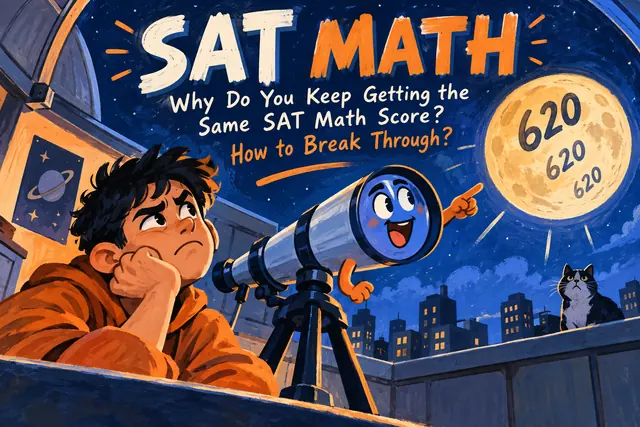
A SAT Math score plateau is a run of similar results despite regular preparation. A few nearby practice scores do not establish a limit on your ability. Start by checking whether the tests, timing, tools and testing conditions were comparable, then look for recurring errors.
Instead of adding more study hours automatically, use your latest practice review to identify what to change. The goal is a more reliable solution process, not a promise of a particular score increase.
Diagnose the pattern before taking another test
Group missed questions, guessed answers and correct answers that took too long. Was the obstacle a missing concept, a misunderstood prompt, an execution error or time pressure? These categories suggest different next steps.
| What you notice | What to check | Try next |
|---|---|---|
| The same concept keeps returning | Can you explain the rule without the solution? | Review that skill, then solve a fresh variation. |
| A solution seems obvious only afterward | Which decision in your own work went wrong? | Write a specific correction and test it later. |
| Untimed work is accurate but timed work is unfinished | Where does the extra time go? | Practise a short timed set and compare approaches. |
| A digital tool adds work | Does graphing or direct algebra fit this question? | Compare both methods on an appropriate example. |
| Scores fluctuate across tests | Were the forms and conditions comparable? | Review the skills and errors alongside the score. |
Think of uncorrected concept gaps as holes in a bucket: more questions alone may leave the same gaps. This is an analogy, not evidence that every plateau has one cause. Reserve enough review time to understand errors; there is no universal 20/80 study ratio.
For related preparation habits, read Preparing for SAT Math? Don’t Make These Big Mistakes.
Review the decision that produced the error
For each selected question, record the skill, your original approach, the first incorrect step and a concrete change to try. For example, replace “be more careful” with “substitute the solution back into the original equation.” Also review guesses that happened to be correct.
Close the explanation and solve the problem again. Later, try a different problem using the same concept. Repeating a memorized answer is weaker evidence of understanding than explaining and applying the method.
A teacher, tutor or study partner can watch your reasoning and help identify a repeated mistake. The original article also linked to this external provider: Cuemath. Check its current services and terms directly; this guide does not verify a free SAT tutoring offer.
For pacing ideas, see Top 10 Tips for Managing Time Effectively on the SAT Math.
Choose digital tools that suit the problem
Practise with the calculator embedded in Bluebook so its controls are familiar. A graph can help locate an intersection or check a root; a short algebraic calculation may be faster for a simple equation. Interpret the result in the context of the question.
Use the Bluebook practice preview to learn the available tools and navigation before a scored practice test. A tool is useful when you can use it accurately; there is no fixed number of seconds it saves on every question.
Separate pacing from content gaps
The standard SAT Math section has 44 questions in two 35-minute modules. That is about 95 seconds per question on average, not a deadline for each item. Some questions take less time, leaving room for others. Use any approved accommodations that apply to your test.
If an untimed solution is still unclear, begin with instruction and untimed practice. If the method is sound but slow, compare approaches on a short timed set. Practise deciding when to mark a question for review and return within the same module.
Mix several already-studied topics to practise recognizing the method without a chapter label. Revisit a weak skill after a gap, then adjust the interval based on what you remember. A two-, seven- or fourteen-day schedule can be a planning example, not a rule that guarantees retention.
For further study guidance, read How to Get 800 on the SAT Math.
Understand adaptive scoring without guessing a cap
Performance in the first module helps determine the difficulty mix in the second. Your section score reflects performance across both modules. You cannot reliably translate a small number of missed questions into an exact score or infer a score ceiling from how hard a module felt.
At any score level, use the actual practice report and your work to locate remaining gaps. A high score does not prove that all concepts are secure, and one error does not have a universal fixed point cost. Keep working carefully in both modules.
Related strategies: Top Proven Strategies to Increase Your SAT Math Score.
Try a focused one-week practice cycle
- Review: Choose one recent official practice result and classify a manageable set of errors, guesses and slow answers.
- Repair: Pick one recurring skill, review its explanation and solve a few fresh examples without rushing.
- Check: Try a short mixed set later in the week. Record accuracy, approach and time without treating it as an official score.
- Adjust: If the same error returns, revisit the explanation or get feedback. If the method is reliable, move to another weakness.
- Reassess: Take another full-length practice test when it will answer a useful question about readiness or pacing. Keep its conditions comparable.
Choose a workload that fits school, rest and other commitments. Progress can show up first as fewer repeated mistakes or better pacing, even before the next overall practice score changes.
Apply the error-log method
A student solves 3(x − 2) = 15 by writing x − 2 = 5, then x = 3. What should the error log say, and how can the answer be checked?
Check your reasoning
The division step is correct. The next step should add 2 to both sides, giving x = 7. Record “undo subtraction by adding the same amount to both sides,” then substitute: 3(7 − 2) = 15. The wrong answer gives 3(3 − 2) = 3. Try a fresh equation later to check the method rather than memorize 7.
Official sources and next steps
Check College Board’s SAT structure, explanation of score calculation, official practice options and calculator policy for current test information. This article supplies a study framework; it does not guarantee a score gain.

Related to This Article
More math articles
- Compare the Temperatures Above and Below Zero
- Major political events
- Shop Troubleshooting: Stop, Inspect, Then Decide
- How to Use Input/output Tables to Add and Subtract Integers?
- Delegates
- Lines of Symmetry for 4th Grade
- Free Grade 7 English Worksheets for West Virginia Students
- How to Solve Word Problems Involving Dividing Fractions
- Multiplying Decimals Practice — Free Step-by-Step Drills
- The Best Grade 8 ELA Practice Tests for Illinois Students










What people say about "SAT Math Score Plateau: Diagnose Errors and Improve Practice"?
No one replied yet.