LSAT Argumentative Writing: Do You Need to Address Every Perspective? (2027 Prep)
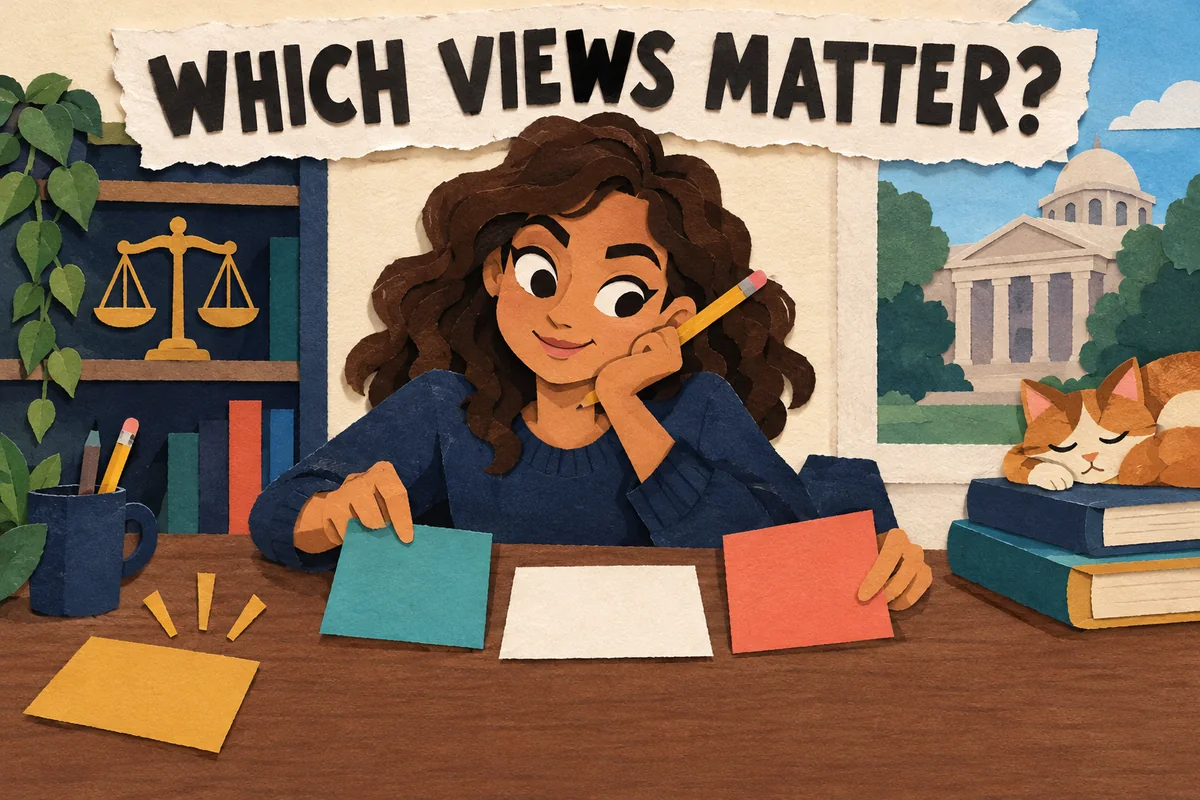
Choose the views that help answer the question and defend your position.
No. LSAC asks you to state your own position and address some ideas from other perspectives. Its specifications set a minimum: engage at least one argument or idea from those views. You do not need a separate paragraph for every speaker. Choose points that help your reasoning, then answer a serious competing view.
That helps when the prompt feels crowded. LSAC says a prompt presents a debatable issue with three or four short perspectives. Plan for 15 minutes, then draft for 35. LSAC asks for engagement with some ideas from other views. Beyond the stated minimum, the overview does not assign a number of perspectives you must discuss.
So do not count how many speakers you mentioned. Ask what each reference does for your argument. A useful view may support your position, expose a weakness you need to answer, or help you set a sensible limit. A name-check that changes nothing can usually go.
First choose a position, then assign each view a job
Read the Key Question before you start sorting the perspectives. It tells you what decision your essay must answer. Next, write a provisional position in one sentence. Keep it narrow enough to defend with the information in the prompt.
Now look at each perspective in relation to that position. A view’s role can change with your thesis. One student may use it as support. Another may see its strongest point as an objection. The speaker’s label alone does not determine its job.
| Possible role | Question to ask | What the essay gains |
|---|---|---|
| Support | Which claim or reason helps defend my position? | A prompt-based reason that supports the thesis |
| Strongest objection | Which competing point would a thoughtful reader want me to answer? | A fair challenge and a chance to explain why your position still holds |
| Useful limit | Does another view reveal a condition, cost, or group my plan overlooks? | A more precise thesis or a practical safeguard |
| Leave aside | Would this point add a new reason, test my position, or clarify a limit? | If not, leaving it out protects space for reasoning |
Use this map as a planning aid. A clear essay may use two perspectives in depth, draw on a third in one sentence, or organize its reasoning another way. The right choice depends on what the Key Question asks and which ideas your thesis needs.
Try the method on an original prompt
This example is written for this lesson. It is not an official LSAT prompt.
Key Question: A city has one downtown block to redesign. Should it keep short-term curb parking, or create a protected route for buses and bicycles?
Perspective 1: Nearby shop owners say short-term parking helps customers make quick visits and gives delivery drivers a place to stop.
Perspective 2: Bus riders and cyclists argue that a protected route would make trips more predictable and reduce conflicts at the curb.
Perspective 3: Residents on side streets worry that diverted traffic could bring more noise and congestion past their homes.
Perspective 4: A city operations manager says a permanent rebuild would cost more than a temporary trial, and that loading and emergency access need to remain workable.
Suppose your provisional position is to test a protected route during the busiest commute periods while keeping a signed loading area outside those hours. The condition tells the city what to do next. The line “All four views have good points” leaves the decision open.
| Perspective | Possible role for this thesis | What to do with it |
|---|---|---|
| Shop owners | Useful limit | Preserve a loading window, then explain why short-term parking need not occupy the curb all day |
| Bus riders and cyclists | Support | Use the safety and predictability concern as a reason for the trial |
| Side-street residents | Strongest objection | Take the displacement concern seriously and include it in the trial’s review |
| Operations manager | Useful limit | Prefer a temporary setup and state how loading and emergency access will be checked |
Notice that the roles follow the thesis. Change your thesis, and the views may switch roles. Pick your position first, then decide which idea challenges it.
Make a reference do more than repeat a view
A thin sentence reports a position: “Some residents worry that traffic will move to side streets.” The reader still cannot see how that concern affects your decision.
A more useful sentence connects the view to a reason and a response: “The residents’ concern is a real cost of the route, so the city should compare traffic on nearby streets during the trial and change the design if the burden shifts there.” It connects the concern to your decision.
Use this note while you plan:
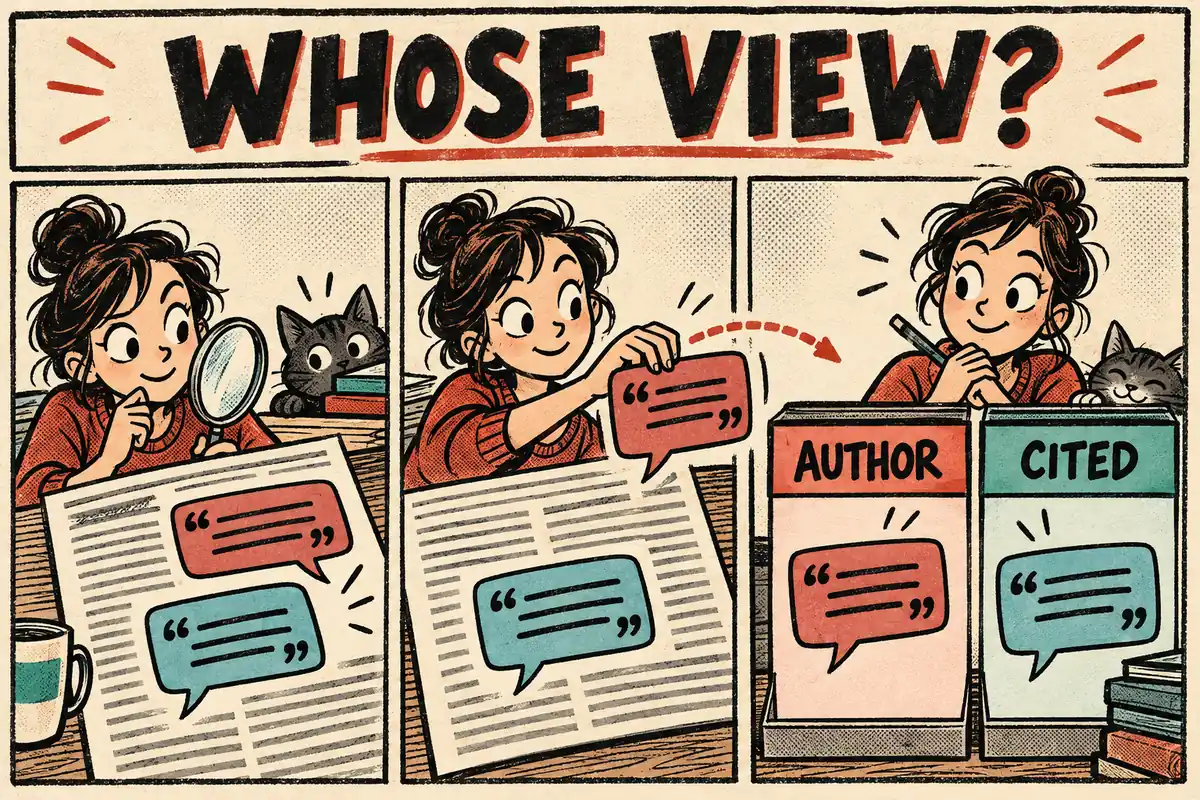
- Claim: What does the perspective say?
- Link: How does it affect your thesis?
- Response: What will you use, answer, or change?
Keep the source’s strength intact. If the perspective says traffic could shift, do not write that it will. If a view raises one group’s concern, do not make it stand for everyone in the city. Use one idea accurately.
Choose the objection your thesis cannot ignore
You have limited writing time. Give the strongest opposing point a clear answer, even if you leave other perspectives aside. Would this concern weaken your main reason? If yes, answer it. If it only adds an unrelated detail, it may not deserve a paragraph.
A preference about barrier color does little to test your position. A concern about displaced traffic can challenge the route directly. Take that risk seriously, then explain how the city will check for it and what you would change if the burden grows.
You can use a concession without giving up your position: “The trial could move traffic onto nearby streets. That risk is why the city should measure those streets and revise the route if the burden grows.” The response accepts a real cost, then shows why a limited trial remains defensible.
Use the 15-minute prewriting period to make choices
Most candidates receive 15 minutes for prewriting analysis and 35 minutes to draft. LSAC supplies guided questions and a digital note tool. Treat that period as time to make decisions: identify the issue, choose a position, select useful views, and sketch the order of your reasons. Use the timing approved for your test.
When you see four perspectives, read each one before choosing which ideas to use. You can mark a view as support, a serious objection, a useful limit, or a point that does not help your thesis. Then use the rest of your planning time to connect the best ideas to your position, and leave enough time to draft.
Before drafting, ask:
- Can a reader tell what you want the decision-maker to do?
- Does each perspective you include have a clear role?
- Have you answered the strongest point against your position?
The essay does not need a paragraph for every perspective, and LSAC’s overview page does not prescribe a paragraph template. Choose a structure that keeps your reasons and response clear. Try one official LawHub prompt in the same interface.
Quick check: should you include this perspective?
Your thesis supports a limited route trial. One perspective says that a permanent redesign would be expensive. Should you use that point?
Answer and explanation
Probably, if you connect it to your proposal. The cost concern supports choosing a temporary trial over an immediate permanent rebuild. A sentence that merely says “the manager is concerned about cost” names the idea but does not explain its role. Show how the concern shapes the decision.
For more practice, visit the LSAT Argumentative Writing study hub. For current task details, read LSAC’s official Argumentative Writing overview and its Argumentative Writing FAQs.
Sources and scope
- LSAC: LSAT Argumentative Writing
- LSAC: Frequently Asked Questions about LSAT Argumentative Writing
- LSAC: Specifications of the LSAT and LSAT Argumentative Writing
This independent study article is not affiliated with or endorsed by LSAC. The practice prompt and examples are original and are not official LSAT content. Check LSAC for current task information and official practice.
Reviewed against official LSAC Argumentative Writing overview, FAQ, and accommodations specifications on October 13, 2026. Recheck current task details at LSAC.

Related to This Article
More math articles
- The Best Grade 2 Math Worksheets for New Hampshire Students
- Degrees to Radians Converter (and Back)
- The Best Grade 7 ELA Practice Tests for Vermont Students
- Unlocking Solutions: A Step-by-Step Guide to How to Solve Non-linear Equations by Substitution
- Top 10 4th Grade SBAC Math Practice Questions
- Taylor and Maclaurin Series Calculator (Free)
- Best Online MFT Programs in California
- Earth’s Layers and Plate Tectonics
- New England Towns: Family, Schools and the Mixed Economy
- Market demand adds individual quantities
















What people say about "LSAT Argumentative Writing: Do You Need to Address Every Perspective? (2027 Prep) - Effortless Math"?
No one replied yet.