LSAT Reading Comprehension: Track Viewpoints Across a Passage (2027 Prep)
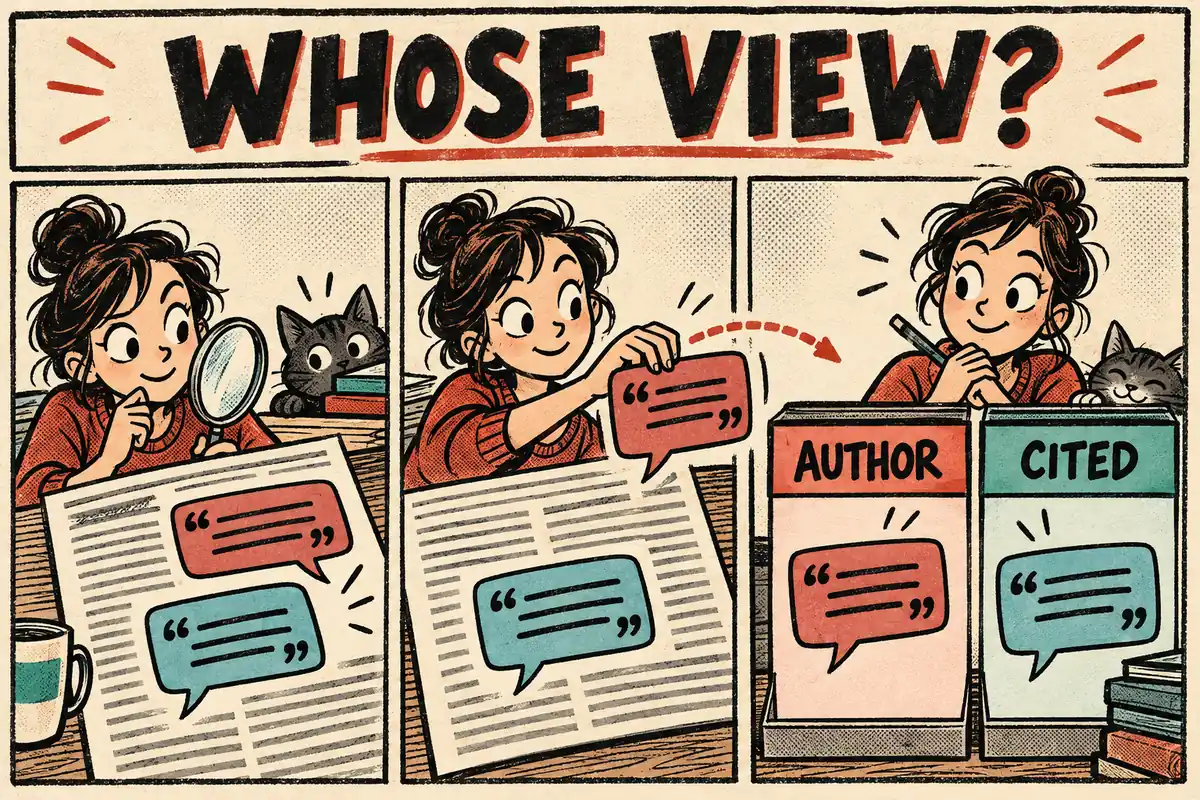
Separate the writer’s position from a view the writer reports.
When a passage gives you more than one voice, keep four things apart: who says it, what that person claims, what the text supports, and how the author responds. A speaker can appear in the passage without speaking for the author. And when the author says little about one claim, that silence does not prove disagreement.
LSAC says Reading Comprehension passages can use complex rhetorical structures, including multiple points of view. Questions can test an author’s attitude, a reasonable inference, or the relationship between two passages. A compact viewpoint map helps you keep those jobs straight while you read. It is a working note, not a script you must force onto every passage.
Use a four-part map
For each important voice, note the speaker, the claim, the evidence or reason attached to it, and the author’s response. The last column is where many missed questions begin. Reporting a view is different from adopting it.
| Who speaks? | What do they claim? | What supports the claim? | What does the author do? |
|---|---|---|---|
| A named person, group, or the author | Write the idea in a short phrase | Record the reason or passage detail | Reports, agrees, qualifies, challenges, or leaves it open |
| Another source | Capture its position, not your guess | Use only reasons actually tied to that view | Compare the author’s wording and later response |
You can use words instead of symbols. If you like shorthand, mark a reported view as R, the author’s own position as A, and a qualification as Q. Keep the notes small enough that you still read the passage. A label should help you find the idea again, not replace understanding it.
Work through an original passage
Read this short example. It is written for this lesson and is not an official LSAT passage:
Some city archivists argue that reconstructed storefronts should remain unmarked. In their view, a label interrupts a visit and makes a replica feel like an exhibit. Restoration staff respond that visitors sometimes mistake new trim for original work, though they do not say how much explanation a label should give. The author accepts that visitors need to recognize what was restored but rejects long interpretive panels. She recommends a one-sentence note naming the restoration date and replacement materials.
Pause before you decide that the author simply agrees with one side. The author’s position combines a concern from the staff with a different remedy. Here is the map:
| Voice | Position in the passage | Author’s relationship | Safe takeaway |
|---|---|---|---|
| City archivists | Leave replicas unmarked to protect the visitor’s experience | The author recognizes a concern about interruption, but does not accept an unmarked replica as the solution | The author shares part of the concern, not the full proposal |
| Restoration staff | Some visitors mistake new trim for original work | The author accepts that visitors need to recognize restoration | The passage gives a reason for identification, not staff’s preferred label length |
| The author | Use a short factual note with date and materials | This is the author’s own recommendation | A concise label can identify the repair without directing the visitor’s judgment |
Notice the restraint in the middle row. The staff report a problem. The passage does not tell us that they want a long panel, a short one, or any particular design. Do not fill in that blank for them.
Tell opposition from qualification and silence
Before answering a question about agreement, sort the relationship into one of four buckets. The wording in the passage has to earn the label.
| Relationship | What it means | What you can safely conclude |
|---|---|---|
| Agreement | The author accepts the same claim or reason | State the shared point at the strength the passage uses |
| Qualification | The author accepts part, narrows it, or adds a condition | Preserve the common ground and the limit |
| Challenge | The author gives a reason against the claim or its support | Name the specific point being challenged |
| Unclear or unaddressed | The text does not establish the author’s view on that point | Do not turn missing evidence into disagreement |
Transitions such as “however,” “yet,” and “although” tell you to inspect a relationship. They do not decide it for you. A writer can concede one point, disagree with a second, and leave a third untouched in the same paragraph.
That last distinction matters. In its official comparative-reading sample explanation, LSAC separates a genuine point of disagreement from claims where the passage does not provide enough evidence to say the authors would disagree. Treat the absence of a statement as a limit on your inference, not as a hidden rebuttal. The examples on this page are original. Use LSAC’s sample set for official practice.
Match your note to the question stem
When the question asks what a critic believes, return to the critic’s row. When it asks for the author’s attitude, look at the author’s response, including any qualifiers. A question about what the passage states may point to either voice. The subject can be the same while the requested speaker changes.
LSAC recommends distinguishing main ideas from support, opinions from facts, and following the relationships between parts of a passage. This map puts those moves in a small space. Read the full passage first if that works for you under timed conditions, then use your notes to return to the right claim. LSAC also encourages students to test different approaches and keep the one that works best for them.
- Name the speaker. Look for an attribution such as “archivists argue” or “the author adds.”
- Write the claim narrowly. Keep words such as “some,” “may,” and “in these cases.”
- Point to its support. Record the reason the passage gives, without importing facts you know from elsewhere.
- Check the author’s response. Does the author agree, qualify, challenge, or stay silent on this point?
- Read the question’s target. Find the exact voice or relationship the stem asks about.
If an answer feels close, compare its strength with your map. “Some visitors may mistake the trim” does not support “all visitors are confused.” A qualified recommendation does not support a sweeping claim that the author rejects every opposing idea.
Try one quick check
In the storefront example, what would the author most likely support?
- A. Every replica should be left unmarked.
- B. Every restored feature needs a long interpretation.
- C. A brief factual note can identify restored materials.
- D. Restoration staff proved that every visitor confuses new trim with old trim.
Answer and explanation
C. The author recommends a one-sentence note naming the date and replacement materials. A and B turn qualified positions into absolute rules. D changes “sometimes” into “every” and treats a reported risk as proof about all visitors.
For official examples and explanations, use LSAC’s Reading Comprehension sample questions. Its suggested approach also explains how to read for main ideas, support, attitudes, and transitions. For a broader study path, visit the LSAT Reading Comprehension study hub.
Sources and scope
- LSAC: Reading Comprehension
- LSAC: Suggested Approach for Reading Comprehension
- LSAC: Reading Comprehension Sample Questions
This independent study article is not affiliated with or endorsed by LSAC. The passage and practice check are original, not official LSAT questions. Check LSAC for current test information and official practice.
Reviewed against LSAC official Reading Comprehension guidance and sample explanations on October 13, 2026. Verify current LSAT details at LSAC.

Related to This Article
More math articles
- Measurement in Chemistry: Units, Density, and Instrument Precision
- What Kind of Math Is on the HSPT Test?
- Working Through a Passage Set
- 3rd Grade Math Skills Every Student Should Master
- How to Graph an Equation in Point-Slope Form?
- Developing platforms
- Top 10 Free Websites for TABE Math Preparation
- How To Create a Distraction-Free Study Environment: 10 Tips
- A Step into The World of Calculus: Rules of Differentiation
- 10 Most Common 4th Grade SBAC Math Questions


















What people say about "LSAT Reading Comprehension: Track Viewpoints Across a Passage (2027 Prep) - Effortless Math"?
No one replied yet.