Matter and Its Changes: Particles, Properties, and Mixtures

An ice cube melts into water. A nail rusts. Both objects change, but the chemical identity of the water survives melting, whereas rusting produces new substances. Follow the identity of the substances when you classify a change.
Matter has mass and occupies space. A pure substance has a fixed chemical identity and composition. A mixture contains substances in variable proportions. Physical changes alter form or state without changing chemical identity. Chemical changes produce different substances through a rearrangement of atoms and electrons.
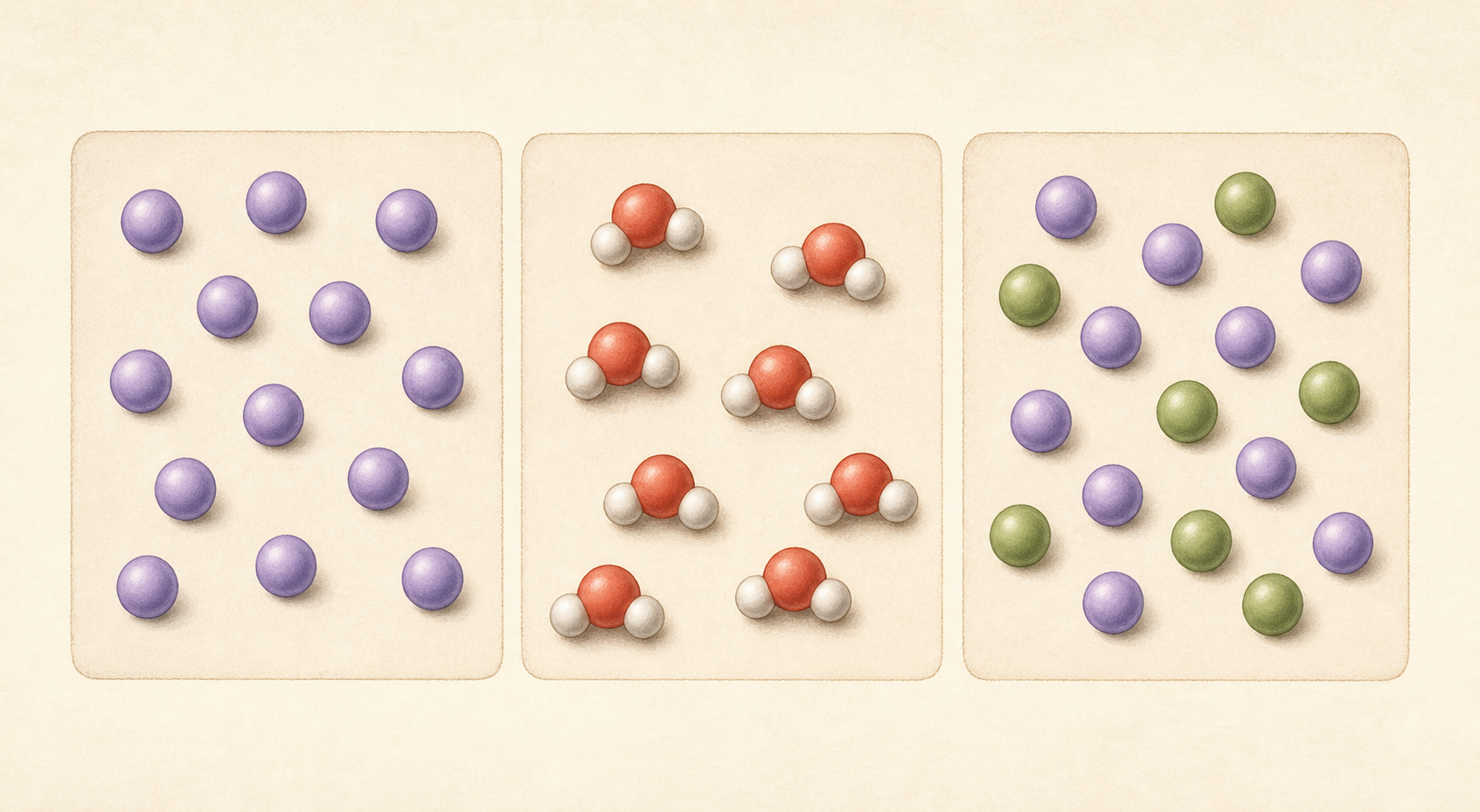
How do elements, compounds, and mixtures differ?
An element contains atoms with the same proton number. A compound contains two or more elements chemically combined in a definite ratio. A mixture contains substances together without requiring one fixed overall composition.
| Sample | Classification | Reason |
|---|---|---|
| Pure copper | Element | It contains copper atoms. |
| Pure water | Compound | Each molecule contains hydrogen and oxygen in a fixed ratio. |
| Salt water | Homogeneous mixture | Its salt concentration can vary. |
| Sand and iron filings | Heterogeneous mixture | The components remain distinguishable. |
What changes when a substance melts?
In a solid, particles remain near relatively fixed positions while moving about those positions. Liquid particles remain close together but can move past one another. Gas particles are widely separated under ordinary conditions and move throughout their container.
Melting changes arrangement and freedom of motion. It does not turn a water molecule into hydrogen gas and oxygen gas. Particle drawings enlarge the particles and simplify their motion, so read the model’s labels and limits.
Worked example: separating a mixture
A dry sample contains sand and iron filings. A magnet can remove the iron because the components differ in magnetic behavior. If the sand is then mixed with water, filtration can collect the insoluble sand.
Dissolved salt passes through ordinary filter paper with the water. Recovering it requires a different property, such as water’s ability to evaporate. Distillation can collect the evaporated water after it condenses. Choose the method from the properties of the components.
Does bubbling prove that a chemical reaction occurred?
Bubbling is evidence to investigate. Boiling water bubbles during a physical change. A carbonate reacting with an acid can produce carbon dioxide in a chemical change. A color change, temperature change, or new solid can also be useful evidence, but interpret each observation in context.
- Identify the starting substances.
- Record what changed.
- Ask whether there is evidence of a different chemical identity.
- Support the classification with that evidence.
Can you apply the idea?
-
Classify pure oxygen gas as an element, compound, or mixture.
Check your answer
An element. Its molecules contain only oxygen atoms.
-
Is sugar dissolved evenly in water a compound or a mixture?
Check your answer
A homogeneous mixture. The sugar-to-water proportion can vary.
-
Classify water freezing.
Check your answer
A physical change: water retains its chemical identity.
-
Classify iron rusting.
Check your answer
A chemical change: iron-containing corrosion products form.
-
Can ordinary filtration separate dissolved salt from water?
Check your answer
No. Dissolved ions pass through ordinary filter paper.
-
A liquid bubbles when heated. What additional question helps classify the change?
Check your answer
Ask whether the gas is vapor of the original liquid or a new substance produced by reaction. Bubbling alone does not settle the classification.
Watch the idea explained
Types of Matter: Elements, Compounds, and Mixtures, Professor Dave Explains.
Where does this fit?
Use the chemistry learning hub to choose a lesson or practice test. Connect this topic with measurement in chemistry, atoms, isotopes, and ions, chemistry math, electrons and periodic trends.
Continue with a chemistry study guide

Related to This Article
More math articles
- The Best Algebra 1 Book for Maryland Students
- How to Find Scalar Multiplication of Vectors?
- The Best ALEKS Math Worksheets: FREE & Printable
- Magic Square Puzzle — Make Every Line Equal
- How to Demystifying the Bell Curve: A Comprehensive Guide to Understanding Normal Distribution
- CLEP U.S. History I 075: Transcendentalism and Individual Conscience
- Estimating and Rounding
- How to Find Vague Limits by Change of Function’s Value
- Play the Math Game: How to Craft Tables and Graphs for Two-variable Equations
- The Best Grade 7 Math Book for Texas Students

















What people say about "Matter and Its Changes: Examples and Practice"?
No one replied yet.