Chemistry Math: Scientific Notation, Ratios, and Meaningful Signs
A calculator can produce a long string of digits without telling you whether the calculation makes sense. Chemistry math starts with the quantities involved. Write the units, estimate the scale, and decide what a sign or exponent means before you accept the display.
Chemistry math uses ratios, algebra, powers of ten, and graphs to describe measured quantities. Scientific notation separates significant digits from scale. Units identify the quantity, while significant figures communicate measurement precision. A numerical result becomes useful when its magnitude, unit, and interpretation agree with the physical situation.
What does a negative exponent mean?
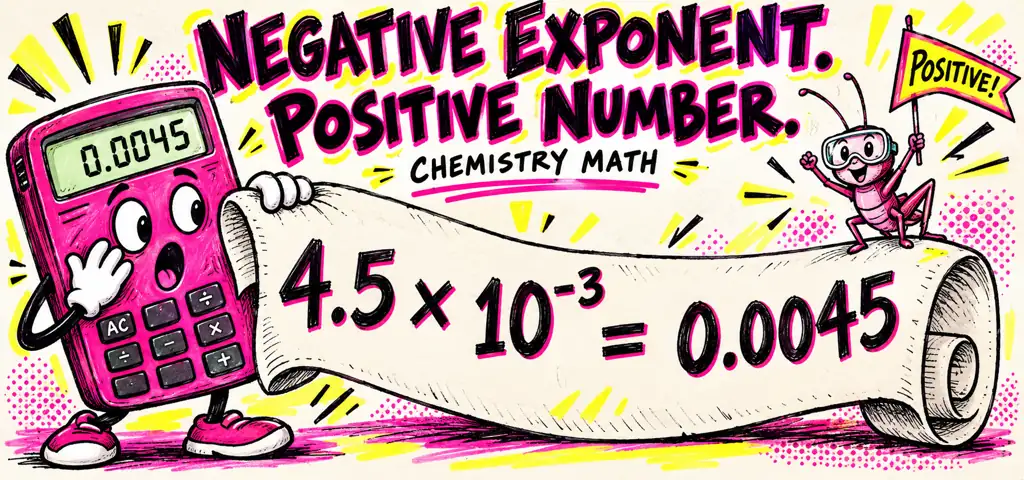
In \(4.5\times10^{-3}\), the exponent means divide by one thousand. The value is \(0.0045\), a positive number. Compare that with a temperature change of \(-4.5\,^{\circ}\mathrm{C}\), where the minus sign means the final temperature is lower than the initial temperature.
For a positive number in scientific notation, the coefficient must be at least 1 and less than 10. Thus \(45\times10^{-4}\) has the right value but is not in normalized scientific notation. Rewrite it as \(4.5\times10^{-3}\).
Worked example: multiply, then normalize
Calculate \((4.0\times10^5)(3.0\times10^{-2})\). Multiply the coefficients and add the exponents:
\[ (4.0\times3.0)\times10^{5+(-2)}=12\times10^3=1.2\times10^4. \]
The two measured inputs each have two significant figures, so report two in the product. Keep extra calculator digits during intermediate work and round the final result.
Addition uses a different procedure. To add \(3.2\times10^4\) and \(4.5\times10^3\), first write both with the same exponent. Their unrounded sum is \(3.65\times10^4\). For measured inputs, round to the thousands place specified by the first addend: \(3.7\times10^4\).
Which mass belongs in the denominator?
A mixture contains 15.0 g of salt and has a total mass of 75.0 g. Its salt mass percent is
\[ \frac{15.0\,\mathrm{g}}{75.0\,\mathrm{g}}\times100\%=20.0\%. \]
The denominator includes the salt. Dividing by the water mass would answer a different question. Since grams cancel, the ratio is dimensionless.
How do you check a graph or calculation?
- Identify the quantities and their units.
- Choose the relationship before entering numbers.
- Estimate the expected size and sign.
- Calculate with units visible, then round.
- Read graph axes and their starting values before comparing bar heights or slopes.
Can you apply the idea?
-
Write \(0.00072\) in scientific notation.
Check your answer
\(7.2\times10^{-4}\). The coefficient is between 1 and 10.
-
Evaluate \((2.0\times10^3)(3.0\times10^2)\).
Check your answer
\(6.0\times10^5\), retaining two significant figures.
-
Is \(10^{-6}\) negative?
Check your answer
No. It equals \(0.000001\), which is positive.
-
A sample cools from \(26.0\,^{\circ}\mathrm{C}\) to \(21.5\,^{\circ}\mathrm{C}\). Find \(\Delta T\).
Check your answer
\(21.5-26.0=-4.5\,^{\circ}\mathrm{C}\). The sample cooled by 4.5 degrees.
-
A 40.0 g mixture contains 8.0 g of solute. Find its mass percent.
Check your answer
\((\frac{8.0}{40.0})\times100\%=2.0\times10^1\%\), to show two significant figures.
-
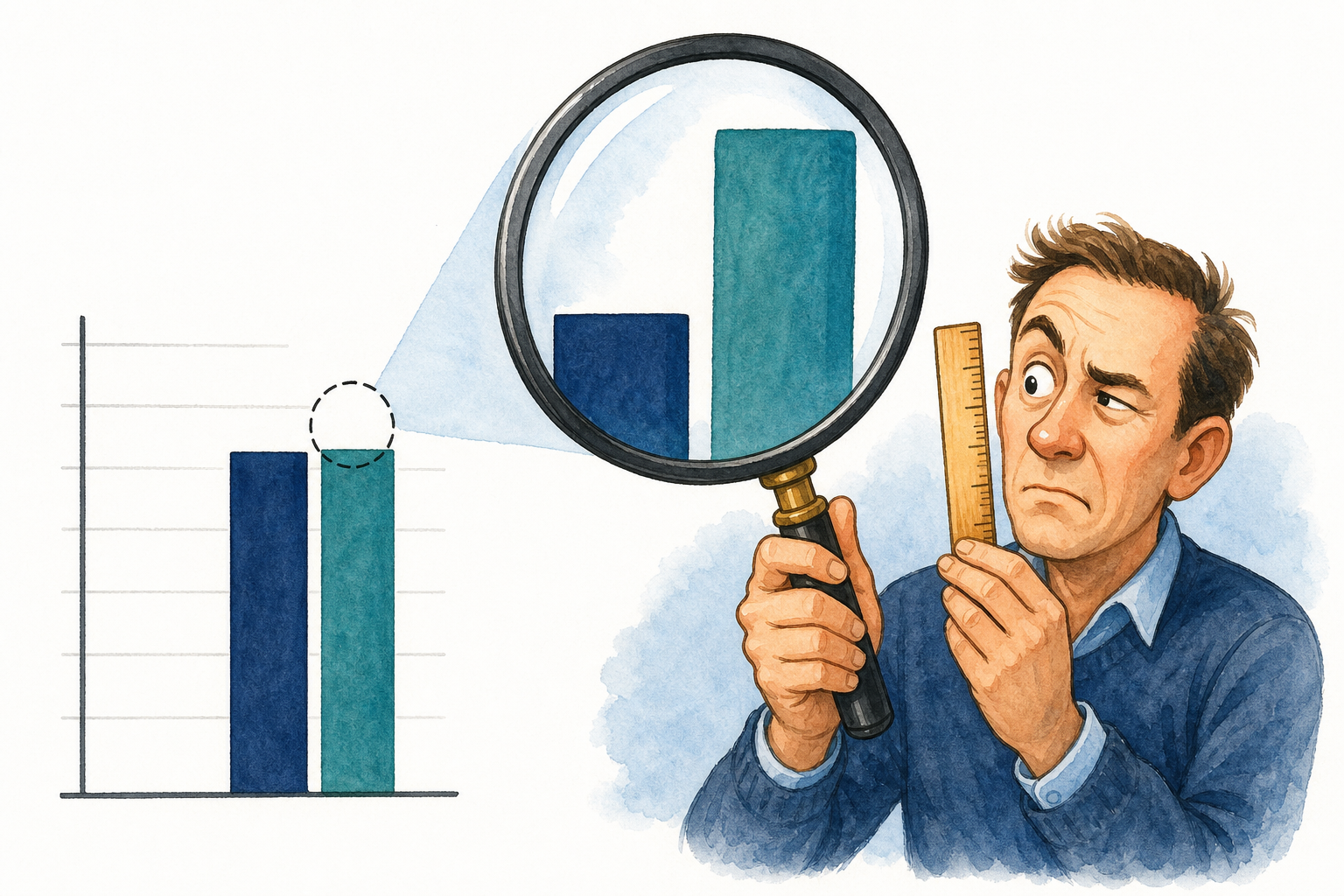
Why can a bar chart with a truncated vertical axis exaggerate a change?
Check your answer
The visible bar heights show only the portion above the chosen axis baseline, which can make a small numerical difference look large.
Watch the idea explained
Express a small number in scientific notation (example) | Pre-Algebra | Khan Academy, Khan Academy.
Express a small positive number in scientific notation using a negative power of ten.
Where does this fit?
Use the chemistry learning hub to choose a lesson or practice test. Connect this topic with scientific reasoning in chemistry, measurement in chemistry, matter and its changes, atoms, isotopes, and ions.
Continue with a chemistry study guide

Related to This Article
More math articles
- How to Use Area Models and the Distributive Property to Multiply?
- 6th Grade SBAC Math FREE Sample Practice Questions
- No-Commission Baccarat and the Dragon-7 Trade-off
- 7th Grade Wisconsin Forward Math Worksheets: FREE & Printable
- The Best Grade 7 Math Book for Utah Students
- Calculating Water Potential: Formula and Worked Examples
- 3rd Grade OST Math FREE Sample Practice Questions
- The Best Grade 3 Math Book for Ohio Students
- 5 Best Headsets for Online Math Classes in 2026
- Region
















What people say about "Chemistry Math: Examples and Practice"?
No one replied yet.