Atoms, Isotopes, and Ions: Reading the Periodic Table
A sodium atom can lose an electron and become a sodium ion. It is still sodium. The proton count fixes the element’s identity, while changes in neutron or electron count answer different questions about the particle.
An atom contains a small nucleus of protons and usually neutrons, with electrons described by distributions around it. Atomic number is proton count. Isotopes of an element have different neutron counts. Ions have a net charge because their electron and proton counts differ. The periodic table arranges elements by atomic number.
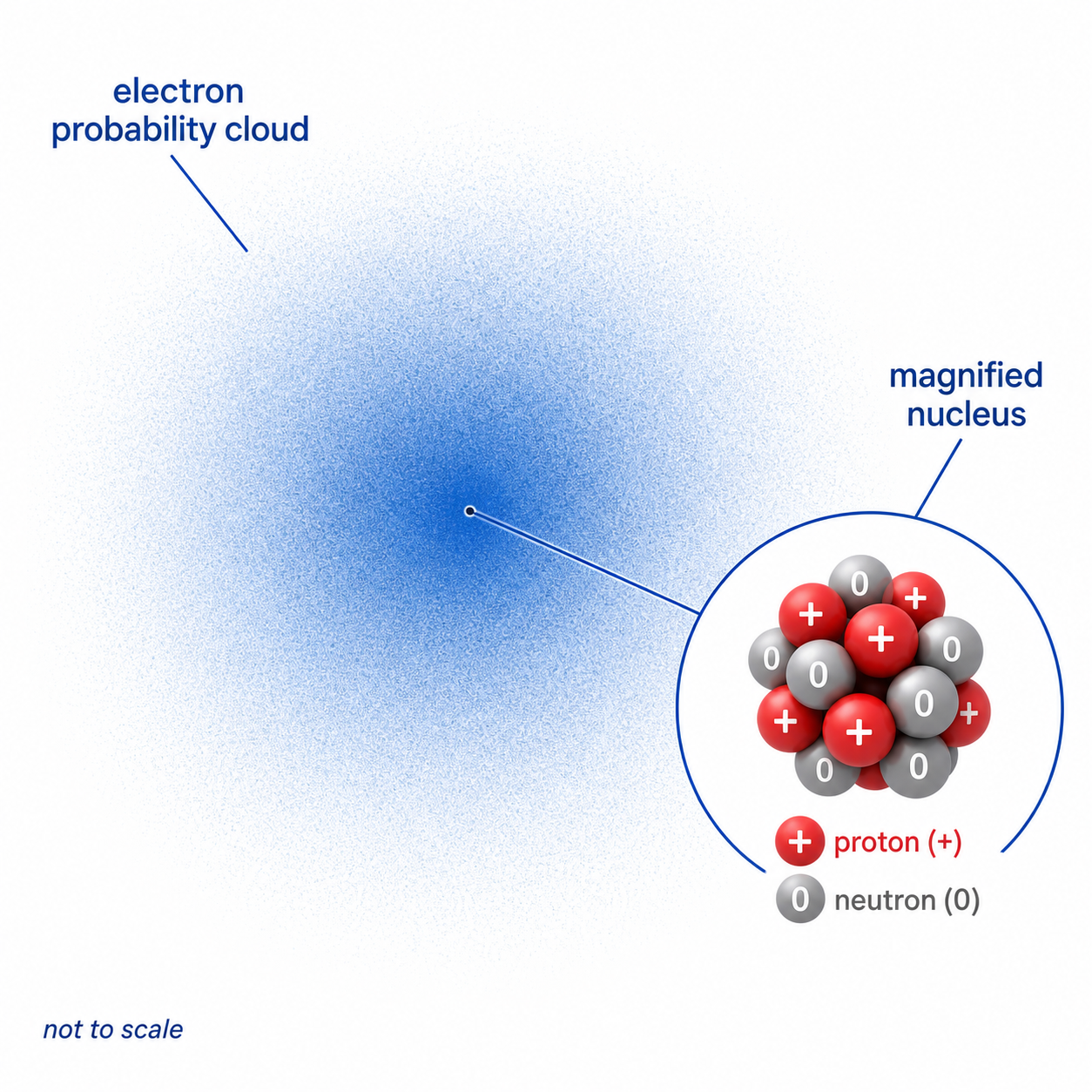
Which number counts which particles?
Use \(Z\) for atomic number and \(A\) for mass number. Then protons equal \(Z\), and neutrons equal \(A-Z\). A neutral atom has \(Z\) electrons.
Mass number counts protons and neutrons in one isotope. The decimal atomic mass on a periodic table usually represents an abundance-weighted average for naturally occurring isotopes. It is not the neutron count, and it need not be a whole number.
Worked example: count particles in an ion
Consider \(^{24}_{12}\mathrm{Mg}^{2+}\). Its atomic number is 12, so it has 12 protons. Its mass number is 24, giving \(24-12=12\) neutrons. The \(2+\) charge means there are two fewer electrons than protons, so it has 10 electrons.
A magnesium-26 ion with the same charge would still have 12 protons and 10 electrons, but it would have 14 neutrons. Changing the isotope changes the neutron count. Changing the charge changes the electron count.
Why does the average atomic mass contain decimals?
Imagine an element with two isotopes having masses of 10.0 u and 11.0 u. Their hypothetical abundances are 20.0% and 80.0%. Convert the percentages to fractions before averaging:
\[ (10.0\,\mathrm{u})(0.200)+(11.0\,\mathrm{u})(0.800)=10.8\,\mathrm{u}. \]
The result lies between the isotope masses and closer to the more abundant isotope. An answer of 21.0 u would reveal that the weighting step was lost.
How does the periodic table help?
Rows are periods and columns are groups. Main-group elements in the same group have related valence-electron patterns, which helps explain similarities in their chemistry. Those similarities are a starting point for prediction, and individual elements still have distinct properties.
- Find the atomic number to identify the element.
- Use a specified isotope’s mass number to count neutrons.
- Use the charge to adjust the electron count.
- Check that the resulting proton-electron difference matches the charge.
Can you apply the idea?
-
An atom has 8 protons. Which element is it?
Check your answer
Oxygen. Atomic number 8 identifies oxygen.
-
How many neutrons are in carbon-14?
Check your answer
Eight: its mass number is 14 and its atomic number is 6.
-
How many electrons are in \(\mathrm{Na}^{+}\), whose atomic number is 11?
Check your answer
Ten. A single positive charge means one fewer electron than proton.
-
How many electrons are in \(\mathrm{Cl}^{-}\), whose atomic number is 17?
Check your answer
Eighteen. A single negative charge means one extra electron.
-
Do two isotopes of an element have different proton counts?
Check your answer
No. They have the same proton count and different neutron counts.
-
Why should a weighted average lie closer to the more abundant isotope mass?
Check your answer
That isotope contributes a larger fraction of the total average.
Watch the idea explained
The Nucleus: Crash Course Chemistry #1, CrashCourse.
This selected excerpt runs from 3:18 to 4:55. Identify protons, neutrons, and electrons, then use proton count to determine atomic number.
Where does this fit?
Use the chemistry learning hub to choose a lesson or practice test. Connect this topic with matter and its changes, electrons and periodic trends, measurement in chemistry, chemical bonds and compound names.
Continue with a chemistry study guide

Related to This Article
More math articles
- Math Exploration: A Journey into Graphs, Tables, and Fractional Word Problems
- Intelligent Math Puzzle – Challenge 78
- How to Help Your 8th Grade Student Prepare for the Kansas KAP Math Test
- Free Grade 7 English Worksheets for West Virginia Students
- Unit Circle Calculator (Free Exact Values for Any Angle)
- Top 10 Free Websites for ALEKS Math Preparation
- The Best Grade 7 Math Book for Kansas Students
- Health Disparities, the Sick Role, and Medicalization
- Algebra Puzzle – Challenge 54
- Calculating Water Potential: Formula and Worked Examples


















What people say about "Atoms, Isotopes, and Ions: Examples and Practice"?
No one replied yet.