Measurement in Chemistry: Units, Density, and Instrument Precision
A mass of 18.6 g and a volume of 6.0 mL tell you more together than either measurement does alone. Their ratio gives the sample’s density. The measurements also set a limit on how many digits your answer can reasonably report.
A chemical measurement combines a numerical value with a unit and a level of precision. Unit conversions express the same quantity in a different unit. Density relates mass to volume. Choosing suitable equipment, reading it correctly, and recording uncertainty help make measurements interpretable and repeatable.
How do units guide a conversion?
To convert 2.50 L to milliliters, use the exact relationship \(1\,\mathrm{L}=1000\,\mathrm{mL}\):
\[ 2.50\,\mathrm{L}\times\frac{1000\,\mathrm{mL}}{1\,\mathrm{L}}=2.50\times10^3\,\mathrm{mL}. \]
Liters cancel. The exact conversion factor does not reduce the original three significant figures. For a conversion involving squared or cubed units, raise the entire conversion factor to the required power.
Worked example: density from displacement
A solid has a mass of 18.6 g. In a graduated cylinder, water rises from 20.0 mL to 26.0 mL when the fully submerged solid is added. Assume it does not dissolve or react, and no air bubbles remain attached.
\[ V=26.0-20.0=6.0\,\mathrm{mL}. \]\[ d=\frac{m}{V}=\frac{18.6\,\mathrm{g}}{6.0\,\mathrm{mL}}=3.1\,\mathrm{g/mL}. \]
The subtraction preserves tenths of a milliliter. That volume has two significant figures, so the density also has two.
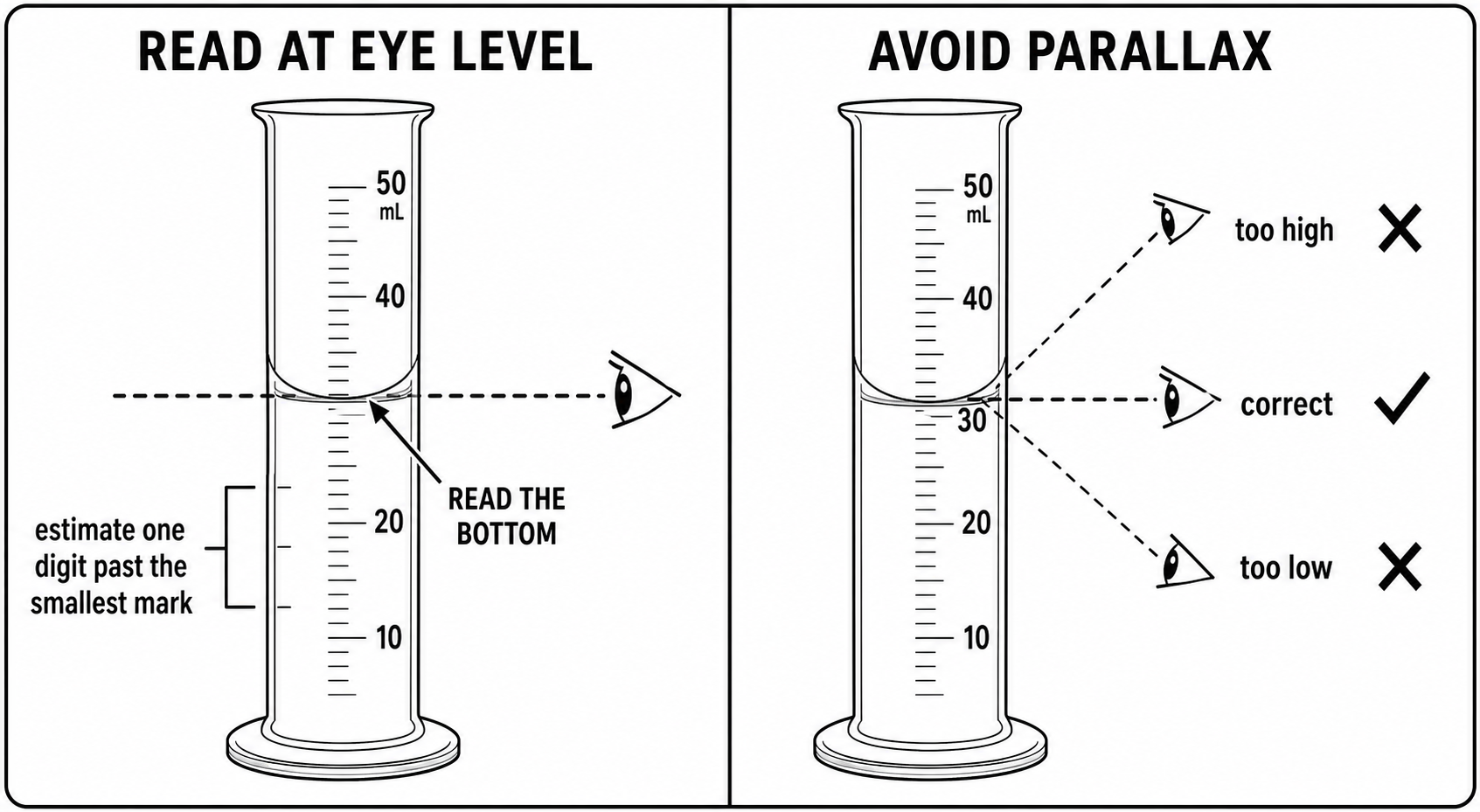
Where should your eye be when reading a cylinder?
Place the cylinder upright on a level surface and bring your eye to the level of the meniscus. For water in clean glass, read the bottom of the concave curve. Looking down from above shifts the apparent reading through parallax.
For an analog scale, record all certain digits and one reasonable estimated digit. A digital instrument reports its available digits directly. Neither display length nor repeated readings alone establishes accuracy.
Accuracy describes closeness to an accepted reference value. Precision describes agreement among repeated measurements. A miscalibrated balance can produce tightly grouped results that are all too high.
A measurement routine you can repeat
- Choose an instrument with suitable range and resolution.
- Check its zero or calibration as directed.
- Read the scale from the correct position.
- Record the value and unit immediately.
- Keep unrounded values for calculations and round the final result appropriately.
Can you apply the idea?
-
Convert \(0.0350\,\mathrm{kg}\) to grams.
Check your answer
\(35.0\,\mathrm{g}\), using the exact factor \(1000\,\mathrm{g/kg}\).
-
Convert \(4.0\,\mathrm{cm^3}\) to milliliters.
Check your answer
\(4.0\,\mathrm{mL}\). One cubic centimeter equals one milliliter exactly.
-
A sample has a mass of 12.0 g and a volume of 4.0 mL. Find its density.
Check your answer
\(3.0\,\mathrm{g/mL}\), to two significant figures.
-
Water rises from 14.2 mL to 18.7 mL. What is the displaced volume?
Check your answer
4.5 mL. Subtract the initial reading from the final reading.
-
Repeated measurements are close together but far from a reference value. Describe them.
Check your answer
They are precise but inaccurate relative to that reference.
-
Why does an exact metric conversion factor not limit significant figures?
Check your answer
It is defined without measurement uncertainty. The measured quantity still determines the reported precision.
Watch the idea explained
Treating units algebraically and dimensional analysis | Algebra I | Khan Academy, Khan Academy.
Follow units through multiplication and conversion factors to check a calculation.
Where does this fit?
Use the chemistry learning hub to choose a lesson or practice test. Connect this topic with chemistry math, matter and its changes, scientific reasoning in chemistry, atoms, isotopes, and ions.
Continue with a chemistry study guide

Related to This Article
More math articles
- Free Grade 5 English Worksheets for Alabama Students
- How to Manage Your Time Effectively on the Praxis Core Math Test?
- The Ultimate PSAT 8/9 Math Course (+FREE Worksheets)
- The Nixon Shock, Oil Crises, Stagflation, and Deindustrialization
- Ben Stokes – strategist and all-rounder for the English cricket team
- Top 10 4th Grade PSSA Math Practice Questions
- Top 10 Tips You MUST Know to Retake the SAT Math
- The Best Grade 6 ELA Practice Tests for Illinois Students
- CLEP U.S. History I 067: Whigs, Democrats, and the Second Party System
- Gender














What people say about "Measurement in Chemistry: Examples and Practice"?
No one replied yet.