CLEP U.S. History I 067: Whigs, Democrats, and the Second Party System
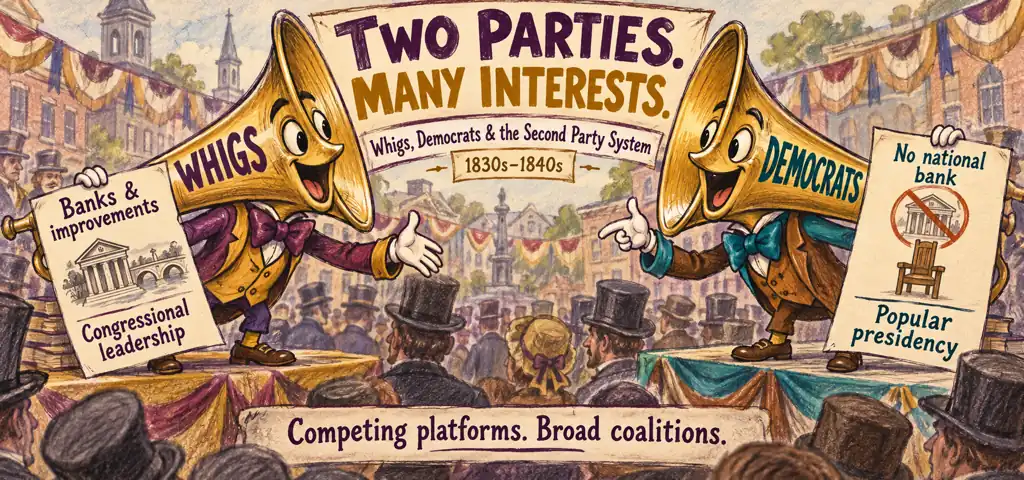
Lesson 12.6 of Chapter 12 of the U.S. History to 1877 study guide on Effortless Math covers CLEP U.S. History I 067: Whigs, Democrats, and the Second Party System: the key terms, the core ideas, and worked examples showing how this topic is tested on the exam.
U.S. History to 1877 | Chapter 12 | Lesson 12.6
Opposition to Jackson brought National Republicans, anti-Masons, some states’ rights southerners, and economic nationalists into the Whig Party. The name recalled critics of royal power and expressed fear of “King Andrew.” Whigs favored congressional leadership, economic development through banks, tariffs, and internal improvements, and often moral reform. Democrats favored a strong popular presidency, limited federal economic intervention, territorial expansion, and suspicion of corporate privilege.
These were broad coalitions, not perfectly consistent philosophies. Both parties sought votes across North and South and therefore muted slavery disputes that might split them. Both accepted white male democracy and used mass organization. Democrats drew strength from farmers, urban workers, immigrants, and southern planters. Whigs attracted many entrepreneurs, commercial farmers, professionals, evangelical reformers, and planters who opposed Jackson. Ethnicity and religion mattered: many Catholic immigrants favored Democrats, while reform-minded native-born Protestants often leaned Whig.
The 1840 “log cabin and hard cider” campaign illustrates popular electioneering. Whigs presented wealthy Virginia-born William Henry Harrison as a humble frontier hero and blamed Van Buren for depression. Harrison won but died after a month. John Tyler succeeded him and vetoed Whig bank bills, showing that an anti-Jackson coalition did not guarantee policy unity.
The second party system increased turnout and gave voters recognizable alternatives. Its national competition temporarily contained sectional conflict by linking voters across regions. That strength became a weakness when territorial expansion made slavery harder to avoid. In the 1850s the Whigs collapsed and Democrats divided sectionally.
Watch, then test the claim
Mr. Eldridge History offers a visual route through this topic. As you watch, compare its explanation with the source limits in the written lesson.
Video: APUSH 4.2 – The Second Party System Explained | Democrats vs. Whigs in Early America, Mr. Eldridge History.
Check your understanding
- Which combination was most characteristic of Whig national policy?
- hard-money policy and abolition of federal economic planning
- internal improvements and congressional leadership
- low tariffs and opposition to a national bank
- executive control of lawmaking and patronage
- rejection of commercial development in favor of subsistence farming
- Democrats and Whigs were alike in that both
- rejected popular electioneering as demagoguery
- endorsed immediate abolition nationally
- sought to restore property qualifications
- built national mass coalitions crossing regions
- adopted identical positions on territorial expansion
- Deep Practice: select all that apply. Whig support often included
- entrepreneurs
- commercial farmers
- professionals
- evangelical reformers
- one uniform social class
- Deep Practice: open response. Explain how national parties could delay sectional crisis without resolving it.
Write a brief response using a named fact from the lesson.
Open the answers and reasoning
Independent preparation. CLEP is a registered trademark of the College Board, which does not endorse this lesson.

Related to This Article
More math articles
- Free Grade 7 English Worksheets for Virginia Students
- The Ultimate HSPT Math Course (+FREE Worksheets & Tests)
- 10 Most Common 7th Grade PSSA Math Questions
- Top 10 7th Grade OST Math Practice Questions
- Straight-ticket voting
- AP Cybersecurity Evidence-Based Responses: Write a Clear Recommendation (2027 Prep)
- How to Solve Word Problems of Absolute Value and Integers?
- Evolution and Natural Selection
- Top 10 PSAT / NMSQT Prep Books (Our 2023 Favorite Picks)
- Top 10 SSAT Upper Level Math Practice Questions


















What people say about "Whigs, Democrats and the Second Party System"?
No one replied yet.