CLEP U.S. History I 066: Indian Removal and Native Resistance
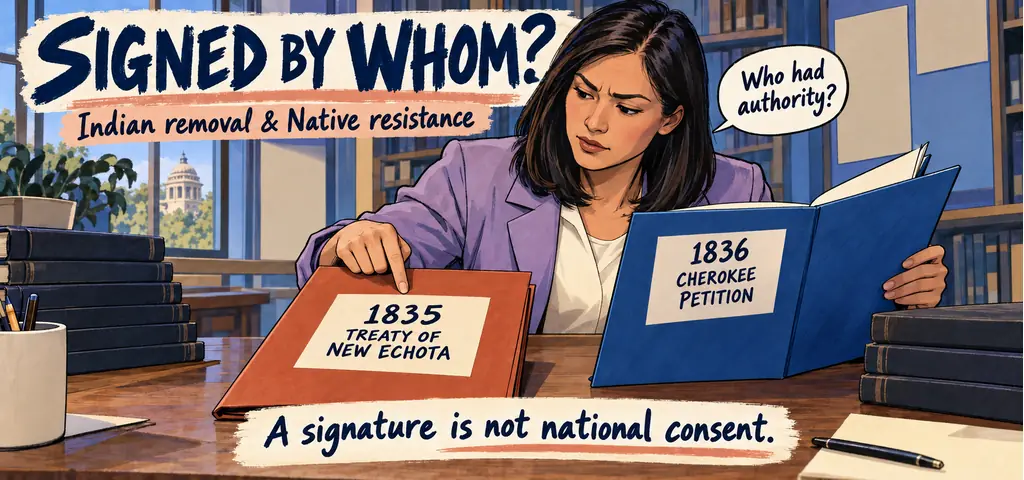
Lesson 12.5 of Chapter 12 of the U.S. History to 1877 study guide on Effortless Math covers CLEP U.S. History I 066: Indian Removal and Native Resistance: the key terms, the core ideas, and worked examples showing how this topic is tested on the exam.
U.S. History to 1877 | Chapter 12 | Lesson 12.5
Southeastern Native nations had adopted varied strategies to defend homelands. Cherokee leaders developed a written constitution and newspaper, used Sequoyah’s syllabary, farmed, and brought legal claims. These adaptations did not protect them from Georgia’s demand for jurisdiction and white desire for land, intensified by gold discovery. The Indian Removal Act of 1830 authorized negotiation of land exchanges west of the Mississippi. Coercive bargaining and power imbalance made “voluntary exchange” misleading.
In Cherokee Nation v. Georgia (1831), the Supreme Court denied original jurisdiction, describing tribes as domestic dependent nations rather than foreign nations for that purpose. In Worcester v. Georgia (1832), it held that Georgia law did not operate within Cherokee territory and recognized federal-tribal relations. Georgia and the executive did not provide effective protection. The cases reveal both judicial recognition and enforcement limits.
A small minority signed the Treaty of New Echota in 1835 without authorization from the Cherokee national government. The Senate ratified it by one vote. Most Cherokee petitioned against removal. In 1838 federal troops forced approximately sixteen thousand Cherokee west. Disease, hunger, exposure, and inadequate supplies killed thousands on the Trail of Tears. Choctaw, Creek, Chickasaw, and Seminole peoples also faced removal. Seminole resistance produced a long, costly war in Florida.
Removal opened millions of acres to white settlement and cotton slavery. Native people rebuilt governments and communities in Indian Territory, demonstrating survival rather than disappearance. The policy was not an inevitable movement of population. It was a federal and state choice executed through treaty manipulation, law, and force.
See the history take shape
Use this lesson from Hip Hughes (HipHughes) to review the period and its central historical problem. Pause when the video reaches the turning point named above.
Video: The Indian Removal Act Explained in 5 Minutes: US History Review, Hip Hughes (HipHughes).
Check your understanding
- Worcester v. Georgia most directly rejected
- Supreme Court review when a state conviction implicated a federal treaty
- the Cherokee Nation’s status as a distinct political community
- federal responsibility for relations with Native nations
- federal treaty making concerning territory west of the Mississippi
- Georgia’s attempt to impose its law within Cherokee territory
- Why did most members of the Cherokee Nation reject the Treaty of New Echota?
- A small unauthorized faction signed despite opposition from the elected Cherokee government.
- The treaty protected Cherokee jurisdiction from Georgia after the removal deadline.
- Removal would occur after approval in a Cherokee national referendum.
- Federal courts received authority to enforce the treaty’s protections.
- Georgia land ceded in earlier treaties was restored to the Cherokee Nation.
- Deep Practice: select all that apply. Removal involved
- land hunger
- cotton expansion
- treaty coercion
- military force
- uncontested consent
- Deep Practice: open response. What does the gap between Worcester and removal show about judicial power?
Write a brief response using a named fact from the lesson.
Open the answers and reasoning
Independent preparation. CLEP is a registered trademark of the College Board, which does not endorse this lesson.

Related to This Article
More math articles
- How to Use Strip Models to Subtract Fractions with Like Denominators
- ACCUPLACER Math – Test Day Tips
- Chapter 26: Political Parties
- Least Common Denominator Calculator: Fractions and Steps
- 10 Most Common 4th Grade Georgia Milestones Assessment System Math Questions
- Free Grade 8 English Worksheets for Illinois Students
- Algebra Puzzle – Challenge 51
- How to Factor Polynomials?
- Political action committees
- A Comprehensive Collection of FREE SAT Math Practice Tests


















What people say about "Indian Removal and Native Resistance"?
No one replied yet.