CLEP U.S. History I 065: Bank War and Economic Power
Lesson 12.4 of Chapter 12 of the U.S. History to 1877 study guide on Effortless Math covers CLEP U.S. History I 065: Bank War and Economic Power: the key terms, the core ideas, and worked examples showing how this topic is tested on the exam.
U.S. History to 1877 | Chapter 12 | Lesson 12.4
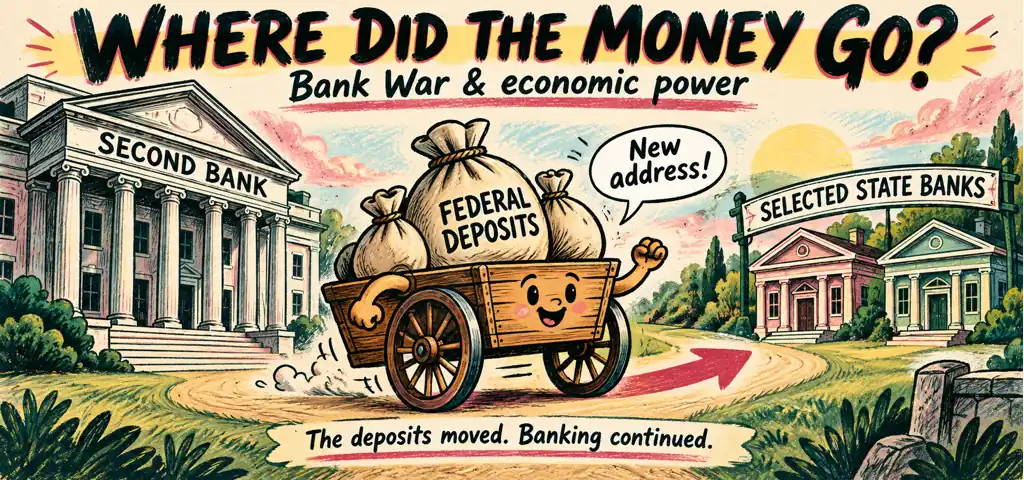
The Second Bank held federal deposits, regulated currency, restrained risky state banks, and supplied national credit. It was also a private corporation with public privileges, headquartered far from many debtors and led by Nicholas Biddle. Jackson distrusted paper credit and concentrated power. Henry Clay and Biddle sought early recharter in 1832, expecting a veto would hurt Jackson. Jackson vetoed and made opposition popular.
The veto message blended constitutional and democratic arguments. Jackson rejected the Supreme Court’s McCulloch decision as binding the executive’s own constitutional judgment, criticized foreign and wealthy stockholders, and argued that government should not grant unequal privileges. Congress lacked votes to override, and voters reelected him. The episode turned institutional policy into a referendum on economic power.
Jackson then removed federal deposits before the charter expired, placing them in selected state “pet banks.” Treasury secretaries resisted. Jackson replaced officials until Roger Taney complied. The Senate censured Jackson, later expunging the censure. The Bank contracted credit in an effort to demonstrate its necessity, causing hardship and further damaging its reputation. Its federal charter expired in 1836.
State-bank lending and land speculation then expanded. The Specie Circular attempted to restrain land purchases by demanding gold or silver. These policies contributed to financial instability, but the Panic of 1837 also reflected cotton prices, British credit, and broader speculation. A precise account neither blames Jackson alone nor treats policy as irrelevant.
A focused video lesson
Heimler's History traces the people and chronology behind this lesson. Listen for the evidence that sharpens the written account, then try the questions below.
Video: JACKSON and Federal Power [APUSH Review Unit 4 Topic 8] Period 4: 1800-1848, Heimler's History.
Check your understanding
- Jackson’s veto message attacked the Second Bank chiefly because it
- lacked any private stockholders
- prevented state banks from issuing any notes
- lent only to western farmers
- concentrated public privilege and economic power
- refused to hold federal deposits
- Jackson’s removal policy redirected federal deposits chiefly into
- Treasury vaults independent of all banks
- branches of the existing national bank
- selected state-chartered “pet banks”
- state treasuries in proportion to population
- direct loans to federal land purchasers
- Deep Practice: select all that apply. Bank War consequences included
- credit contraction
- expanded state lending
- Senate censure
- charter expiration
- permanent end of banking
- Deep Practice: open response. Explain why recharter supporters miscalculated politically.
Write a brief response using a named fact from the lesson.
Open the answers and reasoning
Independent preparation. CLEP is a registered trademark of the College Board, which does not endorse this lesson.

Related to This Article
More math articles
- Linear Regression Calculator — Line of Best Fit & Correlation
- The Best Grade 8 ELA Practice Tests for Missouri Students
- How to Multiply Radical Expressions? (+FREE Worksheet!)
- Probability and Statistics for Beginners: A Friendly Intro
- Improving Your Math in College: What You Should Do
- Dividing by 1-Digit Numbers (No Remainders) for 4th Grade
- Top Ten Cameras for Classroom Recording
- How to Identify the Change, Price, or Amount Paid
- From Simple to Complex: Calculus of Surfaces
- Cell Structure and Function















What people say about "The Bank War and Economic Power"?
No one replied yet.